
In the online world, Catholics periodically go through bouts of convert-skepticism. Perhaps the pithiest expression of this skepticism came from @agraybee on Twitter, way back in 2022: “Every lifelong Catholic I’ve ever met is like ‘I think we’re supposed to give this food to poor people’ and every adult convert is like ‘the Archon of Constantinople’s epistle on the Pentacostine rites of the eucharist clearly states women shouldn’t have drivers’ licenses.’” This tweet has since been shared 4,600 times, not counting what must be tens of thousands of screenshots. It’s even become a meme format, easily adapted to critique any kind of Johnny-come-lately. I most recently saw it applied to soccer neophytes who started caring about the sport only when the United States was named a host of this year’s World Cup.
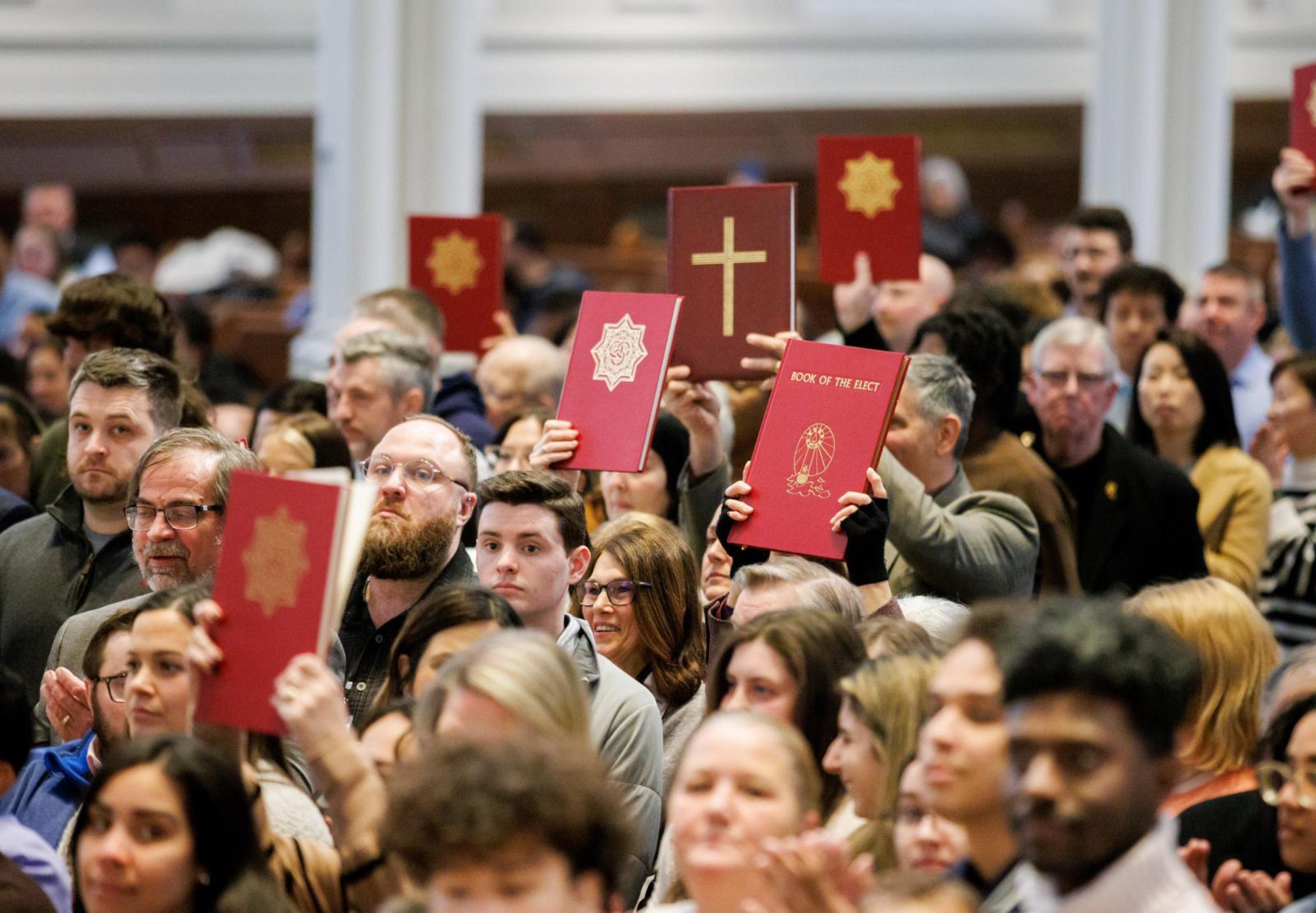
Within its original Catholic context, the tweet summarizes a certain narrative, a certain fear, evoked by events in the real world, such as the rebound in adult conversions to Catholicism that many Western countries are experiencing and the recent publication of a conversion memoir by the most powerful Catholic convert in America. The rebound does seem to be real. This past Easter, many dioceses saw numbers of adult conversions they hadn’t seen since before the pandemic—or even since the early 2010s. There are reasons to be cautious about calling this a “revival”: adult conversions are not making up for the loss of Catholic faith and practice among cradle Catholics; and anyway, most of these places are still recording lower numbers of adult conversions than in the early 2000s. Still, if you went to the Easter Vigil Mass, you may have noticed a larger crowd of baptisms and confirmations at your own church. If you’re involved with the Order of Christian Initiation of Adults (OCIA), you have probably heard the discussions about how many people are coming—and why.
According to stereotypes brewing online, the rebound in adult conversions is driven by noxious political and cultural trends. The idea is that people are coming to the Catholic Church because it is “based”: retro, authoritarian, antiwoke, a powerful Daddy more than the Holy Mother Church many of us know. The stereotype is mostly about men, who are supposedly becoming Catholic because they want a boys’ club where girls can’t lead.
This is a weird stereotype for various reasons. Is the current pope “based”? Is your local parish really a boys’ club? If someone wants to escape girls, gays, and social justice, is their most obvious choice…the Catholic Church? Nor is it clear that cradle Catholics are dependably less “based” or more “woke” than converts. Yes, the most powerful Catholic convert in the United States is J. D. Vance, but the most powerful cradle Catholics in the United States are John Roberts, Amy Coney Barrett, Clarence Thomas, Samuel Alito, Brett Kavanaugh, and Neil Gorsuch (currently a practicing Episcopalian).
Still, there is an important insight hidden within convert-skepticism. The @agraybee quote is funny because many of us recognize it. We have all met cradle Catholics whose faith has shaped them for so long that it flows easily into service—Catholics who are pricked by a certain salutary sense of guilt, but a guilt that makes them give more and judge less. Similarly, many of us have met enthusiastic and somewhat quarrelsome converts who seem less interested in Jesus Christ than in “Christendom” and restoring the Habsburg Empire.
I was one of these obnoxious converts. I don’t think I was drawn to the Catholic Church because of its conservatism, but it’s certainly true that I was brought to the faith in a community of self-consciously conservative Catholics, and the faith I first knew was the Faith as they knew it. They were thoughtful, gentle, and admirable people who took their faith seriously, but there were elements of Catholic social teaching they emphasized and other elements they didn’t talk about as much. They rarely mentioned saints who weren’t also theologians. There were imbalances in the version of Catholic faith to which they introduced me.
But what else is new? Jesus was the first convert-skeptic. He asks the followers of John the Baptist, “What did you go out to the desert to see?” (Luke 7:24). Jesus, a consummate ironist, knows that his most loyal followers have mixed motives. Some seek political power, the toppling of Roman dominion, and the restoration of Jewish rule. Some seek a certain kind of personal gain (or their mothers do!), and he has to remind them, “To sit at my right and at my left…is not mine to give” (Matthew 20:23). Paul reminds the early Christians that whatever they might want from Jesus, they are not going to get it in the form they expect or, perhaps, desire: “For Jews demand signs and Greeks look for wisdom, but we proclaim Christ crucified, a stumbling block to Jews and foolishness to Gentiles, but to those who are called, Jews and Greeks alike, Christ the power of God and the wisdom of God” (1 Corinthians 1:22–4).
And this is the universal experience of the Church for all Catholics, cradle or convert. We are all brought into the great cathedral through one of its several doorways: through a limited community whose culture makes it insightful in some areas and blinkered in others. Whether we are cradle or convert, eventually we discover that there’s more Church outside our one little alcove. There’s something we weren’t taught in our CCD or OCIA classes, and often it’s something we desperately need. None of us can keep the faith we started with.
Cradle Catholics learn the faith in more or less the way native-born Americans learn U.S. history. We learn a bunch of childhood legends, from George Washington and the cherry tree to “Rosa Parks was tired.” Slowly, we pare some of these legends down to the raw truth and build others out into something closer to the complex reality. Converts are tempted to believe that we entered the cathedral by the front door and got the whole thing right away. But it always turns out that we, too, entered by one small, warped side door into one small alcove. My doorway was like that. So was yours!
What will our response be to someone who enters the cathedral through a different doorway? Will it be, “Go away, and come back when you want better things”? Or will we say, “The right wants us to be based and the left woke, but we proclaim Christ crucified”?
We welcome your comments about this article. Please send your response to letters@commonwealmagazine.org.


No comments:
Post a Comment