
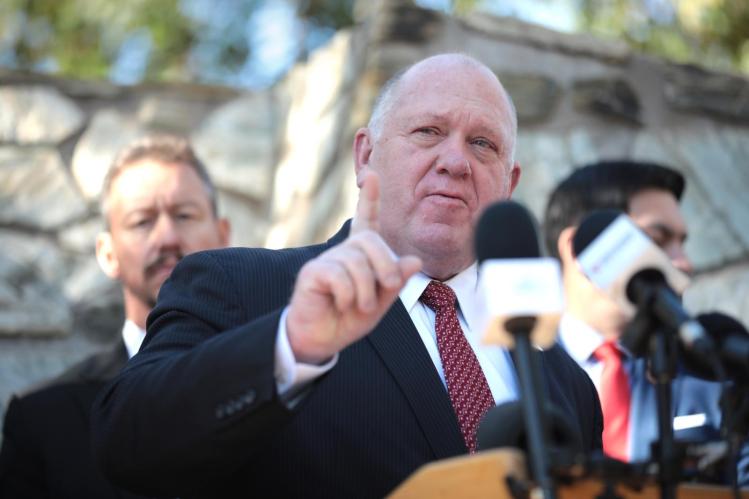
The Gospel according to Tom Homan begins with the story of a five-year-old boy who was the first among nineteen migrants to die of extreme heat in the cargo bed of a truck that transported them across the Mexican border in 2003. Homan, the senior White House staffer dubbed the nation’s “border czar,” tells the story well, and often.
Its power is in the details: the little boy dead in his yellow underpants, his other clothing removed in the suffocating heat. His words to his father, reported by one of the fifty-eight survivors of the smugglers’ rolling hell: “Daddy, Daddy, I’m dying.” The father, also dead, slumped over him.
“I knelt down and put my hand on his head, and I prayed for him,” Homan wrote in a 2020 memoir. The death haunted him, he said, because it made him think of his son, who was the same age. “I can still smell it, taste it, see it. Tears fill my eyes as I write this.”
This is the scene that Homan—noting he’s a lifelong Catholic—recalls when contending that the U.S. Catholic bishops, Pope Leo XIV, and Pope Francis have been “wrong” in holding that the Trump administration’s mass-deportation regime is incompatible with Catholic teaching.
“I can tell you that doesn’t align with my catechism, my parochial-school learnings, that adherence to the law was very important within the Catholic faith, and I think it still is,” he told a sympathetic Raymond Arroyo in a December 11 interview on EWTN.
In Homan’s view, zero-tolerance policies are justified to deter potential migrants from taking the perilous trip north, a journey that has led to numerous deaths, sexual assaults, sex trafficking, and much other misery.
But do the ends justify the means? In Catholic teaching, the short answer is no. The evils being done—the widespread breakups of families, vilification of immigrants, mass detention, the arbitrary withdrawal of legal status—sufficiently stirred the U.S. Catholic bishops to unite behind a measured statement in November announcing: “We oppose the indiscriminate mass deportation of people,” a policy that’s been the root of much suffering.
Despite what the bishops and popes say, Homan’s theology plays well among self-described Catholic organizations that promote the Trump agenda. CatholicVote designated Homan a hero for “his humanitarian approach to immigration policy.” Catholics for Catholics, “fighting to bring the Catholic faith into the public square,” also calls Homan a hero and honored him on January 22 with its “Protector of America” award “for rescuing migrant children.”
Since his return to public life as border czar, Homan has emphasized what he says is his devotion to saving children. His thirty-four-year career in law enforcement had seemed to end on a dissonant note when he resigned as acting director of ICE in 2018, during the first Trump administration, after he took heat for promoting the notorious family-separation policy as a deterrent to illegal migration. Homan was its “intellectual ‘father,’” as The Atlantic’s Caitlin Dickerson wrote. Bishops across the country spoke out against the policy at the time: “Separating babies from their mothers is not the answer and is immoral,” said Cardinal Daniel DiNardo, then-president of the USCCB.
Homan became a Fox News contributor and wrote his memoir, which gave him platforms to strike back at critics and continue proclaiming that hard-nosed immigration enforcement saves lives. Now, he speaks often of saving what he says are three hundred thousand unaccompanied minors “missing” after the Biden administration released them from immigration custody. “Missing” actually means they were missing from ICE records; the children were commonly released to their parents or close relatives. Still, some have been at risk; the DHS inspector general issued a report showing that children released to unrelated sponsors or distant relatives—more than twenty-four thousand in 2023 and 2024 combined—were especially vulnerable to sex trafficking or forced labor. “Trump’s already found thousands of these children,” Homan boasted to a cheering crowd at a Turning Point USA convention.
But it’s misleading to portray the effort solely as a rescue operation. From the start, the aims were twofold. Children were to be located to make sure their “immigration obligations are met,” as well as to check for possible exploitation, according to an ICE memo.
“This is just another way to identify more people to deport,” said Anna Gallagher, executive director of the Catholic Legal Immigration Network, which the bishops founded and oversee. Overall, the policies Homan supports have been devastating for children. “What they’re doing right now is horrific to families, to mothers, fathers and children,” Gallagher said. “Parents are being torn away from their children. And these aren’t criminals.”
She adds: “One thing I’d like to get across is what we are seeing with immigration enforcement across the country is at odds with our Catholic values and what our faith compels us to do: Welcome the stranger and ‘love one another as I have loved you.’”
Homan offers a uniformed-services, God-and-country conservatism that many American Catholics can identify with. He comes from a law-enforcement family in West Carthage, New York, a small town a few miles south of the Army’s Fort Drum, where his father worked, and not far from where the St. Lawrence River flows into Lake Ontario. His father and grandfather were both West Carthage police officers, and he started his career there as well. His father won a Bronze Star Medal for his gallantry in World War II; according to a local newspaper article, he advanced into enemy fire “with utter disregard” during a 1944 battle in the Philippines, pressing on even after being seriously wounded.
Homan once remarked in an interview, “We’re all immigrants. My family came here, a long time ago.” His Homan ancestors came from near London to settle in Salem, Massachusetts, in 1635, according to genealogical records, and moved to the East End of Long Island sometime in the 1670s (before the Puritan settlement’s famed witch trials of 1692–3).
As one of seven children, Homan likes to recall that the entire family went to Sunday Mass together, always sitting in the same two pews. The parish, St. James in Carthage, is more than two centuries old. At the time Homan attended, it was still run by the Philadelphia province of Augustinian priests, the order then educating the future Pope Leo XIV at Villanova University. The Sisters of St. Joseph of Watertown ran the parish school, the Augustinian Academy.
“I’m a lifelong Catholic. You know, I grew up in a strong Catholic household. I was baptized a Catholic, I had my first communion Catholic, I had my confirmation,” Homan said during a February 13, 2025, segment of Arroyo’s EWTN show. “And you know, I love the Catholic Church. But I think the pope has lost his way a bit.” He was referring to a letter Pope Francis had just issued to the U.S. Catholic bishops; it deplored mass deportation and the accompanying rhetoric about immigrant criminality. Homan considered this beyond the Church’s competence.
“He needs to fix the Catholic Church and concentrate on his problems and leave the border problems to us,” he continued.
We lost a lot of the flock, and going to Mass isn’t the same anymore. Let’s get back to the Catholic Church I grew up in, when you actually did call out abortion. You didn’t say that a president or someone in Congress is a good Catholic, even though they support abortion. Let’s get back to the basics of what the Catholic Church is. I love that Catholic Church. The Catholic Church today I’m disappointed in.
Homan, who is sixty-four years old, was schooled during a period when the reforms of the Second Vatican Council percolated through the Church, putting added emphasis on social justice. He completed elementary school in 1975. The high-school portion of Augustinian Academy had shut by then; he moved on to public education. (The White House press office didn’t respond to questions submitted for Homan. The pastor at St. James Parish and principal at Augustinian Academy didn’t respond to requests for comment. The superior of the Sisters of St. Joseph of Watertown said she didn’t know what materials were used to teach religion in the 1970s, and suggested an inquiry to the Diocese of Ogdensburg, which didn’t respond.)
Homan restated his view of Pope Leo’s teachings on immigration in a February 25 interview: “The Catholic faith is always in support of law enforcement. Always has been. And [Pope Leo] should be too.”
In fact, the bishops have weighed Church teaching on law enforcement in this context, concluding that it should be “targeted, proportional, and humane,” which would include limiting the use of detention and acting with “due regard for families.”
The bishops’ support for immigrants began long before Homan took up his Catechism as a schoolboy. The bishops opposed the restrictive immigration law Congress passed in 1924 as discriminatory and “un-American.” They applauded the 1965 law that opened the door to more migration, and especially a provision that would help unite families through unlimited visas for relatives of U.S. residents. In the 1980s, the bishops urged that there be a path to citizenship for immigrants who entered illegally. Perhaps the turning point came as far back as 1888, when Pope Leo XIII chided the American bishops for their chilly response to the mass of impoverished Catholic migrants coming from Italy.
Nor is it new that the bishops have called out law enforcement on its treatment of immigrants. In a 2003 pastoral letter, the U.S. and Mexican bishops urged reform of law-enforcement tactics on both sides of the border. Particularly relevant for the border czar is a passage in which the bishops blamed policymakers—rather than federal agents in the field—for measures “that have had the effect of undermining human dignity of migrants and creating a confrontational and violent relationship between enforcement officers and migrants.” They added: “Alarmingly, migrants often are treated as criminals by civil enforcement authorities. Misperceptions and xenophobic and racist attitudes in both the United States and Mexico contribute to an atmosphere in which undocumented persons are discriminated against and abused.”
What’s changed is that “xenophobic and racist attitudes” are so blatantly propelling federal immigration policy under the Trump administration. For the first time, the United States has a president who publicly revels in nativist bigotry and dictates policy based on it.
Federal court judge Ana Reyes of Washington D.C. made this painfully clear in a February 2 ruling that stopped Homeland Security secretary Kristi Noem from revoking Temporary Protected Status for Haitian immigrants (many of whom are Catholic). She traced how Trump’s “racist tropes of national purity” and Noem’s “expressed animus for nonwhite foreigners” led to a “preordained outcome justified by pretextual reasons.”
Trump has created a propaganda juggernaut devoted to demonizing immigrants. Although most undocumented people are Catholic, the bishops, with few exceptions, were slow to challenge that dehumanizing rhetoric in a meaningful way over the past decade. Nudged by a new Pope Leo, more of the bishops are speaking up. Their joint statement in November called out the “vilification of immigrants.”
Homan responded sharply when reporters asked him about the statement. “So according to [the bishops], the message we should send to the whole world is if you cross the border illegally, which is a crime, don’t worry about it,” he said.
But that’s not what the bishops said. Their statement affirmed that nations have a responsibility to regulate their borders, which has always been one facet of Catholic teaching on migration, and said that a just and orderly immigration system would help protect immigrants from exploitation and serve the common good.
According to the bishops, Homan continued, “If you get ordered removed by a federal judge after due process, don’t worry about it, ’cause there shouldn’t be mass deportations.” Again, that’s not the bishops’ position. They haven’t opposed all deportations, but the “indiscriminate mass deportation of people.”
Statewide bishops’ conferences and individual bishops elaborate on this. The bishops of Minnesota supported deporting “those with criminal records who pose a danger to society,” but oppose “any campaign of indiscriminate immigration enforcement that threatens to unnecessarily or unjustly separate the families of those we have come to know as our brothers and sisters in Christ.”
The New York state bishops said that
general enforcement of the immigration laws must be carried out in a humane manner that does not target the hard-working and law-abiding; that does not permit the wanton and unnecessary separation of families; and that does not rely on campaigns of fear that cripple whole communities.
Bishop William Wack of the Pensacola-Tallahassee Diocese addressed this, too: “While we rightly affirm that law enforcement has a responsibility to apprehend and detain individuals who commit crimes, we must resist the dangerous narrative that every immigrant is a threat; someone to be parodied, punished, and deported.”
The bishops aren’t asking the czar to stop enforcing the law. They’re asking for it to be done humanely. Homan’s view is that “inhumane treatment is just a bunch of crap,” as he said on EWTN.
To let that pass, as Arroyo did in conducting the interview, is to ignore the enormous record that has built up in federal district-court rulings that, taken together, show an astonishing pattern of lawlessness in immigration enforcement. Reuters reported that as of February 14, more than four hundred judges had ruled some 4,400 times since October that the Trump administration was detaining immigrants illegally—a massive and routine denial of the Fifth Amendment right to due process. DHS attributes this to “rogue” judges, a further sign of the agency’s disrespect for the law. Unnecessary incarceration has coerced many detainees to request voluntary departure from the United States rather than exercise their right to seek the various legal remedies from a deportation order.
While Homan insists that his goal is to enforce the law, judges have been shocked by ICE’s failure to adhere to court orders. “The court is not aware of another occasion in the history of the United States in which a federal court has had to threaten contempt [charges]—again and again—to force the United States government to comply with court orders,” the chief federal judge in Minnesota, Patrick J. Schiltz, wrote, identifying 210 orders federal officials violated. (They mostly concerned delays in releasing people from immigration custody or transporting them to distant jails in violation of specific orders to keep them in Minnesota.)
A federal judge in New Jersey wrote that the government had violated scores of court orders in the state. It initially looked like negligence, but “they have since slid downward into manifest recklessness. Immigrants are swept up into custody and shifted repeatedly around the country without warning or explanation.”
Judges have also been appalled by detention conditions, which have worsened as ICE filled its jails with people who pose no danger. For example, a federal district judge found that ICE holding rooms on Long Island were managed “in a manner that shocks the conscience.” After ICE produced “demonstrably false evidence” and failed to comply with a court order, Judge Gary Brown was evidently fed up: “I have never encountered anything like this. ICE’s seeming disregard of procedural requisites, combined with the chillingly brutal conditions of confinement to which Petitioner has been, and presumably would continue to be subjected, cries out for immediate remedy.”
These are a few of the evils that follow from a plan that essentially allows any form of deterrence to discourage migrants from trying to enter the United States unlawfully. It’s a moral issue, and the Gospel calls for the bishops and American Catholics to confront it with, as Pope Francis put it, “a rightly formed conscience.”


No comments:
Post a Comment