
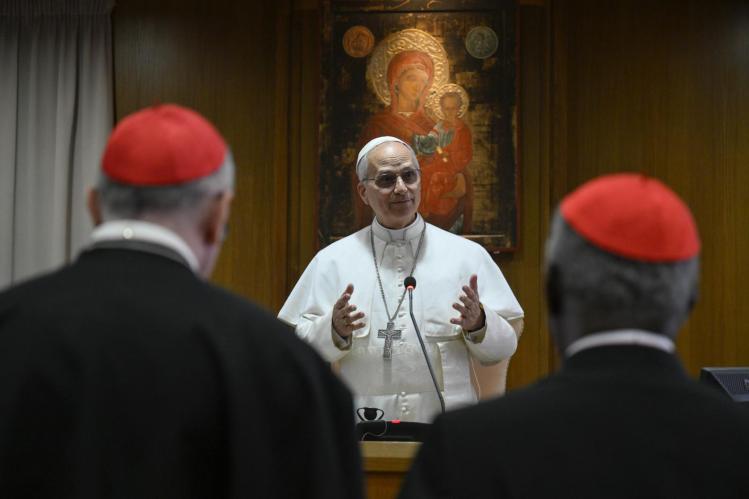
From an institutional point of view, the most consequential, long-term legacy left by Pope Francis to his successor is synodality. While Paul VI had conceived and instituted the Bishops’ Synod in 1965, it was not for “synodality” as we think of it now, but was rather an expression of episcopal collegiality between the bishops and the pope. With Francis, the Synod became the culmination of a long process of ecclesial discernment in the sensus fidei, through the contribution of nonepiscopal members of the Church as voting members of the Synod. Since his election, Pope Leo XIV has sent multiple signals about continuing the synodal journey. Now, as his pontificate enters its second year, it embarks on an important phase in defining a “Leonine” version of synodality, something distinct from Francis’s.
Among the challenges is dealing with the wave of theology (academic and nonacademic) that has embraced synodality more than anything that’s come out of Rome since the Second Vatican Council, yet that has also received synodality in different ways. It’s not just the sheer volume of studies. It’s also a dynamic academic culture that is shaping a new generation of scholars. The contours of this synodal turn in theology are not clear yet—but Church teaching cannot ignore the participation of theologians in the synodal experience and how in some ways it proved as humbling for them as it did for bishops.
But theology can’t reshape institutions for synodal reform of the Church. That’s up to the institutional Church itself. Different synodal experiences in different countries continue—and not just in Germany, which is the flashpoint for ideas about the direction of synodality. Different models of a synodal Catholic Church will emerge around the world. It will be interesting, for example, to see whether a strong reception of Vatican II corresponds to a strong reception of synodality, or how churches that face more existential challenges (like those in China or the Middle East) will take a synodal turn—or not.
At the central level, work on implementing the Final Document of the 2023–4 Synod is visible mostly via publication of study-group reports. These include the report of Study Group 7, which proposes some significant reforms in the bishop-selection process, focusing on greater participation of the people of God and more in-depth discernment, and of Study Group 9, on homosexuality. (The latter got a lot of social-media attention, bringing to mind the battles of the Francis era; Leo has so far stayed away from addressing this issue directly.) Six of the post-synodal study groups are in some way addressing the role of women in the Church.
Looking to the next assembly of the Synod, in October 2028, the General Secretariat of the Synod, led by Secretary General Cardinal Mario Grech, will play a key role. It announced the convocation for a meeting from June 23 to 25 to prepare the continental evaluation assemblies scheduled for the first quarter of 2028. According to the General Secretariat, the participants in that meeting will be:
One representative of the Patriarchs of the Council of the Patriarchs of the Eastern Churches, the Presidents of the International Meetings of Episcopal Conferences, as well as the Presidents of the Episcopal Conferences of USA and Canada, each accompanied by the Coordinator of the Synodal Team of the respective body and, if possible, by the Secretary General. The Holy Father Leo XIV will take part in a specific working session.
Giacomo Costa, SJ, consultant of the General Secretariat and special secretary of the XVI Assembly, has presented a draft document for the implementation of the Synod, and in particular for holding the evaluation assemblies. The final version of the document, intended to complement the Outlines for the Implementation Phase published in June 2025, will be reviewed by the Ordinary Council and is slated for publication early this summer. And on May 20, the Secretariat of the Synod published the road map for the next synodal event at the universal level in Rome: the “Ecclesial Assembly” of October 2028, whose modalities “will be defined more precisely at a later stage.” There we might get a sense of the relationship between episcopal collegiality and ecclesial synodality, signified by the presence of nonbishops among the voting members.
Then there is the pope himself. As he announced in March, the presidents of the world’s bishops’ conferences will meet in the Vatican in October to discuss the theme of the family in light of the post-synodal apostolic exhortation Amoris laetitia. The Dicastery for the Laity, Family, and Life has been asked to organize the meeting; however, “the General Secretariat of the Synod has been asked to offer organizational and methodological support” (in the words of the Secretariat of the Synod itself). This collaboration could be interesting, given that it involves a body that is part of the Roman Curia (the dicastery) and one that isn’t. The April communique of the General Secretariat of the Synod explained (emphasis in the original) that “for sake of clarity, this is not a synodal assembly, but a consultation meeting of the Holy Father with the presidents of the episcopal conferences and the Synods of the Eastern Catholic Churches sui iuris.”
Leo’s relationship with the college of cardinals and his signals about restoring their permanent consultative role also say something about his moves on synodality. In January, he held his first consistory; his next is slated for June. In his April letter to the cardinals, he mentions synodality once: “In my concluding remarks in January, I already referred to some elements regarding synodality that emerged from the groups.” It seems that for now, Leo sees synodality more as collegiality. His style of governance also suggests something about his approach to synodality—namely, about remodeling it for the sake of unity. As he told the Italian bishops in November: “Synodality, which implies an effective exercise of collegiality, requires not only communion among yourselves and with me, but also attentive listening and serious discernment of the requests that come from the people of God.” Leo seems to be moving from Francis’s conception of synodality as part of the strong personal relationship between the pope and the people, to synodality as a style and form of governance that stresses “unity in collegiality.”
Still, it’s essential to keep in mind that in Church history, there has always been little separation between the ad intra (the intra-ecclesial and ecclesiastical dimension) and the ad extra (the relations between the Church and the world), and the balance between the two impacts the relationship between the papacy and synodality. At and since Vatican I (1869–70), the ad intra and ad extra converged on the formation of a doctrine and praxis of a super-papacy. Since Vatican II, and especially under John Paul II, the geopolitical challenges of the Cold War indirectly helped the papacy regain politically what it had to concede theologically to the bishops in terms of episcopal collegiality. But what we have now is also something of a super-papacy, in that the authority emanating from Rome stands in contrast to the scant visibility of national or continental episcopal leaders—even if the synodal process has created a generation of synodal Catholics.
There’s also the matter of Leo’s boost in political relevance in the last few months. Will this overshadow or eclipse synodal developments? Will it draw attention from his work on Church governance and leadership? “Over-papalization” of Church dynamics risks undermining synodal reform and collegiality with the bishops and the bishops’ conferences.
In this moment, the internal ecclesial forces in favor of synodality face not only the usual institutional resistance to change, but also the headwinds of external political forces (Trump and the disruption of the international order, for example). The theological and institutional expansion of the papacy was a reaction, in different phases, against imperial attempts to challenge the freedom of the Church. This expansion has historically overshadowed conciliar, collegial, and synodal forms of Church governance. The push for a conciliar, collegial, and synodal reform of the Church arose in the second half of the twentieth century as part of a “peace dividend,” the assumption that at least in the West, the conflict between church and state, between empire and papacy, had been resolved peacefully. Leo XIV faces a Catholic Church that is today less Western and more global, in which the relationship between religion and politics is often dramatically different from the post-Constantinian European solution.
Yet Leo XIV also faces challenges from the political leadership of his country of origin, which is trying to reintroduce a political theology of the relationship between the United States and the papacy that is in many ways opposed to the one that made a less pope-centered Church imaginable in the first place. It is necessary to have a pontiff with a strong political voice, responding to the attacks coming from new masters of the universe, in order to preach the Gospel of peace. But there’s the question of how that fits alongside efforts at synodality, and what it might augur for the prospects of a more synodal Church.
We welcome your comments about this article. Please send your response to letters@commonwealmagazine.org.


No comments:
Post a Comment