
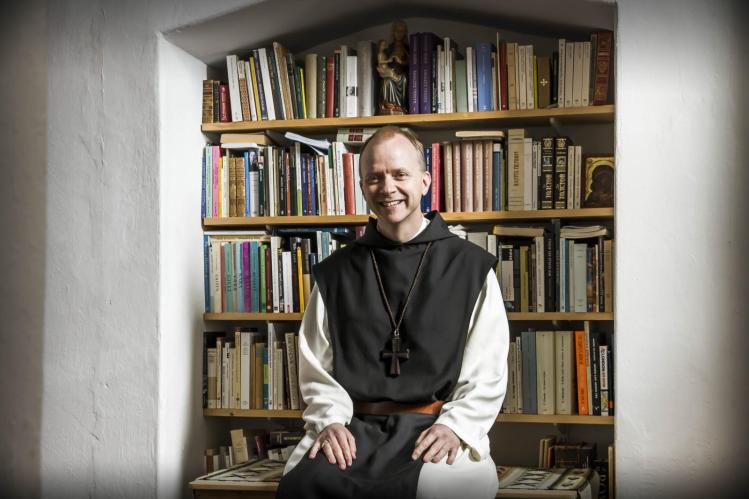
Erik Varden, born in Norway in 1974, doctorate holder from Cambridge University, monk and eventually abbot of the Trappist monastery of Mount St. Bernard in England, and, since 2020, bishop of Trondheim, Norway, is a figure who resists easy classification. He is a member of a contemplative monastic order who also serves in an apostolic ministry. He is a scholar of early and medieval monasticism who writes for a broad audience and draws readily upon modern history and literature. He is committed to the traditional teachings of the Church and approaches those who do not live according to those teachings with sympathy and compassion. Pope Leo’s choice of Varden to lead the Vatican’s Lenten spiritual exercises this year has raised his profile and will no doubt suggest to some the urgency of classifying Varden, since this will help them classify Leo, which is currently a popular sport among professional Catholics.
But, as I say, Varden is hard to classify. On the one hand, he echoes many “postliberal” thinkers in questioning the Enlightenment notion that intellectual and political freedom are found in having, as Kant put it, the “courage to use one’s own mind without another’s guidance,” a mind unconstrained by tradition and authority. Like thinkers from Alasdair MacIntyre to Patrick Deneen, Varden suggests instead that true intellectual courage is rooted in humble submission to a tradition and a community, being formed by its language, culture, and laws. Also like many postliberal thinkers, he notes how the world of liberal modernity has forgotten and forsaken its own religious roots. He writes, in a book with the distinctly unmodern title Chastity, “Given the amnesia to which the West has succumbed regarding its Christian patrimony, a chasm extends between ‘secular’ society and the Church’s sacred shore.” The chasm of forgetting means that “terms such as ‘grace,’ ‘sin,’ ‘redemption,’ even ‘God,’ have largely become meaningless to our world, which sees them as hieroglyphs from a superseded age of cultural evolution.”
On the other hand, unlike some prominent postliberals, Varden displays little interest in marshaling political power to preserve cultural, national, or religious identity. Indeed, he writes in a way that destabilizes notions of identity by showing a remarkable openness to the full range of human experience and cultural artifacts, both sacred and secular. He is realistic about the difficulty of communicating across the chasm between secular society and the Church’s tradition, noting that “when attempts are made to holler across, we risk misunderstanding: for even when the same words are used on either side, they have acquired different meanings.” Still, he remains committed to the project of speaking across difference. Translation is always possible and should be zealously pursued, because ultimately it is the one Word who speaks in all our varied languages: “Christ is the Alpha and the Omega, and all the letters in between.” Of course, translation is also perilous, not so much because we might fail to capture some pure concept that our words ought to signify, but because to translate “is to renounce the certainty that I am the knowing insider while everyone else is outside. When one does this, something new can be said.” The peril of translation is the peril posed to the buffered self by the strangeness of the other, in whom we might encounter the strangeness of the living God.
To see why it’s so difficult to classify Varden, it’s helpful to look at his various remarks on the state of the Church since the Second Vatican Council. He sees the postconciliar woes of Catholicism as a result not so much of the council itself as of the fact that its reception “unfolded within the context of a cultural climate enthused by prospects of starting out afresh from clean slates through minimalist utilitarian schemes.” But we are now in a new context, and he notes the lack of enthusiasm among younger Catholics for the embrace of modernity that so animated the Catholic avant-garde of the 1960s and ’70s:
In my experience, today’s self-identifying “modern Catholics” tend to be octo- or nonagenarian. For them, to be “modern” is a badge of honor, a guarantee of their walking unfailingly toward a splendid tomorrow. To their great grandchildren, meanwhile, the word “modern” has an old-world ring, a musty perfume of yesteryear.
While he does not doubt the sincerity and good will of those who labored to drag the Church kicking and screaming into the modern world and has no nostalgia for the Church of the 1950s, he also recognizes that “what the young see looking back is not the glorious fulfilment of ‘modern’ promise, but a swift unraveling…. Their concern is to ensure that what they see as a formless Church returns to shape, takes a stand and reclaims its dignity.” As Varden reads the signs of our own times, he sees younger Catholics desiring to return to the sources that have given the Church its form, even if they are not entirely clear what those sources are or only half understand their own desire.
The desire for relief from formlessness animates what Varden calls “today’s so-called liturgical ‘conservatism’”: the resurgence of interest among some young Catholics in the preconciliar liturgy and, in some cases, various ascetic disciplines (veiling, fasting, etc.) that accompanied it. To some observers this interest seems at best a manifestation of end-stage hipsterism and at worst a kind of Catholic fundamentalism born out of fear of modern freedom and a longing for simpler times. And certainly enthusiasts for the “Traditional Latin Mass” sometimes make historically uninformed claims about its perennial character that suggest that they are simply looking for a refuge from the inexorable process of change. But Varden sees behind the attraction to older liturgical forms an expression not of fear but of “the yearning of people in a fast-moving, ever more materialist West truly to inhabit their bodies and to realize a deeply felt hunch that their physical self is a reliable bearer of meaning.” The thirst for liturgical tradition is not simply a desire for a Church that is not “formless” (though it is that too); it is above all a desire for a self that is not formless, whose boundaries are not prodded and pummeled by market forces and political ideologies until it is indistinguishable from all the other units of consumption that constitute the citizenry of market capitalism. Varden points to “an aspect of today’s liturgical ‘conservatism’ that [he] sense[s] has been overlooked: namely its physical and ascetic—if you like, it’s ‘yogic’—aspect.” The ritualized body—the body bent with eyes cast down or standing erect with hands uplifted, the body hungry from fasting or footsore from pilgrimage or sleepy from vigil-keeping—gives expression to the meaning of the self in a way mere words or concepts never could. It is at least worth considering whether a liturgy that has been trimmed to fit modern habits and expectations has the same transformative potential.
You might like: Vinson Cunningham on Pope Francis’s ‘Fratelli tutti’
Traditional-liturgy-as-Christian-yoga is a good example of how Varden can value tradition in a way that might cause some discomfort among self-styled traditionalists. We value our own tradition best not by treating it as a sealed system but by looking for echoes of it in other traditions. Varden takes seriously the desire for tradition among the young but is not so naïve as to think that they fully understand their own desire or how to fulfill it. Human desire is sufficiently opaque to itself that what we think we are seeking is not always what we are actually seeking, and this is true of both the religious and the irreligious. The young Augustine desired to hear Ambrose in order to admire his rhetoric, and found to his surprise the truth of the Gospel that would still his restless heart. Likewise, young people may seek in traditional liturgy a safe refuge from the secular world and the vicissitudes of history, and find instead what the human heart truly desires: the wild mystery of God, which tears down all walls of separation that we might seek to erect. Though we must have some knowledge of our destination in order to journey toward it, it is only through making the journey and our encounter with strangers along the way that the full contours of our desire are revealed.
The complexity of desire and how it is shaped by tradition is reflected in Varden’s fascination with language. Ritual itself is a kind of language—a system of signs that bestow meaning. But language is also a kind of ritual, inasmuch as the meaning it conveys is not some conceptual “deliverable,” but something that reveals itself slowly through patient practice. Varden notes in a recent lecture titled “In Praise of Translation” that we are mistaken if we think that understanding another language is a matter of code-cracking, as if a foreign language were essentially the same as our native tongue, but perversely transposed into unintelligible form. Rather, “words are forms of life; and life, to be spoken of well, requires critical, deliberate, humane articulation.” Often in his own writing, particularly when quoting poetry, Varden presents the untranslated original text before offering a translation. This might simply seem precious, as if Varden were just showing off the fact that he has encountered these works in their original language, but in fact it is reflective of his concern that there is something irreducible in the sensual particularity of language—the way it looks on the page or sounds when spoken—and he wants his readers to encounter these works in all their strangeness.
Drawing on rabbinic interpretation, Varden offers an ingenious rereading of the story of Babel in which the tower builders do not live in a world that possesses “one language and the same words” (as the New Revised Standard Version translates Genesis 11:1) but rather “one language and few words.” The tower builders are unified not by a true language, but “through a handful of mobilizing slogans” that serve well to rally people for construction projects, though not so much for human life together. (One is put in mind of Wittgenstein’s imagined primitive “language game” for builders that consists solely of terms like “block,” “pillar,” “slab,” and “beam.”) Varden recounts that, in Jewish legend, when a worker fell to his death the builders barely noticed, but if a brick fell and shattered on the ground, the builders wept. On this reading, the “confusion” of language by its diversification is in fact a restoration of language to its original richness, a richness that allowed Adam to name all the animals in Eden. It is “respite” from the slogan-driven monomania of the tower builders. The proliferation of words, even to the point of mutual unintelligibility, both undercuts the instrumentalization of human life in the service of promethean projects and forces humanity to reckon with otherness: “Any notion of ‘thus’ is tempered henceforth by knowledge that there is an ‘otherwise’; one can no longer speak of ‘here’ without considering an ‘elsewhere.’”
In an essay titled “Can Literature Save Lives?,” Varden reinterprets Ephesians 2:10:
This line is conventionally translated as “We are God’s handiwork,” but we might responsibly render it “We are God’s poem,” as if each element of our existence were a phrase, a line, a letter, or just a comma, perhaps, destined for integration into a meaningful statement lovely in its providential perfection.
The notion of our lives as linguistic artifacts that are intelligible only as integral wholes is reflected in Varden’s frequent recourse to life stories, ranging from the lives of the desert fathers to those of modern men and women, stories both fictional and historical. These stories are offered not merely as inspiring hagiography. What matters is how they reveal something about the otherwise hidden working of grace in the world. In his book The Shattering of Loneliness, Varden recounts the story of the Swedish writer Stig Dagerman, who died by suicide in 1949 at age thirty-one. Dagerman was overwhelmed by the sense that life was simultaneously precious and meaningless. He “wished to believe, but…found the light of which faith speaks unbridgeably remote from the human reality he knew.” Yet, Varden avows, “When I look at Dagerman, I see a brother.” Like Dagerman, Varden sees life as a precious gift that is haunted by meaninglessness: “I accept that, for all my desire to live, I shall die; that I am dust with a nostalgia for glory.” But the Christian language in which Varden has rooted himself allows him to say something more: “I am taught to let glory, by grace, lay claim to my being even now, to make it resonate with music of eternity.” This is because every human story has been taken up into the story of God made flesh. “The Easter proclamation brought about a hermeneutic shift that affected knowledge at every level. Nothing was the same. Everything had to be recalled, reconsidered, reinterpreted.”
Even when recounting lives that end not in tragedy, like Dagerman’s, but in glory, Varden is careful not to idealize them—careful to acknowledge that all lives, however they end, are marked by fragility and subject to fracture. He does this in order to highlight the graciousness of the God who is free from fracture and fragility: “When we read the lives of saints, we repeatedly see God’s magnanimity in letting men and women act out lengthy spells of disorder preceding their awakening to grace, as if the seven days of creation, with gradual distinctions, were re-enacted in individual lives.” As in the original creation of our nature, our recreation through grace is a gradual process of the Spirit moving over the void. Even Jesus, the Holy One of God, submitted himself to formlessness in bringing to fulfillment the “incursion of glory into trauma.”
Perhaps what is most distinctive about Varden’s writing is the way he approaches human failure and frailty. In The Shattering of Loneliness, he offers a remarkable midrash of the story of Lot’s wife, who is turned into a pillar of salt for looking back at Sodom as it is being destroyed. The third-century theologian Origen interpreted her as a woman of Sodom, whose backward glance at the burning city was a sign that her conversion from sin was incomplete. Varden plays this interpretation off against that of the twentieth-century Russian poet Anna Akhmatova. For Akhmatova, who lived in exile, the “reversion” of Lot’s wife to Sodom was not simply nostalgia for vice but an act of love for her beloved home, a sacrifice of her possible future to her beloved past. Varden writes, “To acknowledge the nobility of Lot’s wife’s final gesture, to honor the oblation it spells, is not to condone her incomplete conversion. But it is, perhaps, to begin to understand it.” If there is a “failure” of Lot’s wife, it is not that she loved the sin of Sodom too much, but that she loved the goodness of God too little: “Conversion must be constructed in aspirational, not reactive terms; as an option for what is good, not against what is thought bad—or dangerous.” As he puts it in his book Chastity, “Only what I love will change me beautifully. Behaviors prompted by fear or disdain tend to disfigure.”
It is in Chastity that we find the best example of Varden’s careful negotiation of both fidelity to Church teaching and compassionate acknowledgement of human goodness amid frailty and fracture. For many decades now, the Church’s teachings on sexuality—from contraception to homosexuality to gender identity—have been the site where one sees most strikingly the failed translation of Catholic doctrine into the language of secular modernity; it is perhaps here more than anywhere else that the chasm yawns. True to form, Varden offers no translation algorithm. Rather, he notes: “Delicacy is called for in the re-ordering of disordered love. We are dealing not with programmable machines, but with embodied souls, than which nothing in creation is more sensitive.” Of course, many readers might not get past the word “disordered.” But as Varden continues, he strives to foreground the difficulty of grasping how what is “objectively disordered” might, in God’s providence, form part of the story of a person’s journey to holiness, and how the only way we will know this is once the story is done. Faced with those who are convinced that adherence to the sexual norms of the Church would mean a life bereft of joy, Varden counsels respect and patience. This doesn’t mean throwing the notion of properly ordered love out the window, but requires us “to regard the complexity of life with intelligent compassion in truth, and prerequisite for pastoral care and for friendship.”
Some might be surprised, even shocked, to read a Catholic prelate acknowledge what many ordinary Catholics already hold to be true: “In terms of chastity, a quantum leap is made, for example, in progress from promiscuity to fidelity, whether or not the faithful relationship fully corresponds to the objective order of a nuptial union, sacramentally blessed, between man and woman.” While the new creation is still being formed in us and in our world, we ought not be disdainful of all that falls short of perfection. “Every search for integrity is worthy of respect, deserving of encouragement.” What allows Varden to speak this way is not capitulation to the spirit of the age, but a recognition that the Spirit that animates and gives form to the Church is the Lord of all time and history. This Spirit ought to endow us with a certain equanimity in the face of cultural crisis or confusion. Varden writes, “The Church refuses to either absolutize or materialize eros and, in consequence, sexuality. That is, here and now, a counter-cultural position to assume, but the here and now will pass. The Christian vision of human nature endures.”
Speaking of his youth and his keen sense of the suffering of the world, Varden writes, “Christianity appeared to me a wishful flight away from the inner drama I was trying to negotiate, which was full of ambivalence, far distant from the studied certainties of preachers.” As he does with others, Varden treats his own young self delicately, respectful of his hesitations about answers that seemed to ignore the contradictions and complexities of life—answers that seemed too good to be true. But he is able to follow this path of delicate respect precisely because he has come to believe that what is too good to be true is in fact true, that we are indeed “dust called to glory.” Speaking of his encounter with the Church as a young man, he writes, “I had discovered an environment that embraced my contradictions without compromising truth.” This remains Varden’s vision of the Church: a place that “manages, by harmonic genius, to fathom the violent cries of ‘Crucify!’ and the angelic ‘Hosanna!’ in a single chord that rises out of dissonance toward unheard beauty.”
That vision of the Church allows Varden to draw into its story the whole of humanity. For him, all human culture is part of the Christian patrimony. In the best “humanistic” tradition of the Church, turning to the human is, in Christ, no longer incompatible with turning toward God: “In God incarnate, our humanity itself signified divine life. As a result, it is no longer a fatal disadvantage to have one’s eyes directed ‘downwards.’ Indeed, our senses, previously an impediment to spiritual knowledge, now enjoy privileged access to the work of redemption.” This extends to our encounter with our neighbor, especially those who seem to us most alien. He notes in his lecture on translation that “in Israel’s God-given Law, the stranger, designated oxymoronically a ‘resident alien,’ appears intrinsic to the nation, lodged within it, we might say, as a providential irritant.” It is important to Varden that the Church retain its form, but that form is not defined by tightly policed borders. Rather, it is defined by Christ, the center of the Church who, paradoxically, is found at the periphery, where we meet the stranger.
At one point, Varden refers to “that quintessentially postmodern movement, LGBTQ+—an ineffable acronym, pointing toward a seemingly endless realm of possibility, like a secular appropriation of the Tetragrammaton.” It’s a clever line and might at first seem like a snarky takedown of gender ideology and its limitless voluntarism, casting it as an idolatrous and even blasphemous parody: “I will be what I will be.” But while Varden is clever and witty, he is rarely snarky. He writes at one point, “The gospel offers more than a moral code. It proposes the transformation of the human person.” Perhaps he is suggesting that even here, in the secular desire to be more and other than what the world says we must be, we can hear an echo of the Divine Name, and of a call to transformation that reaches beyond even the most radical self-determination.
Once again, Varden resists our attempts to classify him. He is critical of liberal modernity but does not conform to the often bellicose “postliberalism” of our day, with its anxious guarding of boundaries, whether these be national, ethnic, or ecclesiastical, and its desire to craft political structures that will police those boundaries. As he notes, “God will not let faith be instrumentalized for purely territorial ends.” As a bishop, he is of course a guardian of the faith, but he often writes from the perspective of a pilgrim and explorer, a crosser of boundaries who is willing to take the risks and accept the limits of translation because the alternative is the monotonous idolatry of Babel. In short, Varden is a Catholic who desires to be catholic, to root himself in the soil of the tradition while at the same time journeying to alien lands in order to see better the one who, in Hopkins’s phrase, “plays in ten thousand places.”
We welcome your comments about this article. Please send your response to letters@commonwealmagazine.org.


No comments:
Post a Comment