
Closures and mergers of Catholic parishes in the United States, which disproportionately affect poor Catholics of color, have become so commonplace that the country’s first coordinated, large-scale wave of parish closures is rarely remembered. In September 1988, the archbishop of Detroit, Edmund Szoka, announced in a closed-circuit telebriefing to parishes across the city that forty-three of Detroit’s 112 Catholic churches were recommended for closure. By midsummer 1989, some parishes had successfully resisted, but thirty churches were shuttered. Twenty-five more were deemed “questionably viable” and given one year to meet a series of financial and ministerial metrics devised by the archdiocese without meaningful parishioner input. The Detroit closures of 1989 were unprecedented in scale and were described at the time as the largest single wave of parish closures in U.S. Catholic history. Many of the most embattled parishes, on the city’s east side, had predominantly Black congregations.
Today, if you talk to Catholics in the Detroit area who opposed the 1989 restructuring, you still hear derision toward the archdiocese’s technocratic language. Questionably viable remains that era’s most notorious byword. Ironically, Szoka’s decisions were largely influenced by an archdiocesan task force established in 1983 to improve the Church’s “presence and ministry” in the city. In official statements, this task force invoked the language of “nurture” and “growth” to justify a process that would permanently alter Detroit’s sacred geography. The Church’s physical presence in the city shrank precipitously, deepening the racial divide between Detroit’s remaining urban parishes and largely white suburban churches, and the spiritual anchors for thousands of Catholics were effectively dismantled.
Two decades earlier, a very different and no less surprising reality had taken hold in Detroit. From the late 1960s onward, the city became a de facto hub of Black Catholic theological innovation. In 1968, Detroit hosted the first Catholic Clergy Caucus on the Interracial Apostolate, from which the National Black Catholic Clergy Caucus emerged. The caucus became famous for declaring the Church “primarily a white racist institution.” Its first president was Fr. Donald Clark, then the only Black diocesan priest in Detroit. That same year, Archbishop John Dearden established the nation’s first diocesan office for Black Catholics, the Black Secretariat. In the 1980s, Detroit musician Marjorie Gabriel-Burrow founded one of the first archdiocesan-wide gospel choirs in the country and led the team that created Lead Me, Guide Me (1987), the first African American Catholic hymnal.
It was with Detroit’s foundational contributions to the Black Catholic Movement in mind that I entered St. Charles Lwanga Church on a mid-October Sunday. I had moved back less than two months earlier to research the 1989 parish closures and their lingering effects on the city’s Black Catholic communities. Raised Baptist, I knew the heartache of driving past the defunct Black church of my childhood. I wanted to understand what changes Black Catholics had hoped might follow Vatican II (Dearden, a liberal giant in the American Church, played a notable role in the Council). How did Dearden’s dreams for a modern Church in an increasingly Black city give way to Szoka’s formulaic playbook?
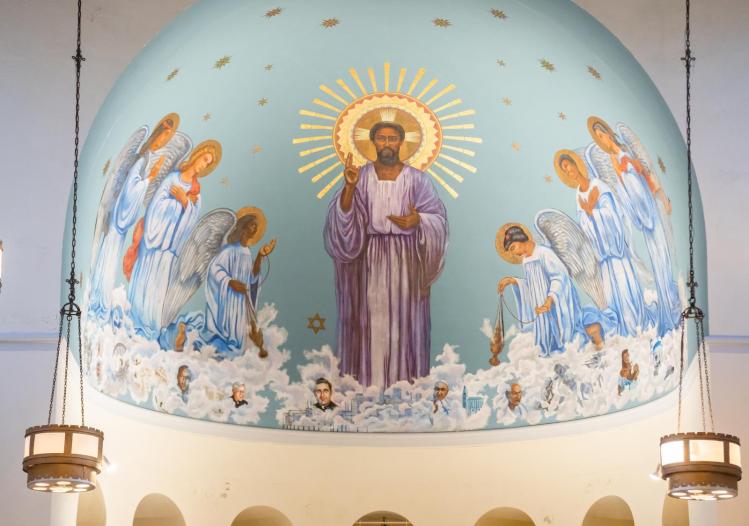
Shortly after I arrived in Detroit, I learned that members of St. Charles Lwanga, formerly St. Cecilia, would soon celebrate their final Mass. The church is perhaps best known for its “Ceciliaville” gym, where some of the most celebrated basketball players of the past sixty years trained. St. Cecilia came to national prominence in the late 1960s when its white priest, Fr. Raymond Ellis, commissioned parishioner and artist DeVon Cunningham to paint a Black Christ mural in the church’s apse in the fall of 1968. The racial composition of the surrounding neighborhood had been rapidly changing throughout the decade. Events such as the city’s 1967 summer rebellion and the burning of religious textbooks by Black students at the St. Cecilia school convinced Fr. Ellis that his Black parishioners needed to see themselves reflected in their everyday religious experiences.
I had known of the mural for years but hadn’t seen it in person until I entered the church alongside former and current parishioners who were there to say goodbye to a place they’d loved for decades. Cunningham’s Black Christ, painted in the stern Pantocrator style, is attended by a multiracial host of angels meant to represent nations around the world (the apse’s original Christ and angels were white). Beneath them stretches a row of faces peering through whirling clouds: Martin Luther King Jr., Malcolm X, the Kennedy brothers, Gandhi, Pope John XXIII, an anonymous maternal figure, and later additions—Fr. Raymond Ellis and Msgr. Thomas Finnegan, two of the most beloved pastors in the parish’s history.
I was far from the only guest that day. Dozens of curious visitors had come. The nave, while nowhere near full, was much more crowded than usual, parishioners later told me. One familiar song the choir performed, “Total Praise,” moved me; it is my mother’s favorite gospel hymn. Before the Liturgy of the Word, the young Franciscan friar who administers the parish, Fr. Athanasius Fornwalt, approached the lectern to clear up some of the confusion preceding that morning’s service: he had jumped the gun.
This would not be the church’s farewell Mass, even though parishioners could expect to find a camera crew from the local Fox affiliate outside afterward. Fr. Theodore Parker, the recently retired Black priest who had served the parish from 2001 to 2024, offered brief closing remarks after the homily. Sudden change can be painful, his message conveyed, but it might also mark the beginning of a new life.
What became clear during coffee hour in the parish hall was that, even if that day did not mark the actual end of the church, many parishioners were treating it that way. All signs except the one that mattered most—an official canonical decree, which hadn’t been issued—seemed to point to that conclusion. (A spokesperson for the Archdiocese of Detroit wrote in an email that “to respect the discernment processes of our parish communities, the Archdiocese does not comment on potential closures or mergers until such decrees are published” and that “activities referencing closure would have been premature.”) Despite the absence of a decree, the congregation of St. Charles Lwanga had been invited to participate in a joint Mass with Christ the King Church, a more racially integrated church on the city’s northwest side, the following Sunday. Many expected that the two churches would eventually merge.
“It’s like a funeral,” René Bascombe, a St. Charles Lwanga parishioner, told me later when we spoke by phone. “And now they tell you they’ll close the door and you gotta figure out what church to go to…. I really don’t know what the outcome of that is going to be. We’re just praying because right now, as you know, it’s still a shock.”
Bascombe, who is seventy-eight, attended St. Cecilia for much of grade school and high school. When her family moved to the parish in the 1950s, St. Cecilia was still predominantly white. She recalls a time when “people wouldn’t even move down in the pews” to make room for her and her family. “But then God is a mighty God, isn’t he?” she said. “He brings about a change and changes people’s attitudes.”
The possibility that St. Charles Lwanga Parish might lose its church building—and its adored mural—has shaken Black Catholic Detroiters across the archdiocese and led some to brace for yet another wave of closures and mergers. A new two-year restructuring process, set to conclude in 2027, was announced in mid-November. The archdiocese’s most recent restructuring in the early 2010s resulted in two closures and dozens of mergers over four years. St. Charles Lwanga itself is the product of a 2013 merger between two predominantly Black churches, St. Cecilia and St. Leo.
As of early November, the parish’s future remained uncertain. One person familiar with the deliberations told me that Archbishop Edward Weisenburger’s presbyteral council recommended keeping the parish open, though the final decision rested with him. Still, the confusion surrounding the false “final Mass” on October 12 prompted parishioners to consider where they would go if the parish does, in fact, close and whether they would remain in the Catholic Church at all.
“The building is to bring us together so we can gel, support one another, love one another, be there for one another,” Bascombe said. “We’re the Church. Yes, it’s just a building. But people got to have a place to meet. That’s even in Christ’s time.”
Jesse Cox, a Black former Dominican friar, began attending St. Charles Lwanga in the early 2010s, drawn by Fr. Parker’s dynamic preaching, the parish’s sense of community, and the church’s gospel choir. Now the chief diversity officer at Madonna University, a private Catholic institution just outside of Detroit, and once a vocations promoter for the Dominican order, Cox recognizes the real organizational challenges confronting the archdiocese. “There are not enough priests,” he said, “but I think that is a paucity of imagination. You could hire an administrator to run a parish, and then the priests could come and be sacramental ministers.”
A creative solution to the priest shortage, Cox acknowledged, wouldn’t address the deeper problem of a shrinking congregation. The core issue for him is how the local Church has failed to encourage Black vocations and engage young people. The threat of church closures brings this issue into focus. Representation matters, he told me, at least to a degree. He pointed to the example of Moses Anderson, Detroit’s first and only Black Catholic bishop to date, who died in 2013. “I don’t know if things would have been different if we’d had a Black bishop here,” Cox said, “but we certainly would have had somebody that we could have related to, somebody who would have been in the ear of the archbishop or the cardinal at the time. But we don’t have that. And I know that every time a parish closes, the Black Catholic community gets smaller. It does not grow.”
Cox wasn’t immediately sure where he would go if St. Charles Lwanga closed. He wasn’t interested in going over to Christ the King, and he couldn’t imagine returning to his local parish. Although his local church was convenient to attend, its liturgical culture was, quite literally for Cox, sleep-inducing. “I said to myself, ‘This is not right. You are not getting what you need to get out of Mass.’ It wasn’t the style. I went to St. Charles Lwanga because there was gospel, the preaching was better, I was more involved. I felt more comfortable.” Cox mentioned St. Moses the Black as a possibility (a west-side parish formed in 2013 from the merger of three largely Black parishes, including St. Benedict the Moor, Detroit’s first parish established specifically for Black Catholics). Later, however, he said he would probably shop around for a “life-giving” community that affirmed the gifts of Black Catholics. “I just might not commit to one place. Because they’re not breaking my heart again.”
Other longtime St. Charles Lwanga parishioners expect to hitch their fates to the church whether it merges with Christ the King or not. Pam Russell, though a Methodist to this day, has led the parish’s music ministry since 1996. A family friend had encouraged her to apply for the job. Russell didn’t like the idea of needing to change her faith to belong to any church community, so she never converted to Catholicism. “I told them from the beginning that I was not going to change my faith,” she said. But the parishioners were warm, and Russell never forgot the affectionate way they welcomed her older sister when she came to watch the choir.
Russell had suspected that a merger might be coming. For at least the past few years, the church’s overworked boiler system had barely functioned during the winter months, and she knew many parishioners refused to endure a cold church again as the year drew to a close. “You can look around and see that the money is not coming in. Look at the walls. The [plaster] is falling down on the choir members. You’ve got to do something.” Russell compared this transitional period in the archdiocese to her time working at Michigan Bell, once the state’s primary telephone provider, which went through a series of mergers in the 1980s and ’90s. “It is what it is,” Pam said. “Just wait and see.”
Although Russell could easily have returned to her old Methodist church—she considers herself a perennial insider-outsider at St. Charles Lwanga—she felt a responsibility to keep the choir intact. Many parishioners see it as a defining pillar of the church. “I believe if I left right now, a lot of the church members would then go to other Catholic churches, and some would even change denominations,” she said. “I didn’t want that to happen.”
In February 2025, then-archbishop of Detroit Allen Vigneron released a pastoral note titled “No Second Tunic,” a reference to Matthew 10: 7–10. In these verses, Christ instructs his disciples to spread the Gospel unencumbered by needless burdens: “Do not take gold or silver or copper for your belts; no sack for the journey, or a second tunic, or sandals, or walking stick.” Vigneron compared the present moment to the Apostolic Age, when the early Church operated with few formal structures and scarce resources. In his view, the Church’s emphasis during this “New Apostolic Age”—an era of institutional austerity, consolidation, and retrenchment—should not be on buildings or historic preservation, but on faithfulness and mission outreach.
In Detroit, as elsewhere in the country, the “timeless message” of the Church that Vigneron invokes has long been in tension with the realities of timeworn church buildings, declining Mass attendance, aging congregations, generational rifts, priest burnout, and dwindling resources in inner-city parishes. Nearly 70 percent of Detroit’s priests are fifty or older, and the Archdiocese of Detroit projects that by 2034 there will be 134 active priests in parish ministry—about 100 fewer than today. A 2023 report by the Center for Applied Research in the Apostolate, which examined parish trends between 1970 and 2020, found that among the eleven U.S. dioceses studied, Detroit had experienced the steepest decrease in the number of parishes, losing nearly 40 percent. Over that same fifty-year span, the Catholic population within the archdiocese fell by nearly one-third, and the number of baptisms dropped by more than 80 percent.
Against this backdrop of contraction, Black parishes that survived earlier rounds of closures are once again facing uncertainty. St. Catherine–St. Edward Church was among those reshaped by the archdiocese’s 1989 restructuring, merging that year with St. Bernard to form what is known today as St. Augustine–St. Monica. Born out of that moment of crisis, the parish has since become a cornerstone of Black Catholic life on Detroit’s east side. It has been home to some of the most influential Black Catholics of the last sixty years—not only in Detroit but across the country—including Fr. Donald Clark, Marjorie Gabriel-Burrow, and the late Deacon Al McNeely.
Valeon Waller, the sixty-four-year-old incoming president of St. Augustine–St. Monica’s parish council, remembers Deacon McNeely well. McNeely, who created the archdiocese’s Ministers of Service program to expand lay participation in parish life, led the premarital workshops that she and her husband attended. Her father, a former Baptist who migrated to Detroit in the 1930s, was among the first Ministers of Service in the archdiocese. Like other lay leaders across Detroit, Waller is trying to balance financial and demographic realism with a tentative optimism based in lay empowerment, and in the belief that the archdiocese may have learned an important lesson from 1989: throughout what it now calls a “parish realignment” process, the lines of communication must stay open, and parishes must have a say in determining their own metrics of “viability.”
What followed the 1989 wave of closures was a long interim of endurance. The burst of theological and cultural self-definition that had animated Detroit’s Black Catholic Movement in the 1960s, ’70s, and ’80s—its experiments in liturgical inculturation, lay ministry, and community outreach—gave way to the practical work of survival. Archdiocesan support was inconsistent, often amounting to tolerance of loss rather than investment in growth. Yet the parishes that remained kept serving their neighborhoods. The Detroit Catholic Pastoral Alliance, which had formed in the late 1960s and stood at the forefront of resisting the 1989 closures, shifted its focus to helping urban parishes survive: developing affordable housing, coordinating antiracism training, and in 2001 establishing an Urban Parish Coalition to pool resources and programming across cash-strapped city churches. Lay ministries like the Ministers of Service continued their work in pastoral care, and parish-based social programs—soup kitchens, senior-citizen outreach, adult and youth education initiatives—carried on.
“We’ve been through this before,” Waller told me. “It’s not so uniquely new to those inner-city parishes because we’ve always socialized, connected one church to another. We can all call upon each other right now if something happens.” This network of mutual support became the lasting inheritance of the Black Catholic Movement in Detroit, keeping parishes tethered to one another even as the Church’s institutional presence in the city continued to shrink.
What does successful evangelization in the city require? Under the archdiocese’s current “Family of Parishes” structure—groups of neighboring parishes that share clergy, resources, and ministries—each community has been asked to collaborate more closely on mission work and administration. Waller drew on her father’s life to offer an example of what such collaboration should mean in practice. After learning that his brother in Detroit had fallen ill, her father arrived in the city with little money. When a Baptist church turned him away without food, he found his way to St. Dominic Church, which ran a soup kitchen. The priest there offered him a job and a place to stay, and in gratitude, he promised to raise his children Catholic. “That’s the model,” Waller said. “Meet the need of the human being. Their spirituality, their growth, will come with wraparound services.” To that end, she hopes to establish an independent, faith-based community resource center in the former St. Augustine–St. Monica School that would serve the entire Detroit Lower Eastside Family of Parishes, which includes eight churches.
“I fear that our numbers are dwindling to the point where it’s easy for our impact to be marginalized,” Waller said. The aging and dying-out of an older Black Catholic population is part of the attrition, but there is also a widening generational divide. Younger Black Catholics, she and others told me, often struggle to reconcile Church teachings on human dignity and a “preferential option for the poor” with the fact that Donald Trump won a majority of Catholic voters in the 2024 presidential election.
“I’m at the bottom of the Baby Boomers, literally,” Waller said.
We were taught, well, the world is imperfect and you have to pray for the deliverance of those who may not have compassion. So it was an inward, “Father, help me to follow.” But for [Millennials], the situation is like, “Wait a minute. I’ve seen you guys care about that for a long time, and I don’t see it getting better.” That’s the world-practical view: “I believe in a God. That sounds wonderful. But how do we align reality with spirituality?”
Waller’s daughter, Valaurian, a thirty-eight-year-old freelance photojournalist and cradle Catholic who documents Detroit’s Black Catholic communities for the archdiocese, was on the verge of leaving the Church before the pandemic because staying in it “started to feel like a job,” she said. Her perspective began to shift as she explored what she called the “little bubble” of Detroit’s Black Catholic churches through contract work with the archdiocese. Over the years, she has held many roles at St. Augustine–St. Monica, from altar server to parish-council member, but she was never a “Bible-thumping Catholic,” and still feels “tension with organized religion in general.” Even before the publication of “No Second Tunic,” Valaurian said, she had “read the room” and suspected another round of downsizing was coming, driven in part by the pandemic’s disproportionate toll on Black congregations and the financial strain it placed on parishes like her own.
“You think about the churches we have [on the east side],” Valaurian said.
Those are the first churches that were built in the archdiocese. Therefore, they’re the oldest. They cost the most to upkeep. The demographics in the city are different than they are in the suburbs. We’ve got less education, we’ve got fewer resources, fewer monetary capabilities. I don’t know, I feel like there should be some kind of equitable solution and not just numbers on a spreadsheet.
In the midst of such frustrations, others in the parish have tried to channel that urgency into new forms of engagement. One of them is Kyle Cascarelli, recently hired by the archdiocese as director of engagement for the Detroit Lower Eastside Family of Parishes. Cascarelli, who is white, joined St. Augustine–St. Monica in 2017. He was impressed by the leadership of its pastor, Msgr. Dan Trapp, who died unexpectedly in 2024, as well as the range of social services the church offered, including a pregnancy crisis center and food pantry. His family, like so many other white Detroiters, had moved out of the city in the 1970s.
He told me somewhat sheepishly that he grew up in Howell, a small city with a national reputation as a hotbed of white-supremacist activity. (The city hired a public-relations firm in 2024 after a neo-Nazi demonstration made headlines.) Cascarelli’s childhood best friend was the only person of color he knew in Howell, and the experience of hearing him called a racial slur in the third grade unsettled him. He told me the music of gospel artist Kirk Franklin would later “save my life,” and he felt a desire to serve Black communities in whatever way he could.
Although he worries that a numbers-driven “disconnected analysis” could determine which parishes survive, he believes there is a good-faith effort to avoid repeating the mistakes of the past. He is fundamentally hopeful about what can come out of the present uncertainty. The Church, though likely to become smaller, might be more rooted in service to the communities that remain.
A conversation Cascarelli had with a Protestant minister friend reminded him of some of the churches of ancient Rome.
Where is Ephesus? Where is Philippi? Where is Corinth? They’re gone. Does that mean those churches didn’t matter? No. Does it mean the apostles who were running them did a bad job? No. It’s just the way time moves. And if a Protestant can tell me that, I think we as Catholics have this really broad and beautiful understanding of the Church and need to remember that we’re a part of something so much bigger. We need to not be fighting so hard for “my ministry, my agenda, my church.”
An unresolved question for parishioners in some of Detroit’s most vulnerable parishes is whether Archbishop Weisenburger, Vigneron’s successor, will seriously weigh non-numerical metrics when making his decisions, and whether such factors can keep Black Catholic churches alive. One gets the sense that those preparing to fight for their churches are thinking as much like preservationists as pastoral ministers. They hope that if their parishes must close, they can do so with dignity.
For many Detroit Catholics, especially in the city’s Black parishes, the struggle is over what the Church should look like in a place that has already lost so much. Will the parishes have real agency, or only the grace of choosing how to let go? The archdiocese insists that renewal sometimes requires contraction, but Detroit’s past offers a harder lesson: closures change buildings and the people who worship inside them. The question that haunted 1989 still lingers. Can a smaller Church truly be a living one?
Editor’s note: On November 1, 2025, the Archdiocese of Detroit issued a decree officially merging St. Charles Lwanga and Christ the King parishes as part of the archdiocese’s on-going restructuring efforts. According to the archdiocese, St. Cecilia Church, the parish church of St. Charles Lwanga Parish, will remain open as an ancillary church, “available for access by the Faithful as the circumstances provide.” The long-anticipated merger, which was publicly announced on November 8, took effect December 3.


No comments:
Post a Comment