
In one of the most highly anticipated cases of last year’s Supreme Court term, a 6-3 majority of the court held that parents have a constitutional right to withdraw their children from religiously objectionable instruction in public schools. Widely viewed as a victory for religious-liberty advocates, Mahmoud v. Taylor is likely to inspire future litigation that seeks to curtail state officials’ broad discretion over the content of school curricula. Should such efforts continue to find welcome reception at the high court, proponents of “parental rights” will have a surprising—if largely forgotten—historical phenomenon to thank: twentieth-century anti-Catholicism.
Although the majority and dissenting justices in Mahmoud disagreed about its scope, they unanimously acknowledged that parents have a constitutional right “to direct the religious upbringing of their children.” Before Mahmoud, the most recent case in which the court reached a similar conclusion was Wisconsin v. Yoder (1972). There, William Bentley Ball—an influential First Amendment litigator and “prominent Roman Catholic layman,” according to his New York Times obituary—persuaded a 7-2 majority of the court that Amish parents could not be required to send their children to school until age sixteen in violation of their religious beliefs. Nearly a half-century earlier, the court found, in Pierce v. Society of Sisters (1925), that Catholics in Oregon could not be prevented from sending their children to parochial schools by a compulsory public-school attendance law. As Justice James McReynolds observed in Pierce, “The fundamental theory of liberty upon which all governments in this Union repose excludes any general power of the State to standardize its children…. The child is not the mere creature of the State; those who nurture him and direct his destiny have the right, coupled with the high duty, to recognize and prepare him for additional obligations.”
The prominent role Catholics played in Yoder and Pierce illustrates the longstanding relationship that the parental-rights movement has had with the American Catholic Church. But what is less well-known is that, in the middle of the twentieth century, during the heyday of what one historian has dubbed “Tri-Faith America,” it was widespread anti-Catholicism that led Catholic lawyers and bishops to develop a strategy to make “parental rights” mainstream.
In light of Mahmoud, there is little doubt that this strategy has proven widely successful. To understand the history of this strategy’s development is also to understand the history of the movement that produced Mahmoud—and even perhaps to predict where the parental-rights movement is headed next.
Before the 1940s, the First Amendment was not enforceable against the states. Thus, the Supreme Court was involved in very few religious-liberty disputes during the first decades of the twentieth century, and most lawyers who represented religious plaintiffs before midcentury came from the local communities in which these disputes arose. This landscape markedly changed, however, when the court decided to “incorporate” the First Amendment’s Free Exercise and Establishment Clauses against the states in the 1940s—a process that was complete when the court handed down Everson v. Board of Education in 1947. In that case, a slim majority of the court was led by Justice Hugo Black, a former member of the Ku Klux Klan, to hold that New Jersey did not violate the Establishment Clause by reimbursing parents for bus transportation to Catholic parochial schools.
Shortly after Everson was decided, the bulletin of the American Catholic bishops’ conference proclaimed that the majority’s holding in the case was a “momentous decision” that “[took] a long step forward towards a reasonable application of the First Amendment to concrete present-day conditions in American life.” Behind closed doors, however, Catholic leaders expressed concern that Justice Black’s constitutionalization of Thomas Jefferson’s infamous “wall of separation between church and state” could imperil the Church’s long-term efforts to obtain limited forms of government aid for parochial schools. Consequently, only one month after Everson was decided, the bishops appropriated $5,000 for a “careful historical analysis of the First Amendment.” The responsibility for leading this effort fell to the legal department of the National Catholic Welfare Conference (NCWC), a small but influential organ of the bishops’ conference based in the nation’s capital that began to advise Catholics around the country about church-state disputes during the mid-twentieth century.
As the NCWC’s legal department prepared for a surge in First Amendment litigation after Everson, the bishops responded to the explosion in anti-Catholic sentiment that followed Everson’s permitting of government aid to parochial schools. In the fall of 1947, this anti-Catholic sentiment seemed to manifest itself most inimically in the establishment of Protestants and Other Americans United for Separation of Church and State (POAU). As the bishops’ bulletin observed, “Persons long known for their persistent talking and writing against the Catholic Church and things Catholic are prominent in a group which has announced the formation [in Washington] of a nationwide organization ‘to [ensure] the separation of Church and state.’” The leader of this new organization, according to the bishops’ release, was the Methodist leader G. Bromley Oxnam, someone “widely known for his anti-Catholic outbursts.”
In the 1940s, Catholic leaders perceived the POAU to be the most formidable anti-Catholic opponent of parochial schools. Consequently, the bishops’ conference directed the legal department to provide diocesan attorneys with a confidential plan to thwart the POAU’s agenda. Among other things, this plan required diocesan attorneys to omit “the names of the public schools in which Nuns teach” from an official directory so that the POAU could not easily pinpoint local school boards that cooperated with the Church. As a member of the legal department characteristically noted one year following this directive, “this anti-Catholic organization has now become well informed of legal developments…and initiating litigation and fostering legislation.”
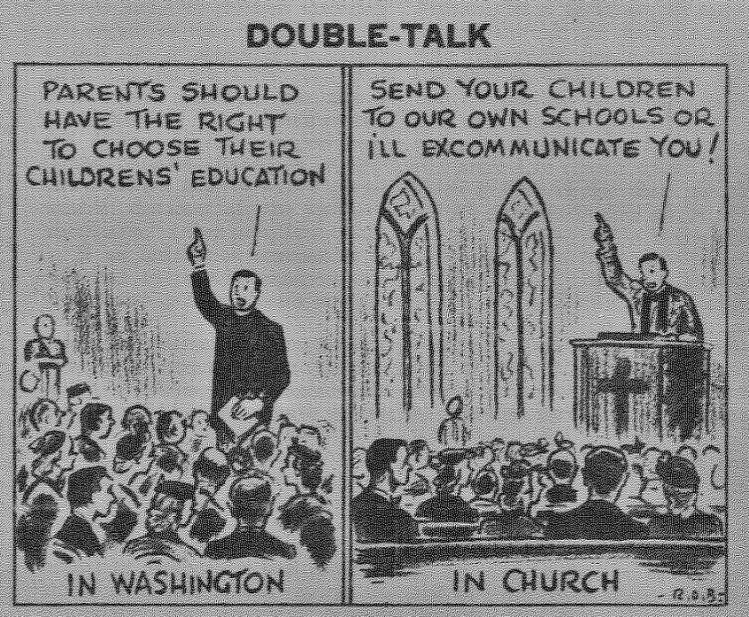
One of the principal strategies that the POAU employed to oppose parochial education was to claim that the American Catholic Church’s defense of parental rights was actually a ruse contrived by the Church’s hierarchy to lead Americans to believe that Catholic parents could meaningfully exercise choice in education. As a POAU cartoon once asserted, the Church was engaged in “double-talk” whereby Catholic parents who exercised their right to “choose their children’s education” would be excommunicated unless they chose to send their children to parochial schools. This claim, of course, evoked popular images of Catholics who could not “think on their own” because of the Church’s hierarchical (and seemingly authoritarian) ecclesiology.
Not all mid-twentieth-century opponents of parochial-school aid may have been motivated by anti-Catholic prejudice, but the volume of anti-Catholic literature published immediately after Everson seems to confirm that opposition to parochial-school aid often went hand in hand with anti-Catholicism. In 1947, for instance, the International Convention of the Disciples of Christ published fifty thousand copies of a pamphlet claiming the “Roman hierarchy” was deceiving the American public into believing that “free textbooks and bus transportation for pupils of parochial schools” were “humane and kindly provisions for the welfare of children.” In reality, the convention argued, the Catholic Church sought to “shift the total support” for a “church controlled educational system” from “the Roman church” to “the public treasury.” On this view, the provisioning of free textbooks and bus transportation to parochial schools was “but the initial step in a long range strategy” to “completely shatter” the “principle of separation of church and state.”
In March 1948, the hostile national response to Everson that the POAU and other organizations fomented appeared to lead the Supreme Court to adopt a newly expansive reading of the Establishment Clause. In McCollum v. Board of Education, the court overwhelmingly found that the use of government property for religious instruction violated the First Amendment.
Catholics widely rebuked McCollum. As the influential Jesuit political philosopher John Courtney Murray sarcastically remarked shortly after McCollum was decided, the decision “substituted” for the First Amendment “the ‘great American principle of the eternal separation of Church and State.’” Robert F. Drinan, Murray’s Jesuit contemporary, likewise found McCollum to be so objectionable that he devoted his master’s thesis at the Georgetown University Law Center to studying the “novel ‘liberty’” purportedly created by the court’s decision. As Drinan argued in America magazine, McCollum failed to respect the Pierce-era conviction that parents have a constitutional right to direct the religious upbringing of their children. “If the rights of parents to choose a school for their children is guaranteed by the Constitution,” Drinan asked, “then should not the lesser right to guide the education of one’s children in a public school be as guaranteed?”
Amid this midcentury moment of interconfessional hostility, the Supreme Court again returned to the relationship between religion and education in Zorach v. Clauson (1952). Only two years after the American Catholic bishops had released a statement titled The Child: Citizen of Two Worlds—in which the bishops depicted Catholic children as having a “first and highest allegiance to the kingdom of God” with which the government could not interfere—the court was asked to consider whether New York could dismiss children from public schools for offsite religious instruction at the direction of their parents. In a 6-3 decision, the court held in Zorach that this arrangement did not violate the Establishment Clause because there was no coercion of religious belief required by the state’s program.
From the legal department’s perspective, Zorach had the potential to correct the chief error of McCollum—namely, the court’s failure to respect parental rights in education. As one lawyer for the department wrote shortly after Zorach, the decision established a “new norm” of “cooperation of Church and State, and, implicitly, cooperation of parents with the State.” Outside Washington, prominent Catholic commentators presented Zorach as a victory for parental rights in education. As the Jesuit editor-in-chief of America magazine, Robert C. Hartnett, wrote in May 1952, “Catholics feel that Mr. [Justice] Douglas [in Zorach] should have resorted explicitly to parental rights to justify the majority ruling. This observation is largely valid…. Even without such resort, however, the Douglas opinion is monumental.”
Although Zorach, like McCollum, did not specifically deal with government aid to parochial schools, the U.S. Catholic Church’s midcentury opponents viewed Zorach as a boon to the Church’s “long-range strategy” to dismantle Thomas Jefferson’s wall of separation between church and state. Following Zorach, the POAU and other similar organizations thus continued to invoke the dangers of what the infamous anti-Catholic essayist Paul Blanshard dubbed “Catholic power” in an effort to stymie the Church’s perceived legal success. For example, less than a year after Zorach, a mailing campaign was initiated to urge Congress to investigate the “subversive activities of the Vatican.” According to the campaign’s model letter to Congress, “the moment is propitious for the initiation of action against an international political organization masquerading as a religious organization, which constitutes an immediate, urgent, and dire threat against our Republic.” Unsurprisingly, this campaign connected fears of Catholic power in general to Catholic schools in particular. The letter read:
[The Church] is able to infiltrate its representatives in the best Communist manner, into key positions: into government at all levels, into education, into the national economy, into our armed forces…. In its parochial schools, the Church has been teaching religious intolerance at the expense of non-Catholic American taxpayers, in violation of the Constitution of the United States.
The Supreme Court’s constitutionalization of parental rights in the 1920s provided Catholic lawyers in Washington with a latent precedential resource on which they could draw in future litigation to vindicate their philosophical and theological convictions about parental rights—namely, that parents have a “basic natural law right to control the education of their children which is recognized by the [federal] Constitution,” as a midcentury internal memorandum noted. But as one influential lawyer for the bishops’ conference conceded after Everson, neither the Constitution nor Bill of Rights “explicitly declares that…parents have the right to manage the education of their children.” Thus, it was far from certain that the U.S. Catholic Church would organize its parochial-school litigation strategy around parental rights in Everson’s wake.
The anti-Catholic sentiment that exploded after Everson—famously illustrated in late-nineteenth-century cartoons by Thomas Nast—led Catholic lawyers and bishops to emphasize that providing limited forms of government aid to Catholic parents did not violate the Establishment Clause, but rather vindicated their constitutional rights to direct the religious upbringing of their children on the same basis as their non-Catholic contemporaries. By framing questions of parochial-school aid in the context of parental rights and placing outsized attention on litigation specifically involving parental rights, the U.S. Catholic Church believed it could better avoid bringing anti-Catholic prejudice into state courtrooms around the country. In 1954, therefore, the bishops’ conference characteristically adopted a resolution directing the legal department to file a supplemental brief in a case “in order to present clearly the Catholic view on the parental right in education.”
Such public involvement of the bishops’ lawyers in individual legal disputes was notable. Indeed, even as the legal department became involved in litigation in various states after Everson—including New Mexico, New York, Illinois, Missouri, and Washington—it sometimes chose to do so in private so that anti-Catholicism would not prejudice state courts against litigants sympathetic to the Church’s interests. As one lawyer for the bishops’ conference observed almost a decade after Everson, it was “highly probable” that local attorneys would continue to “not wish to have any brief amicus curiae filed by a representative of the Catholic Church unless many Protestant organizations file briefs amicus.” Such public affiliation with the Church, it was thought, might disadvantage litigants who were advancing the Church’s substantive legal positions.
Perhaps the most revealing evidence that anti-Catholicism led the twentieth-century Church to turn to “parental rights” can be found in a 1957 dispute in Maine over a city ordinance that authorized public bus transportation to parochial schools. After local counsel requested the Washington-based legal department’s assistance in defending the ordinance, it was decided that the “most expeditious” means of supporting the local litigation efforts was to schedule a meeting between the legal department’s staff and counsel for the city. Concerned that public knowledge of its involvement might agitate anti-Catholic actors in the state, however, the legal department decided that this meeting could not occur in Maine. As one lawyer for the department noted in a memorandum to the bishops’ conference, “We met the [local counsel] in Boston because we were reluctant to make a personal visit to Augusta. Such a visit certainly would have directed attention to [the bishops’] association with the controversy.”
Notably, such an aversion to involving the institutional Church in local litigation continued in later decades. In 1968, for example, the bishops’ conference agreed not to file briefs in two important religious-liberty disputes because filing a brief on behalf of the institutional Church “would inject issues [into the litigation] much broader than the narrow educational ones.” Instead, it was determined that “it would be better that the Catholic expression [of views] be made by the National Catholic Educational Association as a professional educational organization.” This move to emphasize the Church’s “education[al] interests,” an internal research memorandum noted, “hopefully will avoid the opportunity for the [opposing party] to impart undue emphasis to their assertion that the Church, not education, is the direct beneficiary” of the government-aid program at issue in the case.
The Supreme Court’s prayer and bible-reading decisions, Engel v. Vitale (1962) and Abington School District v. Schempp (1963), brought further developments in the U.S. Catholic Church’s approach to church-state litigation. But as this often-overlooked history reveals, it was in the fifteen years after Everson, during the era of “Tri-Faith America,” that anti-Catholicism led the Church to develop its first nationwide strategy to vindicate the rights of Catholic parents to direct the religious upbringing of their children.
This nationwide strategy may have manifested itself differently in different states, but it is nevertheless true that midcentury anti-Catholicism led the Catholic bishops’ conference and its lawyers to develop a “parental rights”–focused approach to church-state litigation. Indeed, given the explosion of fears of Catholic power in Everson’s wake, the Church’s public spokesmen increasingly connected parochial-school aid to the constitutional rights of all American parents to direct the religious upbringing of their children. It was thought that this emphasis on parents, rather than the institutional Church, would undercut claims that government aid to parochial schools would enrich the (Roman) Catholic hierarchy. As one lawyer wrote to a bishop two years after Everson:
We should demonstrate the fact that…released time controvers[ies] as well as the questions involving [bus] transportation and health services are primarily a question of aid to parents and not aid to religion. In short, a unity of effort on the part of parents and the State is not synonymous with union of church and state despite the fact that parents may have a religious motivation for their action.
These parental-rights arguments laid the foundation for the growing movement for educational pluralism in the United States—a movement that is now less associated with bus transportation and secular textbooks than with full-tuition vouchers, the first-ever federal scholarship tax program, and the types of parental opt-outs at issue in Mahmoud v. Taylor. And so it should be of little surprise that the claims of religious discrimination that so animated the parental-rights movement at its midcentury founding continue to shape its litigation efforts today; after all, the plaintiff parents in Mahmoud prevailed before the Supreme Court under a theory of religious discrimination, and school-choice advocates have recently launched new initiatives to identify public programs that discriminate on the basis of religious status across the country.
Only time will tell precisely where the parental-rights movement turns next after Mahmoud. But as one lawyer for the U.S. Catholic bishops’ legal department wrote in the summer of 1962, it is almost certain that real or perceived concerns about discrimination will be front and center. From his perspective, the question that American Catholics had to confront was clear: “Shall we settle for anything less than complete equality?”


No comments:
Post a Comment