
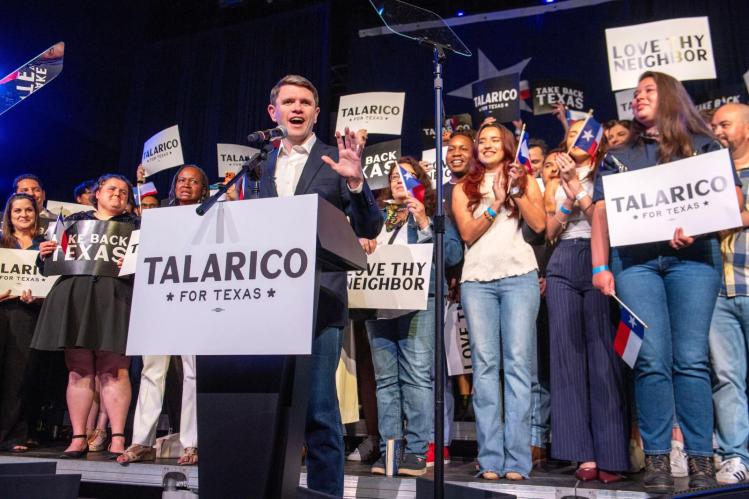
A few months ago, a trusted source emailed me insisting I listen to Ezra Klein’s podcast interview with Texas Democratic senate candidate James Talarico. “I’ve never heard a politician speak so clearly, authentically, and movingly about his own faith and of the contribution that faith perspectives can bring to civic life,” he wrote. At the time I knew less about him than I did about his opponent, U.S. representative Jasmin Crockett, in the then-upcoming March 3 Democratic primary. Talarico would go on to beat Crockett, whose barbed and energetic attacks on Donald Trump and other Republicans had won her a wide following among Democratic voters distraught over their party’s lack of fight. To the extent I had thought about Talarico, he’d reminded me of Beto O’Rourke, whose failed campaigns for senate in 2018 and governor in 2022 (following an abandoned presidential bid in 2020) were lessons in dashed hopes: the value of being a media-anointed Democratic it-boy is limited in deep-red Texas. But Talarico, the son of a minister and a Presbyterian seminarian himself, has already separated himself from figures like O’Rourke. He’s that much talked-about but famously elusive creature: the Democrat who leads with his faith.
The title of Klein’s podcast episode nods to Democrats’ yearning for such a figure: “Can James Talarico Reclaim Christianity for the Left?” Talarico appeals not only to the liberal viewers of MSNow but also to the religious voters agitated by the political hijacking of Christianity by Trump-aligned Evangelicals and Catholics. This dynamic also informed Talarico’s February appearance on Stephen Colbert’s show, an interview that CBS, now deferential to Trump, blocked from airing after the FCC applied pressure. (Colbert’s show will not be returning after this season.) MAGA Republicans seem to fear Talarico, while Democrats, increasingly confident about their midterm chances, embrace him. The Colbert segment was posted to YouTube, where it has garnered nearly 10 million views.
But does Talarico’s appeal stem from his own traits and qualities as a potential senator, or is he popular because he can hit the MAGA crowd where it hurts? In other words, are his champions as guilty of instrumentalizing faith in something like the same way they accuse MAGA Republicans of doing so?
Talarico is steeped in testaments Old and New. Snippets of Scripture and the Gospel thread his stump speeches, and biblical allusions are a regular part of his media appearances. In speaking with Colbert, he made casual and knowing reference to Matthew 25, 31-40; it was easy to hear the lines “whatsoever you do to the least of my brothers, that you do unto me,” though neither host nor guest needed to say it explicitly. Talarico links this to the fight against economic inequality: the real toxic divide is not political or cultural, but between the wealthy and the rest of us. “Love God and love thy neighbor” are the two commandments Talarico says he finds the most important, insisting that these can inspire and unite the part of the electorate that, Republican and Democrat, is being left behind as the rich continue to get richer.
But “reclaiming Christianity for the left” is different from winning in Texas. Talarico’s opponent won’t be decided until a May 26 primary runoff between incumbent John Corbyn and Ken Paxton, the scandal-plagued Texas attorney general. Talarico takes recognizably Democratic positions on fair wages, labor unions, gun control, and immigration. He strongly opposes Paxton’s order forcing public schools to post the Ten Commandments in every classroom (a measure that was upheld by a federal appeals court in April) and introducing time for daily Bible reading. He decries Christian nationalism: “I’m a Christian, but I know that the most dangerous form of government is theocracy.” He thinks the Beatitudes might be a better example to follow and has said he’d rather see “all of us look inward and figure out how we can be more Christlike.” He’s been criticized both for speaking about his faith too much and for unorthodox theological and scriptural claims: God is nonbinary; women should have legal access to abortion given that God asked Mary’s consent before the conception of Jesus. Evangelicals and other religious conservatives go as far as to accuse him of blasphemy.
The primary race between Talarico and Crockett generated huge Democratic turnout, and Talarico has raised $27 million this quarter. But Republicans have the advantage in raising money from outside groups—and continue to hold the electoral edge in Texas, where they still outnumber Democrats. Current polls show Talarico leading both Corbyn and Paxton in theoretical matchups, but no Democrat has won statewide in Texas since 1994.
Despite the electoral realities, it’s hard for commentators not to posit the race as a referendum on the real political meaning of Christianity. “Texans Will Decide if Jesus Was a Lefty” was the headline of a recent article on Talarico by Elizabeth Bruenig at The Atlantic. Of course, what Texans will actually decide is simpler: whether they want more of the same or are persuaded by the alternative Talarico represents. But because of who Talarico is, the race is unavoidably inflected with religion and morality, and with stakes for the remainder of Trump’s presidency. Talarico’s candidacy comes as Pew reports that a majority of Americans view their fellow citizens as morally bad, making the United States an outlier among the twenty-five countries it surveyed—a pretty distressing indictment. Then there’s the Trump administration’s unjust war in Iran; its unapologetic embrace of violent, theocratic tropes; its antagonism toward Pope Leo; its disastrous and inhumane program of mass deportation; and its disdain for any policy or posture that hints at compassion—an attitude that has come to characterize Republican “governance” in general.
“Love thy neighbor” isn’t the rhetorical red meat that some Democrats are hungry for, nor does it necessarily point to a robust set of progressive policy proposals. But the positive response to Talarico’s call to kindness shouldn’t be all that surprising when kindness is in such short supply. He still has several months to show Texans why his faith-informed perspective on public service is not just another instrumental tactic, but a path out of our toxic politics.
We welcome your comments about this article. Please send your response to letters@commonwealmagazine.org.


No comments:
Post a Comment