
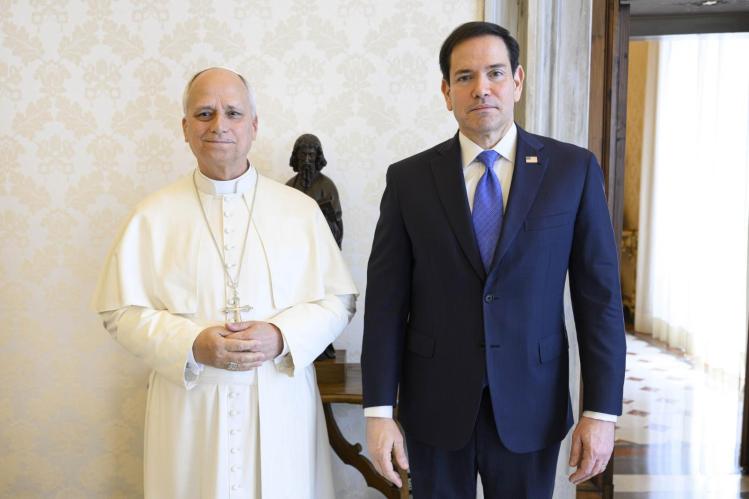
On Thursday, Secretary of State Marco Rubio visited the pope in Rome. The timing of the visit was as newsworthy as the visit itself. For weeks, Pope Leo has been a vocal critic of the U.S. war in Iran. And not surprisingly perhaps, there are now vocal critics of the pope’s criticism back here in the United States. “When every war is presented as unjust, it becomes harder to explain why any particular war is,” laments Matthew Schmitz. Dan Hitchens of First Things regrets that Pope Leo is “almost” a great leader, but for his shortcomings on this issue:
It’s not necessary to relitigate the fascinating arguments about the Book of Joshua, the centurion in the Gospels, King Alfred, St. Louis IX, St. Joan of Arc, the Battle of Lepanto, the Siege of Vienna, the liberation of Nazi-occupied Europe, and any number of thought experiments regarding the tangled and bloody threads of the conflict in the Middle East to make the point that the Holy See is not currently the first place to look for theological rigor.
It is notable that Hitchens’s list ends with World War II. He fails to mention the Church’s support for the United Nations in the aftermath of that conflict. Leo’s Catholic critics tend to focus on just-war theory, while ignoring the support of the last several popes for international law and some kind of world government. This support greatly informs how these popes have viewed modern wars.
For half a century, popes have condemned war in sweeping terms—war itself, not just this or that specific war. In 1965, Pope Paul VI stood before the United Nations and said, “Never again war, never again war!” In 2003, on the eve of the Iraq war, John Paul II spoke to the Diplomatic Corps in the Vatican: “No to war! War is not always inevitable. It is always a defeat for humanity.” In an Angelus address in 2007, Pope Benedict XVI declared: “War, with its aftermath of bereavement and destruction, has always been deemed a disaster in opposition to the plan of God, who created all things for existence and particularly wants to make the human race one family.” And in 2013 Pope Francis, during a Vigil for Peace, said: “War always marks the failure of peace, it is always a defeat for humanity.”
Were all these popes ignorant of just-war theory? Were they pacifists? Were they naïve? Or have they just been careless when talking about theology, as Vice President Vance suggested with respect to Pope Leo?
The modern papal support for world government has roots in the pontificate of Pius XII. In his Christmas address of 1939, delivered as World War II was just beginning, Pius called for peace treaties and postwar disarmament, for “international institutions” to be “created or recreated,” and for a world order that would allow itself to be informed by “divine statutes” lest they become a “dead letter.” Two years later, in his Christmas address of 1941, Pius outlined the five terms for a “new order that all peoples long to see realized after the trials and ruins of this war,” which included disarmament, the prohibition of total war, and religious liberty.
Pius’s successor, Pope John XXIII, cites Pius several times in his 1963 encyclical, Pacem in terris (“Peace on Earth”). Published in the wake of the Cuban Missile Crisis—which John XXIII had a hand in defusing—the encyclical argues that advances in science and technology, as well as the increasing interconnectedness of the global economy, mean that “no State can fittingly pursue its own interests in isolation from the rest.… The prosperity and progress of any State is in part consequence, and in part cause, of the prosperity and progress of all other States.” Beyond the practical need for a coordinated world government to avoid conflict, “there will always be an imperative need—born of man’s very nature—to promote in sufficient measure the universal common good.”
Pope John’s point was that the new material conditions of the twentieth century, together with the perennial moral law imprinted in “man’s very nature,” called out for a world government of one sort or another. At the time, John believed the United Nations was a good model for such a government, and the encyclical concludes with a nod toward the organization. A strong United Nations, the pope hoped, would mean that war itself should become less necessary and harder to justify. The popes are not pacifists—Leo himself said so last week—but they do recognize that war always causes great harm and evil, even when justified, and that it should always be a last resort. The UN should help arrange alternatives to that last resort.
Papal support for the UN does not mean that the popes no longer respect national sovereignty, or that they are calling for a “United States of the World.” Moreover, they recognized, like everyone else, the major role that one particular nation, the United States, played in building up the United Nations. The main hope for the United Nations is that it would provide the legal foundation for better relationships between nations.
In the past, self-styled “neoconservative” American Catholics have been critical of Pacem in terris for not recognizing that a muscular U.S. foreign policy would be necessary to accomplish its goals. George Weigel argued that the encyclical presented a noble ideal but an “inadequate analysis of the obstacles to that vision’s realization.” Instead, as Weigel argues in his book, The Fragility of Order (2018), Pacem in terris should be interpreted to mean that “it is in the American national interest to defend and enlarge the sphere of order in international public life, through prudent efforts at changing what can be changed in the trajectory and conduct of world politics.” In practice, this has meant that neoconservatives support the United States instead of the United Nations as the organizing force best able to “enlarge the sphere of order.” But it is clear that the popes themselves have never believed in this unipolar conception of world order. Here, for example, is Pope Benedict:
[I]t is important to prevent one single power from presenting itself as the guardian of the law, for it is all too easy for one-sided interests to come into play, making it harder to keep justice in view. An urgent requirement is a real ius gentium, a “law of nations,” without disproportionate hegemonies and the actions to which these lead. Only so can it remain clear that the cause at stake is the protection of the rule of law on behalf of everyone, even of those who are fighting on the other side, so to speak. It was this that made the Second World War a convincing enterprise, and it was this that created a genuine peace between former enemies. (“Searching for Peace: Tensions and Dangers”)
The unipolar idea of the United States as the world’s “guardian of the law” collapsed after the Iraq war, but not before greatly damaging the United Nations’ credibility. President Obama’s intervention in Libya, along with his drone program, put another nail in the coffin. Putin’s invasion of Ukraine all but buried it. Trump does not even pretend to care about the United Nations. Nevertheless, Pope Leo continues to champion the UN’s global authority.
The key word for Leo’s statements about world affairs has been “multilateralism.” As he put it in his May 2025 speech to the Diplomatic Corps: “there is a need to give new life to multilateral diplomacy and to those international institutions conceived and designed primarily to remedy eventual disputes within the international community.” Again, world-weary military strategists might roll their eyes at the pope’s remarks. But the UN still matters even if it doesn’t have much hard power. As George Scialabba recently wrote in these pages, “the mere existence of the United Nations would remind even the most lawless of the great powers of the organization’s ultimately prudential rationale: to serve as a brake on the apparently irresistible tendency toward interstate conflict, with its increasingly world-threatening consequences.”
Papal support for the United Nations also has an important implication for just-war theory itself—and this is why Marco Rubio should not expect to change the pope’s mind about the Iran war. One of the principles of the theory is that a war must be declared by the legitimate authority. When it comes to any sort of humanitarian intervention—say, stopping a genocide in Bosnia—the legitimate authority that the popes have recognized is the United Nations and not any particular state. Only the UN may approve military action for humanitarian purposes.
This respect for the United Nations as a legitimate global authority is why, for example, in 2003 then-Cardinal Ratzinger argued that, even if an intervention in Iraq were justified, “it is necessary that the community of nations makes the decision, not a particular power.” Ratzinger also affirmed that the United Nations is the legitimate representative of that community of nations. The United Nations, he said, “is the instrument created after the war for the coordination—including moral—of politics,” and it is the institution that “should make the final decision.”
One would not expect Pope Leo to support even a humanitarian intervention in Iran—much less the kind of war the United States is actually waging—unless it was first approved by the United Nations. Perhaps Leo’s critics think this is naïve. The United Nations certainly does not have the same prestige it enjoyed when Pacem in terris was written. But its loss of authority is at least partly the result of U.S. foreign policy, which has flouted international law almost as often as it has invoked it.
We are entering an era when, as Leo put it recently, “war is back in vogue.” The best-case scenario for the near future would be gray-zone warfare waged mainly by drones. The worst-case scenario would be what U.S. military strategists call a war between “Near-Peer Adversaries” (e.g., the United States and China). Imagine the hellscapes of Mariupol and Gaza on every continent. Many strategists and political leaders seem to believe that war between the great powers is inevitable, and they look forward to a world without the pretense of respect for international law. In light of all this, Leo’s critics need to answer this question: What is their alternative vision for world order? How would they defend the principles of Pacem in terris? The Iran war signals the end of the old order of U.S. hegemony, but not yet the creation of a new one.
We welcome your comments about this article. Please send your response to letters@commonwealmagazine.org.


No comments:
Post a Comment