
Just Policing
Interested in discussing this article in your classroom, parish, reading group, or Commonweal Local Community? Click here for a free discussion guide.
While I have been a Catholic theological ethicist for nearly three decades, I have also worked in the criminal-justice system, both as a correctional officer at a metropolitan maximum-security jail and as a reserve police officer. I remember how, during the Reagan administration, the closing of mental-health facilities and programs forced many people with mental illness onto the streets and into jails. As sociologist Alex S. Vitale observes in his book The End of Policing, “One of the most tragic developments in policing in the last forty years has been the massive expansion of [the police’s] role in managing people with mental illness and other psychiatric disabilities.”
Vitale notes that “studies suggest that anywhere from 5 to 20 percent of all U.S. police incidents involve a PMI [person with mental illness], and that these incidents…are more likely to result in arrest.” Moreover, he reports that 20 to 25 percent of people killed by police exhibit signs of mental illness, meaning they are almost sixteen times more likely than others to be killed by police. Sometimes, those seeking help from the police are instead killed by them. Sonya Massey, a Black woman, was shot by an Illinois deputy after she called 911 to report an intruder. There was no intruder; she appeared to be experiencing a mental-health crisis.
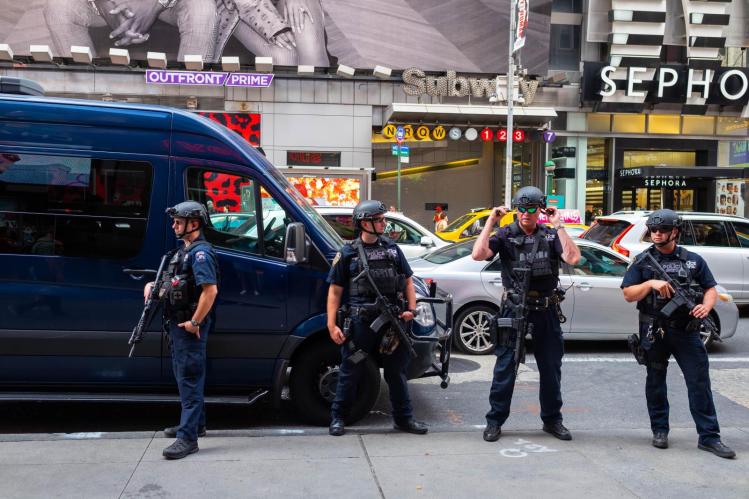
Many sociologists and criminologists attribute these disturbingly disproportionate deaths to the policing model now prevalent in the United States—namely, a military or warrior model which centers on the use of force. As Vitale observes, police “are trained to see the potential threat in any encounter and to use their presence, body language, and verbal commands to take care and to react quickly and aggressively to any threat of violence or the presence of a weapon.” American police officers are also armed now more than ever, and their firearms training in the academy and after occupies far more of their time than anything else, including training on how to deal with persons suffering from mental illness. That approach to policing, Vitale adds, tends to “escalate and destabilize encounters.”
This need not be the case. “In the United Kingdom and other places where police are less likely to be armed,” Vitale notes, “this dynamic is less common.” Not only do police in the United Kingdom and Ireland learn how to disarm persons with knives and other weapons, but they receive more training on mental illness. They also are more likely to have mental-health liaison officers and mental-health nurse practitioners in police dispatch rooms, as well as street triage teams with a nurse accompanying responding officers. As Vitale puts it, “The overall attitude is one of care rather than threat neutralization.”
In the United States, by contrast, the tendency of police to respond to an apparent threat with deadly force is so strong that those experiencing mental distress can rely on it to commit “suicide by cop.” This phenomenon is extremely rare in Ireland and the United Kingdom, where police are much less likely to be armed, are better trained in nonlethal methods, and are more likely to be accompanied by a civilian mental-health worker.
After the murder of George Floyd by a Minneapolis police officer five years ago, there were calls for “defunding” and “abolishing” the police. Others instead sought to change policing as we know it. While Vitale appears to urge the abolition of policing, the “end” he has in mind in his book’s title is not the elimination of police but the purpose (or telos) of police in society. He calls for a rethinking of policing’s “basic role,” “orientation,” “mindset,” “mission,” and “culture,” and a transformation toward a “larger vision.”
In The Ethics of Policing, John Kleinig proposes a “social peacekeeper” model of policing, which is consonant with community policing. This model “acknowledges the nonnegotiable force at police disposal,” but stops short of making it into “the police raison d’être.” Public safety is conceived of as a partnership between police, citizens, and other groups. This model is “broad enough to encompass most of the work that police do, whether it is crimefighting, crime control, or interventions in crisis situations. But what is more important is the irenic cast that it gives to police work.”
He traces this model to 1829, when Sir Robert Peel created the “New Police” of metropolitan London. In The Queen’s Peace: The Origins and Development of the Metropolitan Police 1829–1979, David Ascoli writes that Peel “was stubborn to the point of obsession that his ‘New Police’ should be seen to be free of all taint of militarism.” They were unarmed and wore “a quiet” blue uniform rather than the red coat of the military. In his “General Instructions,” Peel emphasized, “The basic mission for which police exist is to prevent crime and disorder as an alternative to the repression of crime and disorder by military force.”
This model was transplanted to New York City in 1845 and then spread to Boston and Philadelphia. Police were unarmed, and departments did not recruit from the military, because most Americans, writes Robert M. Fogelson in Big-City Police, held “a strong conviction that the police should have an essentially civilian orientation.”
But that all changed after the Civil War, when the surplus of firearms found its way into the hands of the police. During the 1920s, militarization escalated as police armed themselves to deal with gangsters. And it gained further traction during the 1970s and 1980s with the so-called “wars” on drugs and crime. Although reforms toward a community-oriented approach gained support under the Obama and Biden administrations, the Trump administration has “unleashed the police,” militarizing them more than ever.
There are signs of hope: places where police reform is taken seriously and police are trained to listen, de-escalate, and be a part of their community. Vitale highlights Memphis, where a small unit of specially trained police officers are routed to 911 calls involving persons suffering from mental illness. Partnerships are being forged, including with mental-health professionals.
The collaboration between the police department and the mental-health first-responders organization Crisis Assistance Helping Out on the Streets (CAHOOTS) in Eugene, Oregon, is another prime example. “In many cases,” Vitale writes, “it is the civilian mental health workers who take the lead, with police there only to assist if absolutely necessary.” He acknowledges that “these interactions can be dangerous” and may require the use of force, although it should be minimal and constrained. As CAHOOTS member Henry Cakebread says, “We’re lately presented as an alternative to the police, but we couldn’t do our job without the police. They underscore our safety.” According to Vitale, “These teams have shown good results in both reducing arrests and the use of force and in reducing hospitalizations as well, since they can make a more complete assessment and take steps to stabilize the person and connect them to appropriate outpatient services.”
This approach is consonant with Pope Francis’s words to Italian police officers during an audience in Vatican City in June 2017. He emphasized “your vocation is service,” and he highlighted how their mission “is expressed in service to others” through their “constant availability, patience, a spirit of sacrifice and sense of duty.” Instead of viewing those suffering from mental illness as a threat to be neutralized, the peacekeeper model—what I call just policing—can help fulfill the duty to serve them.
This article was published alongside two others in a symposium
about the Church and mental illness. The other contributions can be
found here:
“The Vision of Baptism” by Peter K. Fay
“The Idol of Autonomy” by Meg Kaveny


No comments:
Post a Comment