
Regional
International priests fill vital roles in keeping Diocese of Greensburg operating
Diocese ‘would look a lot different’ without their service, Bishop Larry Kulick says
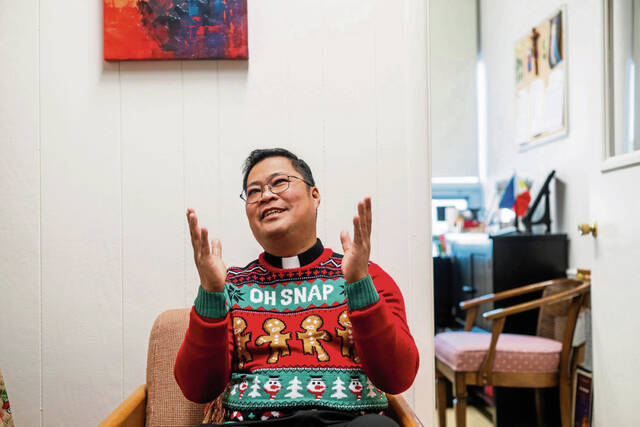
After more than a decade of educating aspiring Catholic priests in his native Philippines, the Rev. Jay Jacinto was ready for a change.
Jacinto, 48, was ordained in 2005. He worked in the Philippines for 17 years before volunteering to serve abroad in 2022. A year later, the bishop of his home diocese assigned him to the Catholic Diocese of Greensburg.
“I was nervous. I was afraid,” Jacinto said, “but then I just saw it as a new challenge for me, a learning experience and an opportunity, of course, to be able to share the goodness of Christ.”
There is no shortage of priests in the Philippines, Jacinto said. But that is not the case in the United States, which saw a 40% decline in total number of priests between 1970 and 2020, according to a 2024 report from the Center for Applied Research in the Apostolate.
The Diocese of Greensburg is no exception. Without the support of international clergy, Bishop Larry Kulick says he wouldn’t be able to staff the diocese’s parishes.
When the diocese first formed, splitting off from the Diocese of Pittsburgh in 1951, it had 114 parishes, 121 priests and about 170,000 church members across its four counties — Armstrong, Fayette, Indiana and Westmoreland.
Today, there are 78 parishes, 71 priests and about 133,000 members, according to spokesperson Cliff Gorski.
Those numbers would be even lower without the support of international clergy, Kulick said. About one-third of the diocese’s priests — 24 — are from foreign countries.
“You take away our international priests, I don’t know what I would do to staff parishes,” he said. “Parish life would look a lot different.”
Monsignor James Gaston suspects church consolidations and closures — which he called deaths — would become more common without international priests.
“If [parishioners] continue to practice their faith, they’d have to move to a neighboring or nearby church,” said Gaston, director of the diocese’s international priest program.
Take the diocese’s four parishes in New Kensington and Lower Burrell, for example.
Three international priests — the Revs. Elpido Alcontin, Dick Anthony Cortado and Rodolfo Mejia Jr. — help fill the parishes’ needs. Mt. Saint Peter, St. Joseph, St. Mary of Czestochowa and St. Margaret Mary churches could not be adequately staffed without them, Gaston said.
“They’d have to have a drastically reduced (Mass) schedule,” he said, “and whether or not they can be maintained long term with the already declining population, those are matters for planning in the future.”
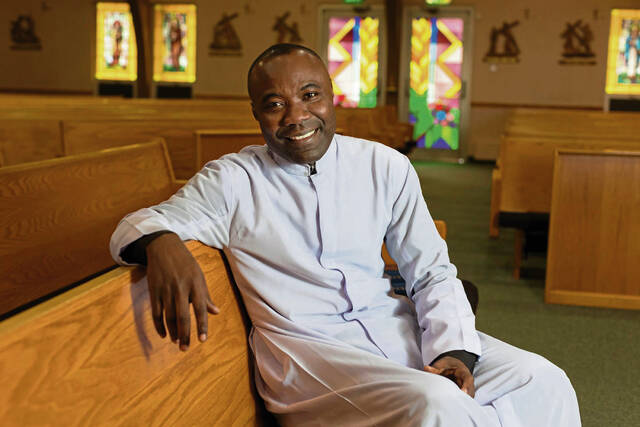
International priests fill clerical gaps
Since being named bishop in 2020, Kulick has worked to keep open as many churches as possible. A decreasing regional population and, subsequently, a declining local economy have made that difficult, he said.
Between 2010 and 2019, population declined 6.3% in Armstrong, 5.4% each in Fayette and Indiana, and 4.4% in Westmoreland, according to the Pennsylvania State Data Center. That represents a loss of more than 32,600 people.
“You can have the best policies. You can have the most faithful people,” Kulick said. “If you don’t have jobs, you don’t have desirable living conditions, and you don’t have population, you’ve got one hand tied behind your back.
“That’s the challenge that I think we’re facing, but it’s a challenge that — talk to fire departments, talk to fraternal organizations, talk to people even in local communities trying to get people to run on a ballot, to fill a ballot for school board or mayor. The demographic is really starting to affect us.”
The diocese’s international priest program, launched in 2010 by Bishop Lawrence Brandt, is helping to address the issue.
Priests from across the globe volunteer to serve five-year missions, not knowing where they will be sent, Gaston said. After a series of virtual interviews, Kulick works with the bishop of the priest’s home diocese to determine if they are a good fit for Greensburg.
Bringing an international priest into a parish comes with a transition period, Gaston said.
“I think initially, (parishioners) are reluctant, are standoffish,” he said, “because the main criticism is it’s hard understand them through their accents and their pronunciation of American English.
“But little by little, what I’m discovering is they’ve learned to come to love and respect the international priests. There’s a growing relationship there, mutually.”
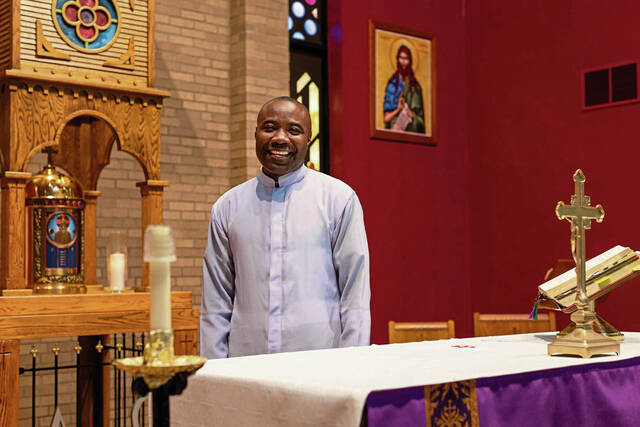
Nigerian priest looks fondly on experience
One of the diocese’s international priests is the Rev. Anthony Onoko, who leads St. John the Baptist Parish in Perryopolis, St. Sebastian Parish in North Belle Vernon and Epiphany of Our Lord Parish in Monessen. Onoko, 44, came to the diocese from his home country, Nigeria, in 2020.
Seven years after being ordained, Onoko volunteered to serve a mission outside of his home country. He was grateful to be assigned to the Diocese of Greensburg, fulfilling his childhood dream of moving to the United States.
“It’s a world power,” Onoko said. “I think I really like that. They have a lot of people of great faith here — good people, kind people.”


No comments:
Post a Comment