
11 February 2020, The Tablet
Pope plays down expectations on married priests


Pope Francis was speaking to the US bishops, making their 'ad limina' visit to report on their dioceses.
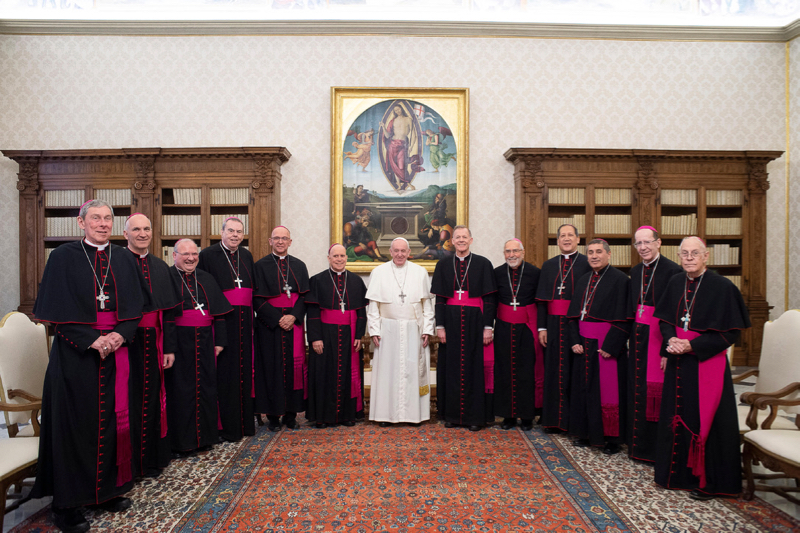
Pope Francis is
pictured with U.S. bishops from Arizona, Colorado, New Mexico, Utah and
Wyoming during their "ad limina" visits to the Vatican Feb. 10, 2020.
Photo: CNS/Paul Haring
Photo: CNS/Paul Haring
The Vatican will release "Querida Amazonia", Beloved Amazonia, the pope's post-synodal document, tomorrow.
The document came up in the two-and-a-half-hour discussion Pope Francis had with bishops from New Mexico, Arizona, Colorado, Utah and Wyoming yesterday two of the bishops said. The bishops were making their "ad limina" visits to Rome to report on the status of their dioceses.
As is his normal practice, Pope Francis told the bishops they could talk about whatever issues they wanted to raise, offering him information, asking him questions or even critiquing him, as long as the critique remained in the room.
Archbishop John Wester of Santa Fe, New Mexico, told Catholic News Service the pope told the bishops: "I want to hear what you have to say. Criticisms, complaints and questions are welcome. That's how the Holy Spirit works. The Holy Spirit can't work if we're all walking on eggshells and afraid to say anything."
The clerical sexual abuse crisis, immigration, polarisation in society and in the church, training seminarians, the ministry of bishops and the role of women in the church were among the topics discussed, several bishops said.
Bishop Oscar Solis of Salt Lake City said Pope Francis did not go into detail about "Querida Amazonia" but he did give the bishops the impression that the issues of ordaining married men and women deacons for ministry in far-flung communities would still be a matter for future discussion and discernment.
"He said he didn't actually believe in the ordination of married men, but what are you going to do with all those people who are deprived of the Eucharist," the bishop said. There are communities where a priest arrives only once a year for Mass.
Archbishop Wester said: "A lot of the media sometimes will glom on to something because it fits a particular agenda, or it sparks a particular controversy that they know is going to kind of bring a lot of future business."
The archbishop told CNS that Pope Francis was asked for "a clarification" about the synod.
"The pope, very gently and very calmly, said, You know, this point was really not a big point," although it did come up, the archbishop said, without saying whether the issue was married priests, women deacons or something else. The gist of the pope's response, the archbishop continued, was "I don't even think at this point that it's something we're going to move on because I haven't sensed that the Holy Spirit is at work in that right now."
Retired Bishop Gerald Kicanas of Tucson, Arizona, said having met almost all the US bishops for "ad limina" conversations since November: "I'm sure he's gotten an earful."
The bishop said he believes the pope has specific hopes for the church in the US.
"I think he senses that there's a kind of, his phrase would be, a spiritual worldliness that has taken over and not having the sense of living my life in a sacrificial way, in a serving kind of way, in a giving kind of way, in a generous way," Bishop Kicanas said.
"My impression is that he sees the United States is very blessed, but perhaps needing to learn how to share those blessings and how to be bring those blessings to the service of others," he said. One example of that, the bishop said, is immigration. "He would love to see countries do their part, not everybody can do everything and there are limits to what any country can do. But we do our part."
Highlight how "all of us are immigrants", Pope Francis told the bishops: "As I look around the room and listen to your names, none of you are Native Americans so we need to realise that most of us have come from elsewhere," Bishop Kicanas said. The pope "would like to see a more generous society, a more giving society, a society that's attentive to those who are in need."
"The gifts that women bring, it's so important not to exclude that, but to include that in our various schools and parishes," the archbishop said.
The pope also discussed the sexual abuse crisis and the need for the church to not only help survivors heal, but to heal itself.
"A wound has been opened, and in some cases, reopened" – for example, because of grand jury reports – "but we see that as providential in that Christ can help us now to heal," Archbishop Wester said. "You have to open the wound in order for the healing to take place."
While it is painful to look back at the abuse that occurred in the church, Archbishop Wester said the bishops "need to look so we can learn from history, to learn from our mistakes."
And in a world marked by "polarisation, that division," Bishop Solis said, Pope Francis emphasised the role of the bishop as a builder of unity, a person who must be willing to listen to a diversity of opinions, pray about decisions and trust the Holy Spirit will guide the discernment.
"He values differences of opinion," the bishop said. "I think he must have heard about the lack of civility" that seems to be afflicting public discourse in the United States. "People don't discuss anymore" but move immediately to "looking at each other with hatred".
Bishop Solis was celebrating the 16th anniversary of his ordination as a bishop and said he spent it "engaging in a very, very personal and beautiful, Spirit-filled conversation our Holy Father, Pope Francis. It was the best gift I've ever received in my life. I forgot all my problems."


No comments:
Post a Comment