
05 September 2018 | by Christopher Lamb
The Tablet
Culture wars
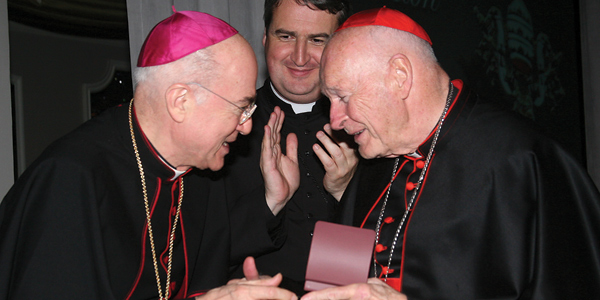
Archbishop Viganio (left) and the then Cardinal McCarrick at an event in 2012
Vatican in crisis
On 7 April 2018, in a nondescript conference room down in the bowels
of Rome’s Church Village Hotel, Cardinal Raymond Burke was midway
through a speech on the limits of papal power.Speaking in Italian and reading from a pre-prepared text, the United States’ cardinal, a prominent critic of Pope Francis, started to explain the process of how to correct the Roman Pontiff. As he spoke to the crowd of several hundred, there was an outbreak of clapping and cheers before a small group suddenly shouted out: “People of God, stand up! We are the ones who have to act!”
It was a striking display of how visceral and vitriolic opposition to the 266th Successor of St Peter has become – and all of it at a location just two miles from the Vatican.
Among the audience in the hotel conference room was Archbishop Carlo Mario Viganò, the former papal ambassador to Washington who, four months later, would launch his own broadside against Pope Francis.
While Cardinal Burke’s reflection that April afternoon concentrated on the canonical and theological limits to a pope’s power, Viganò’s 11-page testimony bypassed the niceties of theology and went straight for the papal jugular, calling on Francis to resign.
The explosive central charge made by the 77-year-old retired Vatican diplomat is that he personally told the Pope in June 2013 that Cardinal Theodore McCarrick had “corrupted generations of seminarians and priests”, and that Pope Benedict had ordered him to withdraw to a life of prayer and penance.
Dig a little deeper into this saga, however, and you find that it also revolves around the idol of power, the love of which the Pope has railed against, with his many condemnations of clericalism. According to Francis, it is the concentration of power in the hands of a church elite that is at the root of the sexual abuse crisis and its assorted cover-ups.
However, a powerful and vocal group disagrees. Already opposed to Francis for having loosened the regulations over giving communion to divorced and remarried Catholics, they argue that child abuse is linked to the large number of gay men in the priesthood and claim a powerful “homosexual current” exists in the Vatican. Add to this the Pope’s perceived softness on the “gay issue”, and his allergy to the Church becoming embroiled in ideological wars against the legalisation of same-sex marriage and abortion, and the roots of the angry opposition to Francis become a little clearer.
In his j’accuse against Francis, Archbishop Viganò uses dramatic and forthright prose to rail against “homosexual networks” inside the Church and accuses several high-level figures in the Vatican of knowing about the “pervert” McCarrick’s abuses; he targets the Pope’s closest US allies – many “blinded by their pro-gay ideology” – with a slew of accusations.
As of Tuesday morning this week, the Vatican had not made any official comment on Viganò central claims, following the Pope’s strategy not to “say a single word” about the accusations.
In his homily in the chapel of his Santa Marta residence on Monday morning, he repeated that the only response to those who seek division and scandal is “silence” and “prayer”. Senior figures in the Vatican are also refusing to talk to journalists on the record about Viganò’s claims, presumably in the hope that the truth about the situation will eventually become clear.
But the 81-year-old Jesuit Pope has been caught in a bind by his former envoy to Washington’s testimony. If he engages with his allegations, he runs the risk of being entangled in a never-ending “he said, she said” battle. However, saying nothing looks as though he might have something to hide. The other problem, Vatican sources tell me, is this: should the Pope respond to Viganò, it would inevitably lead to searching questions being raised about the actions of his predecessors, Benedict XVI and St John Paul II, which he does not want to precipitate. According to Viganò, it was under the Polish pope that the allegations of misconduct by McCarrick first became known to the Vatican, while Benedict seems to have been unable or unwilling to discipline the well-connected former Archbishop of Washington.
Archbishop Viganò, described by one source as a “meticulous record keeper”, has so far produced no evidence for his claim that Francis knew that McCarrick was a serial predator and “covered for him to the bitter end”. Yet, his bombshell has created an unpleasant, and often vicious atmosphere in some parts of the Church. The anger that was expressed in that conference room in April has been evident on social media this week. Such is the febrile environment in Rome that several commentators became convinced that during the 29 August Wednesday General Audience, a portion of the crowd chanted “Viganò! Viganò!” This turned out to be false: the chants were “Italo! Italo!” and came from a group of students from Lucca, who were calling out to their Archbishop, Italo Castellani, who was up on the audience stage with the Pope.
This fevered, highly polarised and at times ugly environment has obscured a calm and balanced analysis of Archbishop Viganò’s document. As a Vatican diplomat, trained for a life of loyal service to the papacy and the former holder of one of the Holy See’s most prestigious foreign service postings, it is not possible to dismiss his claims as coming from a fringe figure. Any assessment revolves around Viganò’s claim that Benedict XVI, in 2009 or 2010, placed the then Cardinal McCarrick under sanctions when allegations of abusive behaviour came to his attention. Archbishop Viganò says that he informed Francis of these sanctions during a meeting on 23 June 2013.
There is well-documented evidence that McCarrick kept up an active schedule of engagements after the alleged restrictions were put in place, frequently travelling across the globe and even being publicly praised by Viganò at a May 2012 event as “loved by us all”. Whatever the sanctions were, they were unenforced, and Archbishop Viganò now says they were kept private. There is also no suggestion from Viganò that Benedict or Francis or the Vatican had known about allegations that McCarrick had abused children or minors. When a credible accusation that the former cardinal had committed sexual offences against a minor became known, Francis authorised his removal from ministry and his expulsion from the college of cardinals. McCarrick now faces a canonical trial.
A careful reading of the Viganò testimony also shows that, according to Viganò himself, it was the Pope who initially raised the question of McCarrick when they met privately for 40 minutes in the Pope’s apartment on 23 June 2013. Francis knew McCarrick as a protector of the Institute of the Incarnate Word, a religious order founded in Argentina by a priest who would be found guilty of sexual misconduct with adults in 2016. As Archbishop Jorge Mario Bergoglio, Francis had disassociated himself from the Institute, even though McCarrick would fly into Argentina to perform ordinations for the order.
McCarrick, a power-broker in the global church, may also have felt able to flout any restrictions placed on him due to powerful protectors inside the Vatican, such as Cardinal Angelo Sodano, the Holy See’s long-serving former Secretary of State. McCarrick had a reputation as an extraordinary fundraiser. In 1988, he had helped set up the Papal Foundation, which has raised many millions from wealthy US Catholics to support special projects of the Pope.
How much did this have to do with his promotion and protection from the highest levels inside the Church? Viganò’s testimony states that the Vatican became aware of allegations against McCarrick at the end of 2000, when Cardinal Sodano was operating the levers of power as Secretary of State, and at the same time as McCarrick’s appointment as Archbishop of Washington.
The US prelate went on to be named a cardinal in 2001, before being allowed to ease into an active retirement in 2006 despite the payment of settlements in 2005 and 2007 to two former seminarians or young priests who had accused him of harassment or misconduct. Cardinal Sodano, now 90, has been accused of protecting the institutional Church when it comes to abuse, and was a known protector of the notorious abuser – and prestigious fundraiser – Fr Marcial Maciel, founder of the Legionaries of Christ. It is now looking increasingly likely that there will be an inquiry into how McCarrick rose up the ranks of the Church.
Meanwhile, many in the Vatican are calling Archbishop Viganò’s credibility as a reliable witness into question: his evidence, it has to be argued, must be read in the context of his opposition to Pope Francis. Two Vatican media advisers, Fr Federico Lombardi – a former Director of the Holy See Press Office – and Fr Tom Rosica have disputed Viganò’s account of the meeting at the nunciature during the 2015 papal visit to the United States between the Pope and Kim Davis, the county clerk jailed for refusing to issue marriage licenses to same-sex couples.
Even among opponents of Francis there are growing doubts about the quality of Archbishop Viganò’s testimony, which was written “shoulder to shoulder” with the Italian journalist and Francis critic Marco Tosatti. Benjamin Harnwell, the Director of the Dignitatis Humanae Institute, which is backed by Cardinal Burke and Steve Bannon, former strategist to President Donald Trump, has publicly questioned Viganò’s credibility. Mr Harnwell has called Viganò’s claim that Cardinal Renato Martino, his institute’s honorary president, is part of the “homosexual current” in the Vatican, a “smear” and a “slur”.
Five-and-a-half years ago the cardinals elected a Pope who took the name of St Francis of Assisi, the saint of poverty, humility and peace, whom the crucified Christ called on to “rebuild my Church”. The Church that Francis leads needs to be rebuilt in the wake of the abuse scandal and the cover-ups, which he believes can only be done through an honest, collective taking of responsibility, without indulging in mutual recrimination. If even some of Archbishop Viganò’s claims are correct, and the cover-up of McCarrick’s abusive behaviour over many years had reached the highest levels of the Church, then nothing less than a radical upending by Francis of the old ecclesiastical power system, including its shielding of wrongdoers, will be needed before the foundations for a renewed Church can be laid.


No comments:
Post a Comment