
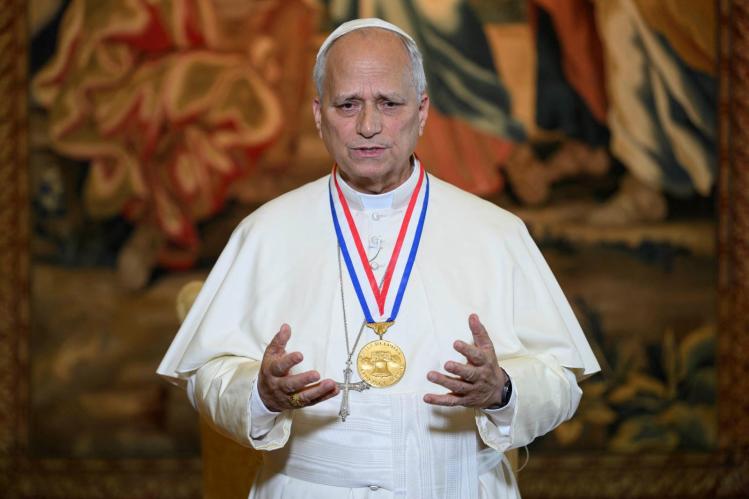
“A country’s vitality is deeply tied to the value it affords to human life in every form and condition.” Accepting the National Constitution Center’s Liberty Medal on Friday, Pope Leo XIV emphasized the United States’s promise to uphold human dignity.
The award, which “honors men and women of courage and conviction who strive to secure the blessings of liberty for people around the globe,” had already been presented in person to Leo at the Vatican in April. In Friday’s unique gathering, he addressed the assembled crowd remotely, as civic and religious leaders honored the pope and reflected on the meaning of freedom and human dignity. What I didn’t expect—though perhaps I should have—was Leo’s illuminating synthesis of political freedoms, the imago Dei, care for the vulnerable, and the nature of true peace.
Before Leo gave his address, political leaders—including Pennsylvania governor Josh Shapiro, state attorney general David Sunday, and Philadelphia mayor Cherelle Parker—stood alongside leaders of various religious communities in Philadelphia, many of whom are members of the nonprofit organization Interfaith Philadelphia. Imam Quaiser D. Abdullah reminded those gathered that the government does not create human dignity: “At its best, government recognizes it, protects it, and builds the institutions that prevent the powerful from violating that dignity.” Rabbi Jill L. Maderer reflected on the Book of Micah’s description of freedom: “We may sit in safety beneath our own vine and fig tree, that none shall make us afraid.” Reverend Carolyn C. Cavaness, pastor of Mother Bethel AME—a church on the oldest parcel of land continually owned by African Americans in the United States—insisted that God calls us all to freedom: “Our traditions sing different verses of the same liberation song…. Faith is most faithful when it serves the least, the last, and the left out.” Archbishop of Philadelphia Nelson J. Pérez took up this last point: Leo’s life and work, he said, have been “marked by a desire for genuine encounter with all people and filled with the compassionate love of Jesus Christ. That love unconditionally embraces the stranger, the immigrant, the poor, the unhoused, the sick, those struggling with addiction, and all those in need.”
Then Leo appeared on screen, sitting in a chair and looking on a large screen at the Philadelphia crowd. He smiled and waved gently. “From our youth, most of us have admired the eloquence” of the Declaration of Independence and its ideals, he began, “with their resounding appeal to the law of nature and to nature’s God…. While couched in the language of the Enlightenment, that claim is ultimately grounded in an understanding of the human person inspired by the great biblical vision of man and woman being created in the divine image.” Human dignity, grounded in our God-given nature, “precedes the establishment of any State, and whose custody constitutes its very purpose.”
Institutions, laws, and political rights are necessary to protect human dignity—for everyone, without exception—and the state must pay special attention to the rights of those whose dignity is under threat. “The moral greatness of a nation is manifested, above all, in its capacity to support, protect, and cherish the lives of all, especially the most vulnerable and those whose worth is questioned.” Leo was not shy about what this commitment to human dignity can look like in the political realm. Reverence for life, the first right that the founders established, should inspire us to “safeguard [this] gift from the moment of conception to natural death.” America became a “byword for freedom,” he insisted, as it “opened its doors to successive waves of immigrants, enabling them and their children to play their part in shaping the future of the nation.”
The ceremony itself attested to the ideal of e pluribus unum—the truth of human dignity and respect for rights echoes through different traditions, and can be articulated in both civic and religious language. This diversity, Leo suggested, should engender not conflict but peace, a word he used five times in his brief remarks. There is a certain strain of American patriotism that sees violence as inherent to protecting our rights—“freedom isn’t free,” for example, or, quoting Jefferson, “The tree of liberty must be refreshed from time to time with the blood of patriots and tyrants.” This strain can lead Americans to respond to challenges and crises in violent ways. Leo didn’t say that violence can never be justified in a free society; he suggested, rather, that the natural state of a society in which everyone’s rights are protected is not vigilance or violence but good will, dialogue, and peace.
In the leadup to the semiquincentennial, Leo declined Donald Trump’s invitation to spend July 4 in the United States, instead opting to visit the island of Lampedusa in Italy, one of the primary landing points for migrants making the dangerous crossing of the Mediterranean from Africa. It’s a not-so-subtle message: on a day we celebrate our political freedoms, we must acknowledge the deeper truth of human dignity that gives rise to them. Just across the street from the Constitution Center at Independence Mall, the blank space on a wall where a display about slavery was taken down on Trump’s orders is a stark reminder of the current administration’s disdain for the country’s ideals and its failures to protect human dignity.
In recognizing the dignity of others, especially those who are different from us, we are moved to defend their rights—that is the foundation of peace. Leo concluded his remarks: “I commend all of you, as well as the future of the Nation, to the One who is himself the source of true freedom and lasting peace, the One whose very name is Peace.”
We welcome your comments about this article. Please send your response to letters@commonwealmagazine.org.


No comments:
Post a Comment