
Editorial: Following schism, SSPX leaders must work for unity
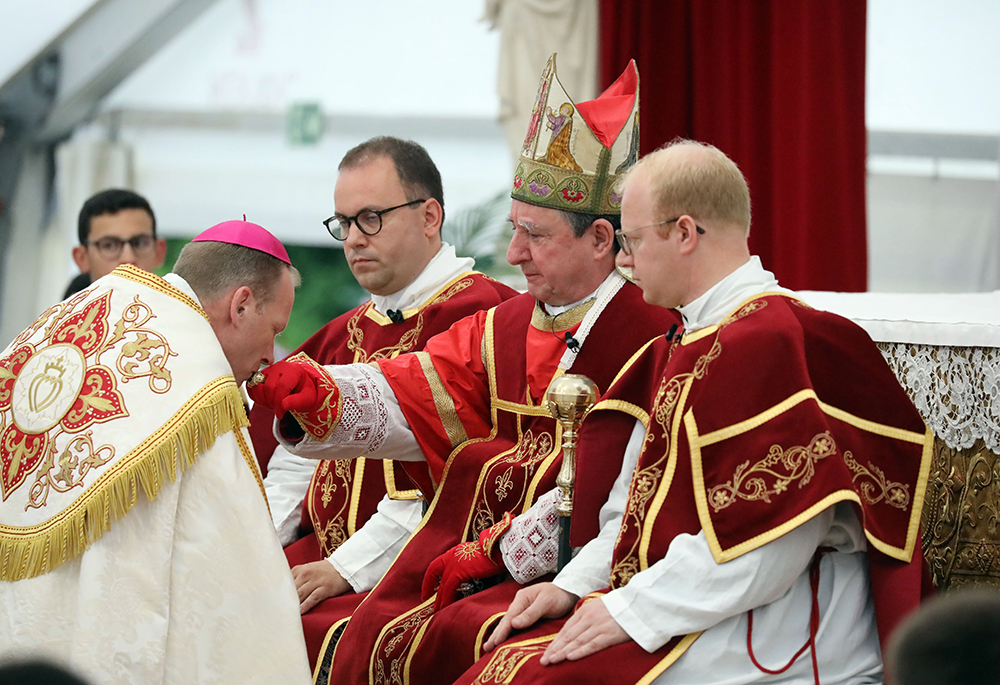
Newly consecrated Society of St. Pius X Bishop Michael Goldade is seen kissing the ring of Bishop Alfonso de Galarreta during an SSPX liturgical celebration July 1, 2026, in Écône, Switzerland. (OSV News/CPP)
Church unity does not mean everyone holding hands singing "Kumbaya." It also doesn't mean pretending a problem doesn't exist.
Sometimes it means telling people they are out because they did not abide by the rules.
That's what Pope Leo XIV recently did with the Society of St. Pius X, known as SSPX, known for celebrating the Latin Mass and rejecting some of the church's Vatican II reforms.
In a move not done lightly July 2, the Vatican announced that the SSPX clergy had brought upon themselves an automatic, or latae sententiae, excommunication because they consecrated bishops without papal approval. It also said the group was in schism with the Catholic Church and that sacraments of penance and matrimony administered by SSPX priests were invalid, and lay Catholics who "adhere formally" to the group were similarly excommunicated.
It's not as if they hadn't been warned that their ceremony without papal blessing would have consequences. The day before the Mass — attended by over 15,000 people at the foothills of the Swiss Alps where the group's international seminary is located — the pope himself had pleaded with them not to do this.
His letter to the head of the society, Fr. Davide Pagliarani, did not mince words saying the ceremony would be akin to tearing "the seamless garment of Christ" and "a sin of extreme gravity."
SSPX leaders went ahead with their plans in a four-hour Mass and thereby cut themselves off from the church.
NCR's Vatican correspondent Justin McLellan's coverage of the consecrations and reaction from laypeople who attended it shows that the situation is serious and complicated. Those he spoke to might not have been NCR readers, but they certainly share our faith tradition and a camaraderie with each other over their similar beliefs. Some grew up in SSPX families and this was the only church they knew.
Many there seemed unfazed by the Vatican's direct edict and were confident that the society was doing the right thing.
A woman from Mexico City, for example, told McLellan she was in a place where her ideas were aligned and "no one is moving me from there," and by no one, she meant the pope.
Given the group's rejection of many Vatican II reforms and its troubling history — the Anti-Defamation League describes SSPX leaders as promoting "theological and conspiratorial anti-Semitism among its adherents" — this excommunication might be celebrated in some circles.
But we do not take a triumphant view about what unfolded. Instead, we look to the voices of those who see this rupture as a sad moment, particularly several U.S. bishops, since in the U.S., alone, there are more than 100 SSPX chapels and 28 schools.
This hit close to home for two dioceses in the Midwest.
One of the newly ordained, now excommunicated bishops, Michael Goldade, grew up in St Marys, Kansas, and for about seven years he was prior of the SSPX church, St. Vincent de Paul, in Kansas City, Missouri, which is not officially part of the Kansas City-St. Joseph Diocese but is located in its boundaries.
The bishop there, James V. Johnston Jr., said the illicit ordinations of four bishops without a papal mandate was "unfortunate and indeed, a source of grief." The U.S. headquarters of SSPX in Platte City is also located within this diocese.
On his Facebook page July 2, Johnston stressed concern for the SSPX members in his diocese and said he wanted to reassure them of his pastoral concern and "desire to assist you in this time of crisis."
Archbishop Shawn McKnight of the Archdiocese of Kansas City, Kansas, which includes St. Marys, Kansas, home to what the SSPX claims is the largest SSPX-built church in the world, The Immaculata, spoke more in depth about the schism and its local impact in a July 2 statement.
McKnight called what transpired "a source of profound sorrow for the whole Church" and said it was "particularly sorrowful because the Holy See has, for many years, sought reconciliation and full communion with the Society of Saint Pius X." He also said the imposed "canonical penalties" were "not intended as expressions of hostility or rejection, but as medicinal measures that reflect the seriousness of the offense and are ordered toward repentance, healing, and the eventual restoration of communion."
He urged those in his archdiocese who attend SSPX services to "know that they are loved by the Church and remain the object of our prayers for unity." He also asked them to stay united with the pope and to seek guidance from local priests about any questions they might have about the validity of sacraments they may have received.
Advertisement
He also went a step further to say that the "Church's doors remain open, and our hope remains that the unity for which Christ prayed may one day be fully realized."
We say "Amen" to that, recognizing that the decisions of the SSPX leadership have had major implications and their actions will need to be unpacked, and in some cases, undone, if the group seeks to have unity with the Catholic Church.
Richard DeClue, a theology professor at the Word on Fire Institute who has written about the society's history, emphasized how Catholics who share many of the group's "concerns and confusions" will be impacted by the schism.
"Those people deserve to be treated pastorally as well," he told Our Sunday Visitor. "They shouldn't feel like orphans within their own Church just because they love tradition, and they love magisterial teachings from decades ago, and they love the traditional liturgy that’s part of their conciliar U.S. Church’s liturgical heritage."
Similarly, Michael Sean Winters wrote recently in these pages, that sympathy for these faithful is warranted. But he also said: "We need have no sympathy for the men who permitted themselves to be consecrated nor those who performed the ritual in Écône. They should know better." They should know how their leadership has led their followers to a place of schism.
Massimo Introvigne, an Italian religion sociologist who has studied SSPX, thinks that despite this rift, dialogue will resume.
"The dialogue, at least under the table, will continue," he told Catholic News Service. "But to have a meaningful dialogue, some things should change," he said, including changes in SSPX leadership.
And that's what we will keep our eyes on.


No comments:
Post a Comment