
For several days in late June, a black Ford F-250 pickup with Wyoming plates took over multiple parking spaces on a street in my Brooklyn neighborhood. An outsized exhibit of compensatory masculine menace—knobby tires, raised suspension, bulging fenders—it was for good measure bristling with aggressively pro-Trump bumper stickers, decals, and banners. There were warnings and wisecracks about immigrants and trans people, the “Biden crime family” and “stolen” elections, the deep state and “leftist communist Democrats”—who, one message further declared, “suck.” Another wittily likened “wokeism” to sexually transmitted diseases. More than one depicted Trump as Jesus. Many insisted not only on the right to own firearms, but the duty to use them. “Don’t California My Wyoming,” said another, in petulant summation. Resting on its haunches like an AI-generated cryptid, the truck appeared ready to leap at the first passerby heedless enough to utter a liberal platitude. I took consolation in the fact that high gas prices resulting directly from the president’s war of choice in Iran would make the drive home a very expensive one.
Of course, it was only a truck. Wyoming is home to 590,000 people. Though that’s less than one-tenth the population of New York City, it stands to reason that not all of them share the opinions of that particular driver. Liz Cheney, for instance. Or Cheyenne bishop Steven Biegler, who this spring issued a letter to his diocese—which encompasses the entire state—urging compassion for immigrants targeted by the Trump administration, pointedly titled “Be a Merciful Neighbor.” (My colleague Heidi Schlumpf interviewed Biegler for a recent episode of The Commonweal Podcast.)
Cheyenne is also the seat of Wyoming’s government, a fact planted into my brain via the rote-memorizing exercises typical of middle-school education a half-century ago, this one requiring every fifth grader to learn all of the state capitals. Annapolis, Atlanta, Augusta, Austin, Baton Rouge…. Fifty years later, reciting the list can bring calm during anxious, insomniac nights. Back then, it seemed like something that schoolchildren all around the country might be doing. Learning essential facts about these United States seemed to link everyone my age and added to the collective sense of excitement around the Bicentennial.
Bicentennial-related field trips and projects took up much of that spring. In history class, we did a multiday reenactment of the Second Continental Congress, based mostly on what we’d gleaned from watching the 1972 film 1776 (adapted from the 1968 Broadway musical), which was shown in the school auditorium over the course of a week. It was already a chestnut then, but no one knew enough to notice or care. The drama of the signing of the Declaration of Independence—with music—consumed the entire fifth grade. The energy carried over into the classroom, set up to look like Independence Hall, with desks draped in green tablecloths and topped with candlesticks borrowed from home. Some of us even wore costume powdered wigs, available for purchase along with all the other Bicentennial-themed kitsch then being sold in stores everywhere.
It was, in retrospect, rather innocent, even if at that age we weren’t entirely sheltered from the world around us. It was hard not to have heard something about Watergate or Vietnam or the assassination attempts on President Gerald Ford. But years would pass before we learned of McCarthyism or Japanese internment camps or what the dropping of atomic bombs meant for the people of Hiroshima and Nagasaki, to say nothing of the facts of “Operation Wetback” or the Johnson-Reed Act or the Tulsa Race Massacre or the role of the United States in toppling governments in Chile, Iran, and elsewhere. Those—and numerous other inconvenient truths dating back to the founding—were necessarily left for later. In the meantime, we mimicked dialogue and sang lyrics from 1776: “A resolution—on independency!” For ten- and eleven-year-olds, it was fun to be a patriotic American.
But a child’s patriotism isn’t an adult’s patriotism, which by its nature is a trickier proposition. The difficulty “lies with loving one’s country in the right way,” Adlai Stevenson wrote in a 1963 essay, an excerpt of which appears in the current issue of Harper’s Magazine. Though “the love itself is profound and instinctive, rooted in the childhood delights of being alive,” it ultimately demands something else—a “more complex and discriminating love.” Stevenson was writing in the lingering shadow of McCarthyism and amid the rise of Birchism, malignant examples of a “superpatriotism” that “denounce[s] honest divergences as akin to treason.” Citing what he called the essentially conservative nature of our country (“for no nation in history has had so much to conserve”), he also warns that “to defend every abuse, every self-interest, every encrusted position in the name of love of country—when in fact it is only love of the status quo—that is the lie to which any conservative society is prone.” Inaction and mere reaction are not enough. “Our society can stand a large dose of constructive criticism,” he insists. “The patriots are those who love America enough to see her as a model for mankind. This is not treachery but the truest and noblest affection.”
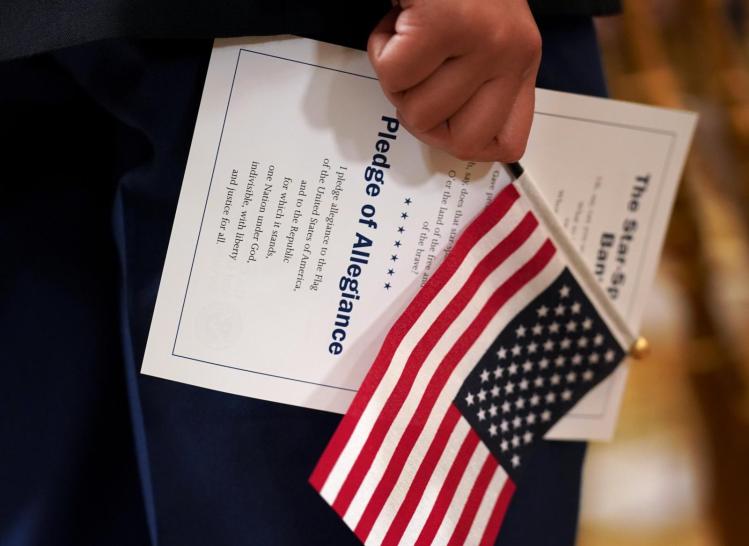
True and noble affection seems in short supply. New Gallup data shows that just over half of those surveyed are proud to be American—the lowest since Gallup began asking the question in 2001. It certainly isn’t evident, despite the president’s furious attempts, in his joyless, resentment-filled “celebrations” of America’s Semiquincentennial. Nor does it figure in the administration’s florid denouncements of honest divergences on matters of great significance to the American people: the unjust and illegally conducted war in Iran; indiscriminate mass deportations; the chilling of free speech; the attack on voting rights and threats to free and fair elections; the continued dismantling of social safety net programs as wealth further concentrates at the top, which itself poses dangers to our democratic form of government. Trumpism evinces no familiarity with concepts like nobleness or affection, to say nothing of truth. It celebrates selfishness, juvenile jingoism, cruelty, and mendacity. What it presents as American patriotism is a curdled, unrecognizable version that rightly elicits ridicule, scorn, and, in some cases, worry—not just here but also abroad. Though Trump and his supporters are certain not to care, the country that once stood as a beacon to all the rest is now held in far lower regard than it was before he returned to office. According to a new Pew report, global trust in the United States is down, and significantly, thanks to him, with fewer people viewing the country as a reliable partner amid widespread concerns about its foreign policy and the health of its democracy. True and noble affection should manifest as a desire to make your nation an inspiring example rather than an aspiring pariah—but that sensibility must be present to begin with.
Another lesson about patriotism that many have noted is this: a healthy love of country begins with being grateful for the good fortune to live in it. I didn’t learn this only in school or books. Parents, relatives, and neighbors who understood the difference between honoring an ideal and worshipping an idol—even if they didn’t articulate it as such—also played a part. They did so through their actions: getting up, caring for children, going to work, coming home, being kind to others, constantly reminding us that whatever advantages we had didn’t make us better than anyone else.
I can be angry at that Wyoming truck owner for hogging space and advertising his ignorance. If I cannot understand his desire to be a jerk, I cannot deny his right to act like one. Maybe one day he’ll change his ways. There are all kinds of people in this country, as is obvious in the crowds at every roadside rest stop, national park, public beach, airport security line, and Fourth of July fireworks show. That in itself still suggests something of a model for mankind. As hard as it can be these days to do so, we must still try to be thankful for it.
We welcome your comments about this article. Please send your response to letters@commonwealmagazine.org.


No comments:
Post a Comment