
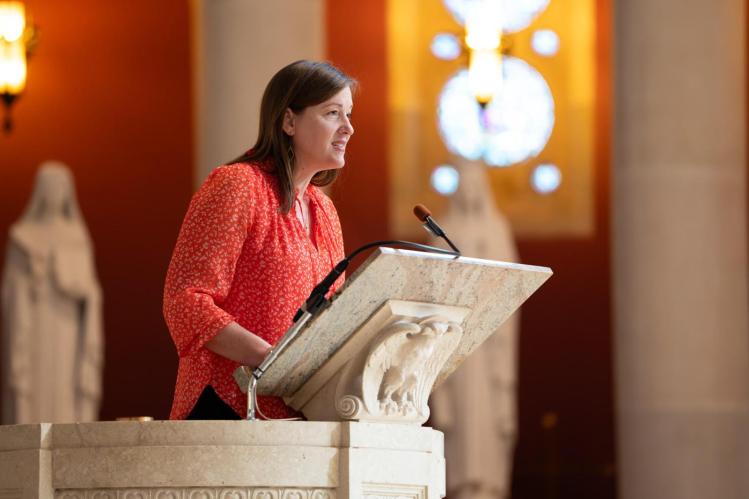
Sarah Watson grew up only a few houses from the Catholic parish and school that were the center of her family’s life. As a high schooler, she taught religious education, and after college became a youth minister and worked in Catholic schools. She has had “a call to be part of spreading God’s Word my whole life,” she says—one that has only intensified over time. “As I’ve grown and aged, it’s become clearer that I have things to say.”
But even as a young child, Watson noticed that women weren’t in the pulpit. Now, as assistant superintendent of Catholic schools for the Archdiocese of Indianapolis, she regularly reflects on Scripture as part of her job and has preached at parish retreats and missions. Last year, she became part of the first cohort of a new program to train laywomen preachers. She is convinced of the need to uplift diverse voices in the Church, including through women preaching during Mass.
For decades, many Catholics have been calling for the expansion of lay liturgical preaching. Canon law currently allows lay preaching in other contexts, but does not allow lay ministers to preach the homily at Mass. Now, with the continuation of the synodal process under Pope Leo XIV and the creation of a new study group focused on liturgical issues, the Church may finally be ready to open this ministry beyond the ordained priesthood and diaconate. It’s not just an issue about equal opportunities for women and laymen; it’s about the need for better preaching, which requires diverse voices in the pulpit. And if ever there were a need for prophetic preaching in our parishes, it would be during this time of existential threat to our social fabric.
“I think God is calling us to set the Word afire within people’s lives, which would lead to action toward a world that more mirrors the image of what God has dreamed of, the reign of God,” said Ann Garrido, an associate professor of homiletics at Aquinas Institute of Theology in St. Louis. “To do that, we need to reach the broadest group of people, with different kinds of preaching and more than one voice.”
Garrido is part of a group of twenty-seven Catholic leaders from around the world who recently called for an expansion of liturgical preaching to qualified laypeople. The group, which included theologians, ecclesiologists, preachers, and a canonist, met for four days in St. Louis in 2024 for a symposium on the topic. Using prayer and the synodal process of “Conversation in the Spirit” to discern, they wrote a “Proposal for Lay Eucharistic Preaching to Further a Synodal Church in Mission.” The proposal makes two recommendations: one, to amend canon 767 to allow “properly prepared laity” to preach the homily, along with priests and deacons; two, to expand the use of installed ministries such as lector and catechist and to create a new ministry of “lay preacher.”
The group submitted the proposal to the U.S. bishops’ conference and the Vatican synod office in spring 2024, and its influence was apparent in the Synod on Synodality’s preparatory document, which called for expanding lay ministries, especially for women. “There is also a call for adequately trained lay men and women to contribute to preaching the Word of God,” the synod document said.
After the 2023 and 2024 global meetings in Rome, the synod members did not come to consensus about expanding lay preaching. But they did call for a study group to examine “celebratory styles that make visible the face of a synodal Church,” including liturgical preaching. That study group’s first report, released in December 2025, included among its list of questions to address: “How can the modes of liturgical preaching be reinterpreted from a synodal perspective?”
But some advocates of lay preaching believe synodality should not just be a way to interpret liturgy, it must also be expressed in liturgy. For Layla Karst, associate professor of theological studies at Loyola Marymount University in Los Angeles, that means moving from a model in which clerics preach and laypeople passively listen to one in which all the baptized are called to “honest speech” and humble listening. “If synodality is a constitutive dimension of the Church, as Francis has claimed, this cannot only be reflected in the ways the Church conducts itself outside of liturgical celebrations. Our liturgies must also be genuine and authentic expressions of this synodal Church,” she said in her presentation at the symposium.
Karst cited three scriptural examples of people from the peripheries who were called to spread the good news: the Samaritan woman, Mary Magdalene in the garden, and the disciples on the road to Emmaus. Such voices from the peripheries are needed in our liturgies today, and their absence challenges the Church’s credibility. Allowing lay preaching in the pulpit during Sunday liturgy—where most Catholics hear reflections on Scripture—would model that the Church is serious about “walking together,” as Pope Francis described synodality.
An expansion of lay preaching would not mean that every person would be eligible to give a homily at Mass. Formation is necessary for preachers, and those who preach—including those who are ordained—should be educated on Scripture, have strong speaking skills, and demonstrate emotional and spiritual maturity. Surveys of U.S. Catholics regularly find dissatisfaction with parish preaching; a 2020 study from the Pew Research Center found that only 32 percent of Catholics said they were “very satisfied”—lower than any Protestant group. Even Pope Francis chimed in on the need for better homilies, suggesting that too often they are too long and unfocused.
To support better preaching, the Lilly Endowment philanthropic foundation has made more than one hundred grants of at least $1 million each to Christian organizations through its Compelling Preaching Initiative since 2022. Among the Catholic grantees is a new program to train laywomen preachers called “Proclaim,” a collaboration between Saint Mary’s College in Notre Dame, Indiana, and Discerning Deacons, a group working to restore women deacons in the Catholic Church. Notre Dame’s McGrath Institute for Church Life and St. Thomas More Church in St. Paul, Minnesota, are also partners in the program. Twenty-seven women from eighteen dioceses are currently working toward a certificate in Catholic Preaching and Ministry of the Word through Proclaim’s twenty-two-month hybrid program of online courses, regular meetings with “formation companions,” practical experience in “preaching circles,” and a summer in-person intensive at Saint Mary’s College.
The idea for the project grew out of Discerning Deacons’ listening sessions for the Synod on Synodality, in which nearly eight thousand people shared their experiences and aspirations for the Church. A repeated concern: more women’s voices, especially in preaching. “The hunger for a women’s perspective is very deep,” said Lisa Orchen, Proclaim’s program director. “We hardly ever hear the Gospel preached through the lens and life of a woman. We’re missing so much. We need all the voices: ordained voices, lay voices, men’s voices, women’s voices, the religious, and the married.”
Proclaim doesn’t take a position on lay liturgical preaching, instead focusing on the many avenues where laywomen can already preach. For example, laypeople can preach at retreats, in adult faith formation and Bible study in parishes, in college and high-school campus ministries, and in hospitals and prisons. They can preach as part of Liturgy of the Hours, even as part of children’s Liturgy of the Word, if the priest authorizes it. But too often, women are less likely than laymen to be invited to do even these allowed reflections because laymen hold more visible positions in the Church than laywomen.
Orchen believes that as more Catholics experience preaching from a woman’s perspective and find it spiritually nourishing, the hunger will only grow. The goal at Proclaim is to “widen the imagination” by equipping women with skills and providing pathways for their preaching. “Preaching is more than the homily,” Orchen said. “Let’s focus on what we can do.”
For now, the Proclaim program focuses on women, but supports lay preaching overall. Of course, laymen who feel called to preaching have the option of pursuing diaconal ordination, since deacons can preach during Mass. Restoring a female diaconate would also solve the problem of bringing women’s voices into liturgical preaching, but movement on that issue seems either stalled or glacially slow.
In the early Church, Christians preached because they received the gift from the Spirit and were confirmed in that gift by their community. As clergy and laity began to be more strictly differentiated, Church laws restricted preaching to clergy, bishops, and some heads of religious orders. At the Fourth Lateran Council in 1215, unauthorized preaching was declared heretical. Preaching was equated with teaching doctrine, and did not include reflection on the day’s scriptures, as it does today. The Second Vatican Council emphasized the importance of Scripture, especially in liturgy, and laid the foundation for lay preaching by focusing on the priesthood of all the baptized.
After the 1983 Code of Canon Law allowed laity to preach in some circumstances, lay preaching flourished in some dioceses where bishops, such as Matthew Clark of Rochester, New York, allowed it. But Church leaders’ concerns about the proper role of priests led to more restrictions. In 2001, the U.S. Conference of Catholic Bishops issued a decree that disallowed lay preaching at “the moment reserved to the homily.” After that, lay liturgical preaching in parishes faded.
But the hunger for women’s voices remained, and into the void came a project called Catholic Women Preach. In Advent of 2011, a group of women at the now-closed Woodstock Theological Center at Georgetown filmed a series of Sunday homilies for their email subscribers. Around the same time, the Church-reform group FutureChurch was developing a similar concept of video-recorded homilies as part of its Mary Magdalene celebrations. They joined together, and Catholic Women Preach officially launched in Advent of 2016 with theologian Jamie Phelps as the first preacher. Since then, the website has received more than 2 million views on its videos of 450 women preachers. The project has emphasized diversity, most recently featuring Latina and migrant women and activists in Advent 2025. Select homilies have been collected into a series of books edited by Elizabeth Donnelly, one of the original Woodstock preachers, and FutureChurch program director Russ Petrus.
Petrus and Donnelly see women’s preaching as a justice issue and part of wider Church-reform concerns, including the ordination of women as priests or deacons. “If they’re not going to let us be deacons, then you’ve got to get more laypeople involved in preaching at Eucharist,” said Donnelly. Petrus said that although “women’s preaching is a good in and of itself,” exposing Catholics to women on the altar also “can only amplify the calls for women to be ordained.”
But the organizers of Proclaim and the group advocating for expanding lay eucharistic preaching see the issue as separate from ordination. They focus, instead, on a theology that says all the baptized have responsibilities in the Church, not only through consultations such as the synodal process, but in spreading the Gospel, including through preaching, if the Holy Spirit gives them the gifts and the calling.
Rhonda Miska, who has a doctorate in preaching and serves as Proclaim’s lead cohort facilitator, takes a “both-and” approach. “Make the most of the opportunities that currently exist and preach where you can,” she said. “Then if something emerges in the future, women are prepared and equipped.”
It’s a sound strategy, but it assumes that reaching people will primarily still happen in the pews on a Sunday morning. “When we look at the current disaffiliation rates, we have to look outside [churches] because they’re not coming in,” said Kayla August, a doctoral student at the Clough School of Theology and Ministry at Boston College, whose work focuses on preaching. Today’s preachers, she said, should follow the model of Jesus, who preached outside of liturgical settings and met people where they were. In her work with young adults on a college campus, August has seen students moved to tears when they hear someone like themselves sharing their faith. “They realize that what they have to say about God matters too,” she said.
If preaching is, as Sam Sawyer, SJ, defined it, “believing out loud,” the best homilies will come from folks who feel called to share their faith in an authentic way. Expanding lay liturgical preaching would also reflect Jesus’ inclusion and the synodal mission of a Church that values all Christians’ participation. The idea that all voices matter should be preached in our Church—and modeled by putting laypeople in the pulpit.
We welcome your comments about this article. Please send your response to letters@commonwealmagazine.org.


No comments:
Post a Comment