
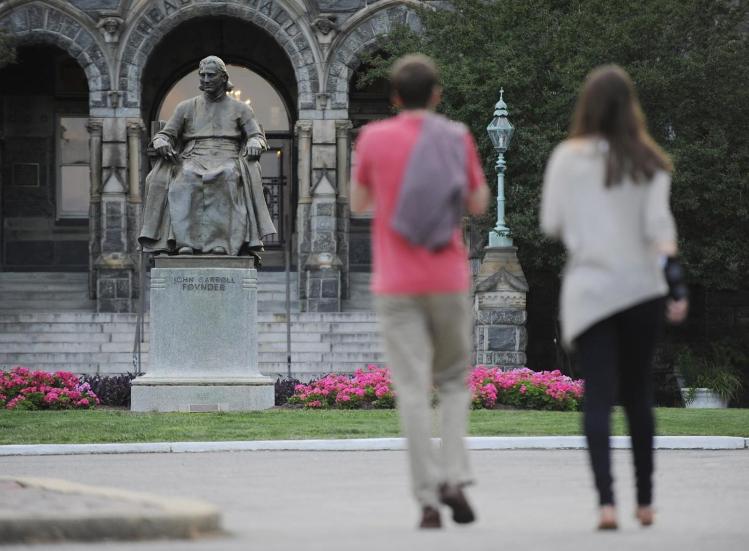
As graduates walked across the stage to receive their degrees at Lourdes University in Sylvania, Ohio, over Mother’s Day weekend, the ceremony was more poignant than usual. Lourdes is one of at least three Catholic colleges closing this year, part of a wider trend expected to claim hundreds of institutions over the next decade.
The closures are the result of declining enrollment, much of it caused by the “demographic cliff” of prospective college-age students, mounting financial challenges from decreased tuition revenue, and loss of federal grants and funding. Also closing this year are Ana Maria College in Paxton, Massachusetts, and Siena Heights University in Adrian, Michigan. All three institutions were founded by orders of religious women and prioritized serving poor and marginalized populations—unfortunately not a ticket to financial success.
Perhaps nothing could have saved smaller, fragile institutions such as Lourdes. But one researcher is convinced that Catholic colleges and universities would do better to focus on benefits beyond the “return on investment” of getting a high-paying job touted in higher education today. “Jobs are important, but the reduction of the human being and of education to money is dangerous,” said Jason King, the Beirne Chair of Catholic Studies and director of the Center for Catholic Studies at St. Mary’s University in San Antonio, Texas. “The real value of education is to think beyond that.”
It turns out that Catholic colleges and universities do focus on other outcomes, according to a multiyear national study led by King. The Holistic Impact Report study has found for two years in a row that graduates of Catholic institutions report higher rates of meaning and purpose in life, more community engagement, and an increased likelihood to involve morality in decision-making. Graduates were also more likely to report that their college experience provided a sense of community and encouraged faith-based discussions.
King contrasts those outcomes with the “return on investment” model of higher education underscored by school rankings that include graduates’ salary, net worth, and rates of home ownership. The 2016 comments of a Catholic university president who said struggling freshmen were bunnies who needed to be “drowned”—kicking some students out to improve retention rates—is just an extreme example of that mindset. While financial considerations are necessary, King says, the ROI model hurts both institutions and students. “It really challenges any Catholic mission that seeks to educate the whole person,” he said. “And it really is damaging to students, because you’re basically training them to be worker drones.” Tying a person’s value and worth to external markers such as a lucrative career increases anxiety, which already plagues this generation.
But King also differentiates this holistic approach from the approach taken by schools that highlight a traditionalist Catholic identity—one that earns them a spot on the Cardinal Newman Society’s guide to “faithful” colleges and universities. The society, founded in 1993, occasionally makes the news for opposing speakers at Catholic institutions; it focuses on issues such as abortion and LGBTQ rights. The college guide’s criteria for a faithful Catholic identity include single-sex dormitories; a policy against speakers who oppose Catholic moral teachings; weekly Mass and regular adoration and confession; rigorous theology and philosophy requirements; and a high percentage of board members, faculty, and students who are practicing Catholics. Among the recommended institutions are Ave Maria University in Florida; Benedictine College in Kansas; Franciscan University in Steubenville, Ohio; Christendom College in Virginia; the University of Dallas; and the Catholic University of America in Washington D.C.
King is not alone in finding this narrow definition of Catholic identity and its binary, “in or out” approach to be problematic, but his study’s focus on more holistic values provides a workable alternative. He doesn’t mean to create an opposing list of “progressive schools”; in fact, the study found higher rates of the values he examined consistent across ideologies, political affiliation, demographics, and location. But while some “trad” schools are touting their increased enrollment and fundraising, it’s helpful to have other criteria to understand the benefits of Catholic colleges, rather than just counting the number of hours of adoration on campus.
I don’t think it’s any coincidence that the holistic values of meaning and purpose, community engagement, and ethical decision-making are similar to the outcomes of a liberal-arts education. But as students are choosing other, potentially more lucrative majors, some Catholic colleges and universities are cutting liberal-arts majors, minors, and core requirements. Fordham University just announced a reduction from two required philosophy and theology courses to one each as part of its revised core program. St. Norbert College in Wisconsin, Manhattan College in New York, and Marymount University in Virginia recently eliminated theology or religious-studies majors. According to a study by the Association of Catholic Colleges and Universities, the number of member institutions with theology or religious-studies departments dropped to 63 percent in 2023, from 69 percent in 2016. The average number of required credit hours in theology also fell, from 5.1 to 4.5.
King believes theology could be key to the holistic values identified in his study, because it helps students think through big questions by drawing on the Catholic tradition. But the discipline would need to think differently, going beyond the “guild” mentality that encourages scholars to hyperspecialize and a “check the boxes” attitude toward core curricula. Instead, he believes theology departments should focus on what he calls “integral human flourishing” with courses on marriage, money, and work, for example.
These are challenging times for Catholic colleges and universities, especially smaller institutions that have prioritized educating women, Latino, first-generation, and nontraditional students. Finger-pointing that blames “feminized leadership” for “conflict-averse administrative cultures that impede clarity,” as this author in the Catholic periodical Crisis Magazine does, tries to provide a simplistic and sexist solution to a much more complex reality. Administrators who think that strengthening Catholic identity through the “more trad” route will be the ticket to financial success will likely find that the pool of hyperconservative Catholic families is limited. And a Wall Street, “drown the bunnies” mentality that focuses purely on ROI may “work,” but at a cost to mission.
The holistic-values approach offers concrete language and data about the ways faith-based institutions can not only educate but form young people for the challenges ahead. It may not save every school, says King, whose first teaching job was at Lourdes University. “They tried really hard to stick to their mission,” he said. “That was a better approach, even if they didn’t make it, than selling out.”
We welcome your comments about this article. Please send your response to letters@commonwealmagazine.org.


No comments:
Post a Comment