
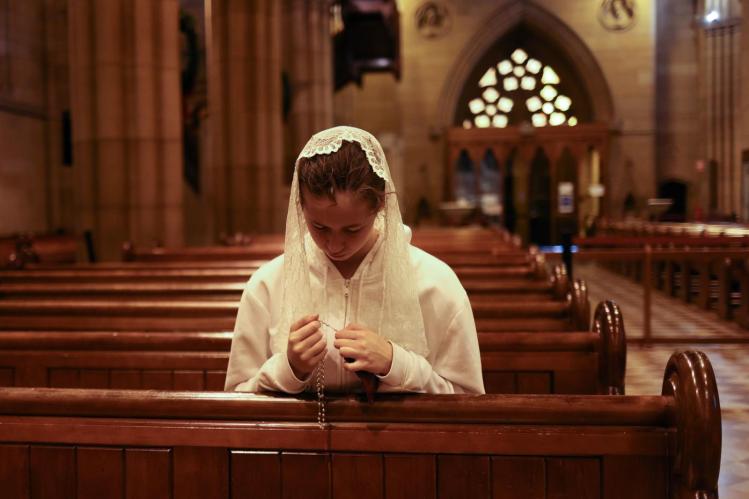
“I wish I liked Catholics more,” Sebastian Flyte confesses to Charles Ryder during a visit to Brideshead, the Flyte family estate, in Evelyn Waugh’s 1945 novel Brideshead Revisited. “They seem just like other people,” Ryder, an agnostic, responds. “That’s exactly what they’re not,” Sebastian objects. “It’s not just that they’re a clique—as a matter of fact, they’re at least four cliques all blackguarding each other half the time—but they’ve got an entirely different outlook on life; everything they think important is different from other people.”
If only he were right about that last part. I suspect that, among American Catholics at least, that “entirely different outlook” disappeared when we escaped the urban ghettoes, quieted Protestant suspicions about our patriotism, absconded to the suburbs, conquered higher education, and reveled—with a sense of longed-for vindication—in unprecedented affluence. But the fact of Catholics being divided into cliques seems as unalterable as the articles of faith themselves. Ryan Burge, who keeps track of the demography of America religion, has recently written in Arc about the correlation between being white and Christian and support for the Republican Party. Over the past fifty years, white Christians “have shifted decisively to the right,” Burge writes. This trend is especially pronounced among Evangelicals, but it also evident among Catholics—and across all age cohorts. Sadly, Donald Trump has won the white Catholic vote in all three of his presidential runs and seems to have enjoyed the favor of more than a few prominent U.S. bishops. Of course, this is not surprising. It has been true for some time that political views increasingly determine religious affiliation, not the other way around. Polarization in American society is as present in the pews as it is in the voting booth. Or, as it used to be said, the most segregated time in America is Sunday morning—only now we are segregated not only by race but also by politics.
I often come across anecdotal evidence of these facts in the parking lot of Catholic churches. Churchgoing Catholics, at least in my part of the world, seem inordinately fond of bumper stickers. Prolife messages are, of course, fairly common—and welcome. I have found especially cheering a sticker that loudly proclaims, “Try God!” But the messages can also be nakedly tribal and partisan. I was somewhat perplexed by a sticker on the back window of a pickup truck that proclaimed “God” on one side and “Guns” on the other. Running across the bottom was “Grady Judd.” What could explain this strange trinity, and who in the world was Grady Judd? Just below that bumper sticker was a “Word on Fire” sticker. I am not suggesting there is any correlation between Bishop Robert Barron’s “Word on Fire” evangelical outreach and gun idolatry, but clearly the owner of the pickup truck thought there was some spiritual affinity between the two messages. Well, people make mistakes all the time.
A quick Google search revealed that Judd is a popular Florida sheriff known for his steely law-and-order reputation. Trump is an admirer. Judd is known for his “tell it like it is” approach to crime and law enforcement. Asked why his deputies fired sixty-eight shots in a deadly confrontation with a murderer, he responded, “That’s all the bullets we had, or we would have shot him more.” Judd seems to be some sort of folk hero, and there are a whole host of Grady Judd stickers available online.
I confess that the apparent political allegiances and enthusiasms of many of my fellow Catholics, and many of the clergy, often leave me feeling chagrined and somewhat despondent. I understand why churchgoers welcome and admire police officers. When I lived in New York City in the 1970s, I was very grateful for the presence of police. The association of God with guns is harder to understand. Such sentiments remind me of the angry responses Commonweal used to get to its direct-mail solicitations, which were mostly sent to prospective Catholic subscribers. There was a lot of name calling. “Heretics” was a favorite term of opprobrium. These angry correspondents routinely dismissed Commonweal as “socialist” or “communist” or—what often seemed even more sinister—“liberal.” An especially popular accusation was that we naively believed what we read in the “anti-Catholic” New York Times. We were “dupes” and “elitists.” More industrious respondents would tape coins to the return subscription or fundraising form, hoping to increase Commonweal’s postage bill.
I became the object of this sort of invective when a profile of me appeared in Catholic Digest, just after I became editor of the magazine in 2003. The article had the unfortunate title “The Suspicious Catholic,” and while it praised certain of my attitudes and talents, it also noted that my wife is Jewish and that our children’s religious upbringing was unorthodox. The response of Catholic Digest readers was outrage and caustic denunciation. I was consigned to Hell—or what often sounded like something worse. When I later happened to meet the publisher of Catholic Digest, he sheepishly confessed that the magazine had never gotten so much hate mail about one article. I have often second guessed our decisions about the religious education of our children, but the vitriol of Digest readers—tainted with obvious anti-Semitism—only heightened my resolve at the time. As Scripture tells us, they will know we are Christians by how we love one another.
So, to quote Sebastian Flyte, on many days I wish I liked Catholics more, and I guess I wish my fellow Catholics had liked me more. Of course, Catholicism is not a magic elixir that turns adherents into good neighbors or citizens, let alone saints. I spent a year teaching religion in a diocesan high school, and the behavior of my Catholic students was enough to convince me that, as the saying goes, Original Sin is the only part of Christian theology that is empirically unassailable. My years as an editor at Commonweal opened my eyes to the fact that Catholic opinion is hardly monolithic; Catholics are indeed divided by “cliques all blackguarding each other half the time.” Let me hasten to add that I have known a good many conservative as well as liberal Catholics, and the moral virtues are about evenly divided between the two camps, although in my infallible opinion political wisdom is not. “As a historical force, religion has been neither simply good nor simply evil but has merely reflected human nature in all its dimensions,” the theologian David Bentley Hart has written. Charles Ryder was perhaps more right than wrong in thinking that Catholics “seem just like other people.” Hart goes on to write that “it is the sheer ‘impracticality’ of Christianity itself that interests me: its extraordinary claims, its peculiar understanding of love and service, which down the centuries have not so much dominated Western civilization as haunted it.” Sometimes that haunting is the most we can hope for.
We welcome your comments about this article. Please send your response to letters@commonwealmagazine.org.


No comments:
Post a Comment