
Eighteen months after Kamala Harris’s disastrous defeat, there are mounting expectations of a decisive victory for Democrats in November’s midterms—a “blue wave” that will seal Donald Trump’s lame-duck status. But a closer look at the range of truly competitive U.S. House districts reveals a more sobering picture. The number of vulnerable Republicans has held steady at around thirteen or fourteen, according to Cook Political Report. Flipping the House looks likely given the GOP’s slim five-seat majority, but to match their margin after the 2018 blue wave, Democrats need a net gain of twenty-three seats. Pickups elsewhere will depend on an extraordinary degree of anti-incumbent sentiment in places that have favored the GOP since the Tea Party era.
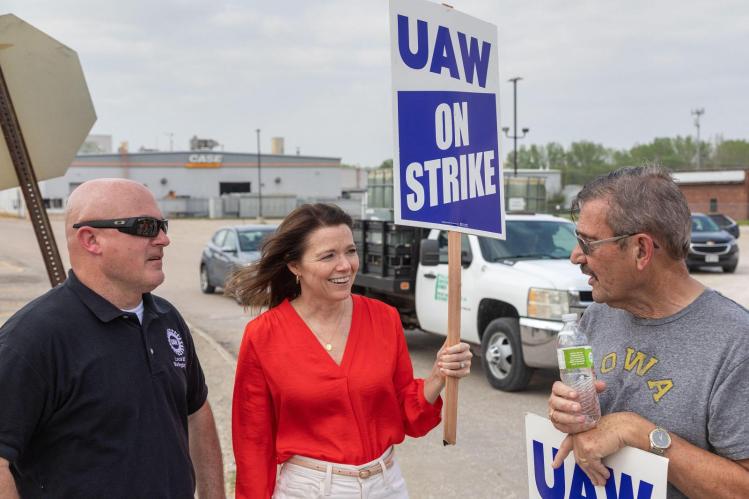
Democrats’ prospects will also hinge, in large part, on the fates of several female candidates in close races. Their predominance in must-win swing-state districts is noteworthy, in part because Democrats have, relative to past election cycles, thus far underplayed its significance. Three particularly prominent races involve women who ran close races but lost in 2024: Rebecca Cooke of Wisconsin, Christina Bohannan of Iowa, and Janelle Stelson of Pennsylvania. Their ability to capitalize on Trump’s plummeting support with independents and build polling leads beyond the margin of error will be an important sign of whether other Democrats might score upsets in more daunting contests.
Cooke, Bohannan, and Stelson, all of whom are favorites in their upcoming primaries, are among the eleven women the Democratic Congressional Campaign Committee (DCCC) has officially backed in its twenty “red-to-blue” House targets. They are joined on this list by Scranton, Pennsylvania, mayor Paige Cognetti; pastor and Iowa state senator Sarah Trone Garriott; Marlene Galán-Woods and JoAnna Mendoza, both of Arizona; Shannon Taylor and former representative Elaine Luria, both of Virginia; Jessica Killin of Colorado; and Jasmeet Bains of California. After the primaries, there is a good chance this women-led cohort will be rounded out by Lindsay James of Iowa, another progressive pastor, and other female contenders in Michigan, Nebraska, Florida, and Texas, all of whom face comparatively longer odds.
Gerrymandering by Republicans—newly expanded in Florida—has tempered Democratic ambitions outside these swing districts, but not all contests in solidly red “Trump country” are a foregone conclusion. In Texas, for example, public school teacher Katy Padilla Stout is attempting to overtake Brandon “The AK Guy” Herrera, a Second Amendment–obsessed YouTube influencer. (The seat is open after Republican Rep. Tony Gonzales was forced to resign over multiple reports of sexual misconduct.) In Nebraska, meanwhile, Denise Powell, a local political fundraiser, has a reasonable shot at flipping the “purplish” seat currently held by Rep. Don Bacon, an anti-tariff Republican who is retiring at the end of his term. If the GOP’s “enthusiasm gap” continues to widen, historically poor consumer sentiment and the backlash to the Iran War could help put more districts in play. Despite the setbacks of recent years—which magnified the Democrats’ weaknesses in middle America—liberal strategists are increasingly confident that their party’s growing lead in the “generic ballot” will expand the range of viable challengers.
In the 2018 blue wave, the victories of both female “national security” candidates in the mold of Abigail Spanberger (now Virginia governor) and the populist feminists of the Squad appeared to confirm that the liberal “Resistance” to Trump’s authoritarian chauvinism could translate into electoral wins. Some pundits went so far as to dub 2018 the “Year of the Woman.” Whether Democrats secure a narrow majority or thrash Trump’s GOP, it’s safe to assume successful female candidates will be central to the story again. But the extent to which Democrats will highlight this dynamic as Election Day approaches is an open question. So far, they have generally not touted the female makeup of their slate.
If anything, there has been more D.C. chatter to the effect that, instead of prioritizing diversity and historic nominations, Democrats need a “straight, white, Christian man” to helm the party’s comeback in 2028. Perhaps reflecting that preference and the party’s determination to improve its standing with young men, especially in places that have grown hostile to the liberal establishment, Democratic strategists and PACs have enlisted muscular, adamantly pro-union male candidates—Brian Poindexter of Ohio, Bob Brooks of Pennsylvania, and Sam Forstag of Montana. Similarly, on the party’s left wing, rough-hewn pugilists like Graham Platner, Democrats’ now-presumptive nominee against incumbent Maine senator Susan Collins, have dominated the headlines.
Still, the prevalence of female candidates suggests that there is more than one pathway for insurgents in red and purple states. These candidates have focused consistently on affordability, protecting the safety net and natural resources, and cleaning up D.C. corruption—the progressive version of “draining the swamp”—while retreating from identity politics in their bid to expand their party’s tent. On the night of November 3, left-leaning women may well be credited with flipping the House. But the scale of their victory will come down to their appeal to “kitchen-table” concerns, thriving communities, and the importance of having “regular working people” wielding power in Washington, rather than the emphasis on the #MeToo movement and abortion access that characterized the 2018 and 2022 midterms.
Despite their similar messages, there are ideological differences percolating behind the brand of pragmatic populism these candidates share. Cooke, Cognetti, Bohannan, Stelson, and James have arguably taken the firmest line against corporate power, corruption, and unaccountable elites, often lambasting the self-dealing of their Republican opponents and lamenting cuts to social services. They also tend to highlight their relative distance from the Democratic establishment. Bohannan has connected her modest upbringing—she grew up in a trailer—to her economic priorities. Cognetti, despite an insider’s CV as a former Obama-campaign fundraiser and advisor to the Treasury Department, has played up her decision to take on Scranton’s Democratic machine and its old boys club when she ran for mayor in 2019 as an independent. Stelson—who left a long-running career as a TV news anchor in Lancaster, Pennsylvania, to run against incumbent Scott Perry in 2024—has placed a premium on integrity while stressing her public reputation and knowledge of local issues. Especially in blue-collar counties where Trump’s 2016 attacks on George W. Bush’s legacy were a big part of his appeal, a reputation for “maverick” or “heterodox” stances could boost candidates hoping to tap into voters’ growing appetite for political outsiders.
Cooke, who was raised on a Wisconsin dairy farm that Big Ag eventually squeezed out of the market, has won support from moderate caucuses such as the New Democrat Coalition and Blue Dog Coalition, but also from Bernie Sanders and labor unions. A former waitress and current small-business owner, she also expressed support for Zohran Mamdani before his victory in the New York City mayoral election last November. Conservative pundits tried to use this against her, framing it as a misstep that will imperil her chances to unseat hard-right Rep. Derrick Van Orden, but the consequences so far seem negligible. As in neighboring Iowa, the economic difficulties caused by Trump’s haphazard tariffs, the surge in energy and fertilizer prices due to the Iran war, and federal cuts to SNAP and rural health services have been acute in Wisconsin, where manufacturing jobs fell by approximately 9,500 last year. Such conditions would dog any vulnerable incumbent, but the fact that they stem from explicit policy choices arguably makes it harder for ideologues like Van Orden to combat them with hostility to “wokeness” and “radical leftists.”
Of course, not every female candidate approved by the DCCC is mounting a populist challenge to vested interests and machine politics. Candidates with combat or national security backgrounds, such as Mendoza in Arizona and Luria in Virginia, tend to have either more moderate or vague commitments to “lowering costs” for working Americans. Some candidates also try to use authenticity as a stand-in for policy specifics, often ineffectively. Bains, a California physician who is vying with Randy Villegas, the favorite of progressives, has repeatedly changed her stance on Medicare for All and walked back her past criticism of Israel. Meanwhile, Galán-Woods, the daughter of Cuban immigrants and a former registered Republican, can be expected to take a fairly hawkish line on foreign policy. In Galán-Woods’s Arizona district and others outside the Midwest, the electorate is primarily composed of affluent suburbanites, with whom Democrats have already made steady gains, raising the possibility the Progressive Caucus won’t expand much in the 120th Congress.
Wherever they are on the policy spectrum, these candidates are all tasked with overcoming their party’s tarnished, “out-of-touch” brand. Above all, they must convince disaffected Trump voters and right-leaning independents their outreach is genuine and not merely about drumming up the votes necessary to hand Mike Johnson’s speaker’s gavel to Hakeem Jeffries. Cooke’s Americana-tinged campaign is a case in point: it seems designed to avoid the pitfalls faced by momentary celebrity candidates such as Aftyn Behn, whose “close but not close enough” loss in a Tennessee special election last December was attributed to past statements deemed either too progressive or elitist. Cooke may be a progressive populist at heart, but she is more akin to her state’s Democratic senator, Tammy Baldwin, than to Rep. Alexandria Ocasio-Cortez and other outspoken candidates backed by the Democratic Socialists of America in major coastal cities.
The debate over whether to moderate on key “wedge” issues and even pointedly break from the so-called “groups,” advocacy organizations who are said to have excessive influence over candidates, is not limited to the party’s cultural vulnerabilities. Some centrist Democratic factions have gone a step further, suggesting the Biden administration’s economic agenda was a failure in both execution and conception. Supported by consultants aligned with Wall Street and Silicon Valley, they argue that Biden’s green industrial policy was misguided and that the anti-monopoly framework promoted by Lina Khan, former chair of the Federal Trade Commission, doesn’t get to the heart of what voters “want” out of the economy. Specifically, exercising greater corporate oversight and penalizing monopolistic practices aren’t conducive to fostering “abundance” and rapid economic growth.
So far, however, most “red-to-blue” candidates haven’t aligned with the neo-Clintonian direction publicly urged by centrist groups like Third Way. On the cultural front, barring the occasional, carefully worded statement about the need for responsible immigration reform that secures the border and deters crime—a position echoed by Texas Senate candidate James Talarico and Dan Osborn, the independent running for Senate in heavily Republican Nebraska—these contenders haven’t so much disavowed progressive “purity tests” as sidestepped them. That reflects a bet that economic fears will far outweigh culture wars this cycle, and that those fears can’t be met with rhetoric and half measures. Contra the prescriptions of the abundance movement or Thomas Friedman’s “Waymo Democrats,” the most promising challengers recognize that the party has to be bolder if they want to address the crises that gave rise to Trumpism in the first place.
Nevertheless, the women leading the Democrats’ midterm campaign are under pressure to limit their attacks on “crony capitalism” to Trump’s most egregious offenses and not go as far as avowed left populists like Platner or Abdul El-Sayed, the anti-establishment Senate candidate in Michigan’s Democratic primary. Although this factor may be inconsequential in a “wave election,” it points to an underlying ambiguity of the Democrats’ midterm strategy. They have shown rare discipline in uniting behind the theme of “affordability,” but this is a rather generic message that fails on its own to illuminate the power dynamics that have made basic living needs so costly everywhere. As the campaign enters full swing, those candidates who truly intend to win back voters in areas that once formed the bulwark of the New Deal coalition should bear in mind the accumulated costs of evasion.
We welcome your comments about this article. Please send your response to letters@commonwealmagazine.org.


No comments:
Post a Comment