
Moral Authority
Jesus went to Capernaum; and when the Sabbath came, he entered the synagogue and taught. They were astounded at his teaching, for he taught them as one having authority. Mark 1:21-22.
|
| |||||||||||||||


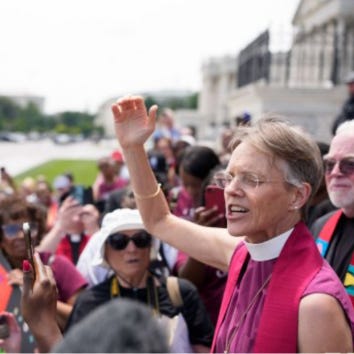
During Holy Week, I was invited by NOTUS (News of the United States) to be one of sixteen public figures to answer the question:
“Where should Washington look for moral authority in 2026?”
The timing seemed pointed. We’re living through a moment when the language of faith is used to justify harm, when the name of Jesus is invoked to bless policies that contradict nearly everything he taught. Religious leaders around the world, including Pope Leo XIV, are speaking up to counter this misappropriation of faith and to advocate for peace.
Moral authority cannot be bestowed, won in an election, or taken by force. It is earned slowly, through consistent ethical behavior and a refusal to lie.
When leaders claim moral authority while their actions contradict it, naming that contradiction isn’t a political attack. It’s an observation. Their behavior speaks for itself.
My answer was straightforward: Washington’s moral authority can be found where it has always been, in leaders whose work is rooted in integrity, dignity, and a commitment to the common good. There is no shortage of such leaders, but we often can’t hear them because other voices are louder, the ones that tell us what we want to hear, shift blame away from ourselves, and promise easy answers to complex problems.
I have served as bishop in Washington for nearly fifteen years. I am often inspired by the quiet moral seriousness of some of the leaders I have met. They work on both sides of the aisle. They disagree on policy. But their integrity is never in question.
 |
Yet, as a whole, our government has lost its moral footing. That’s not one person’s fault, nor that of one political party. It didn’t happen overnight, although the accelerated decline in recent months has been excruciating to watch. The human cost is real and rising.
History offers precedent. Countries lose their way, and the fear that we are losing ours is not irrational. Far too many of us are allowing this to happen. But history also offers something else: evidence that moral leaders, and people working together, can set a new course.
You can find all the responses to NOTUS’ question here. They are all worth reading. A few struck me as particularly compelling:
Professor Danielle Allen of Harvard suggests Lincoln’s Gettysburg Address and the question Lincoln asked: Can a country built on liberty and human equality endure? Her answer is that it depends on whether we choose to honor the dignity of every person. “The toxic culture of insult-slinging that Americans are so tired of stands as the antithesis of this founding ideal.”
Eboo Patel, founder and president of Interfaith America, points somewhere unexpected: youth coaches. Volunteer coaches do three things democracy needs. They build character. They teach people to work alongside those who are different from them. And they make clear that citizenship requires showing up. “If you want your kid to be involved in constructive activities, you need to give your time to help develop other people’s kids.”
That’s the democratic ideal at work.
Christian theologian Russell Moore points to a deeper truth: “Every lasting change for the better in this country has recognized that loyalty to conscience, truth, and human dignity must outrank loyalty to tribe, party, or even country.” Vineet Chander of Princeton puts it more quietly: “In a polarized age, authority will belong to those who embody compassion in action, not simply those who claim it in rhetoric.”
Two contributors point to Minnesota, where residents responded to ICE raids this past January with nonviolent resistance, harkening back to the Montgomery bus boycotts and the march on Selma. Another names Pope Leo as a model, for his commitment to first principles and refusal to be shaken. Sarah Yager of Human Rights Watch
offers a word I keep returning to: restraint. “Recklessness, speed, and profit have victims. Their experiences show what happens when harm is treated as a tool or a tradeoff rather than a limit.”
There is more moral authority in this country than we realize. It lives in faith communities, in local organizations, and in people who refuse to give up hope. As its momentum builds, moral authority will return to Washington.
But collective moral courage doesn’t arise on its own. It begins because someone goes first.
Each of us can be that person. Whenever we tell the truth under pressure, look out for our neighbors, do something hard for love’s sake, forgive a mistake, choose dignity over contempt, and speak up when it would be safer to remain quiet, we make it easier for someone else to do the same.
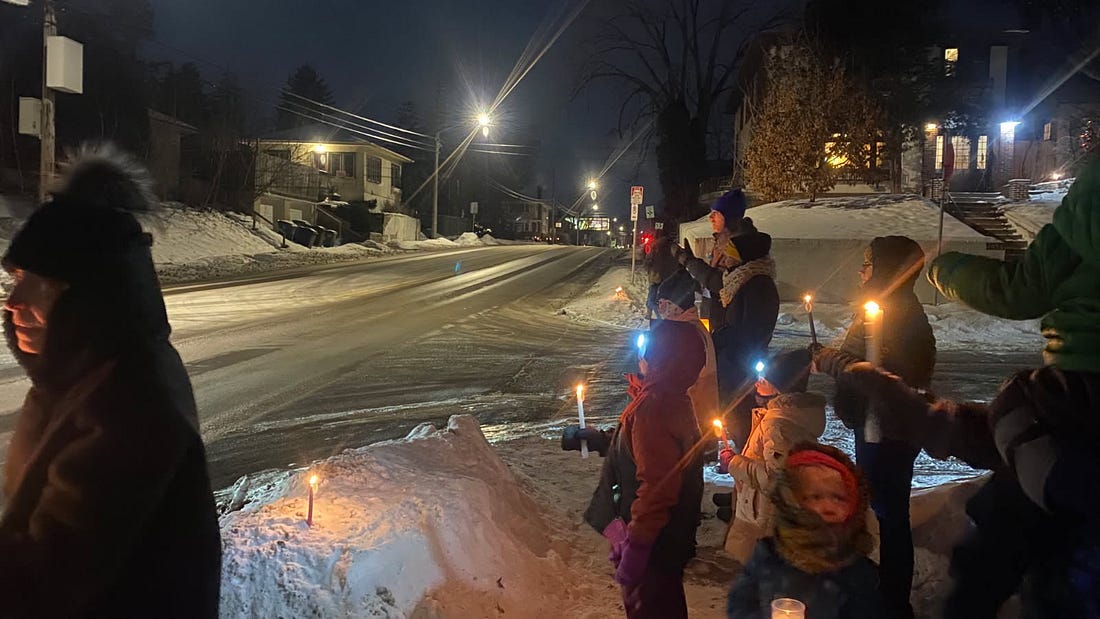 |
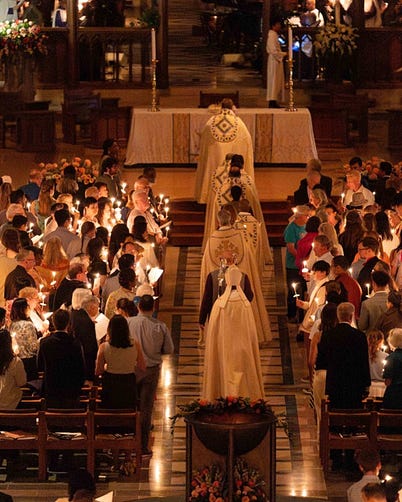
On Easter Eve, we gather in darkness to proclaim the light of Christ. We light the Easter candle from a fire, and then share that light among us, one candle at a time. That’s how moral leadership works. Not one great illumination, but many small candles, each one lit from the source of light, each made possible by the one before it.
The world gets lighter that way. Not all at once, but one brave candle at a time.


Thank you for your guidance. God bless you and faith justice will prevail
ReplyDelete