
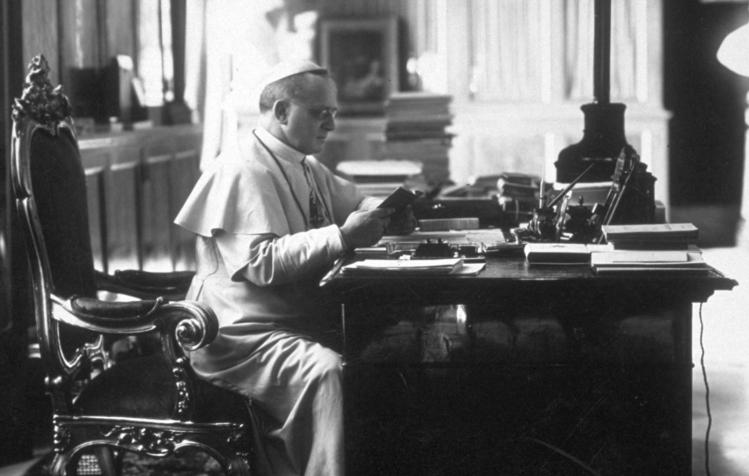
Historians are wary of making comparisons between different eras and events, but also professionally disposed to doing so—Church historians included. Hence this consideration of the role and response of the Catholic Church in the Trump era in the United States, and in the Fascist era of Italy from the mid-1920s to the mid-1940s. There are differences, of course. Yet given the current moment—an authoritarian president attacking democracy at home and waging war abroad, a U.S.-born pope in the Vatican—it’s helpful to consider some of the similarities.
The Vatican and Italian Church’s relationship with Mussolini’s regime went through many phases. Few Catholics protested the early arrests and assassinations of socialist and communist dissidents by the Blackshirts. Few were shocked when the Popular Party was shut down and its founder, Fr. Luigi Sturzo, fled into exile in 1924. The creeping totalitarianism evident in 1925 and 1926—abolition of anti-Fascist parties, suppressing freedom of the press—didn’t derail negotiations over the Lateran Treaty of 1929. Indeed, some of these antiliberal measures were consistent with positions taken by Pius IX in his Syllabus Errorum (1864).
Tensions emerged in 1931, when Fascist educational policies were seen by the Church as an encroachment on its freedom to run its own organizations. But the colonial wars Mussolini launched in East Africa beginning in 1935 raised enthusiasm among Italian Catholics who saw in the new Italian imperialism an opportunity for missionary work and Church expansion. The racist laws Mussolini adopted from Nazi Germany in 1938 didn’t raise serious alarm in the Italian Church; though they did trigger Pius XI’s sharp turn against racist ideologies in the last months of his life, the Vatican and Italian bishops didn’t turn against Fascism until the war started going badly for Germany and Italy. After 1942, Pius XII gave the first speeches in favor of the rights of the human person and democracy, and Catholics started organizing for the post-Fascist period. The Vatican realized that the regime that had protected the Church from communism and chaos, gave the pope the Vatican City State, and ensured a privileged status for the Church was now an existential threat to Catholicism and the papacy. The Vatican was still in its early days as a sovereign, independent state under international law, and its survival was not guaranteed in a postwar order where Russians and Americans might not be willing or able to let the 1929 settlement of the “Roman question” stand. No longer an asset, Mussolini and Nazi-allied Fascism had become a liability.
Consider the January 6, 2021, attack on the U.S. Capitol alongside the early years of Mussolini: it revealed the strongman’s deep instincts. Just as Catholics in Italy accepted Mussolini, Catholics in the U.S. saw Trump as “better than the alternative,” which would have been an enemy of the Church. The first months of the second Trump administration were comparable to 1938: racist, anti-immigrant policies didn’t seem to directly threaten the Church. Then, at the end of 2025, ICE went to Minneapolis. The three months of state-sponsored terror that followed—along with the bellicose, expansionist pronouncements on Greenland, the military action in Venezuela, and the illegal war on Iran—were a wake-up call for many bishops. Cardinals Cupich, McElroy, and Tobin went on the record about ICE and the morality of U.S. foreign policy in a joint statement in January, while military bishop Timothy Broglio spoke out about the immorality of an attack against Greenland.
In the second year of the second Trump administration, more individual bishops are speaking out, as is the USCCB, though more diplomatically: it has taken legal steps to counter Trump policies and public statements in order to distance itself from the regime. It’s not that the USCCB has become liberal or more favorable to the Democrats. Many bishops have simply realized that, between the collapse of Church attendance among immigrants and the infringement of religious liberty, Trump is bad for the Church. They have also realized that Trump is bad for world peace, the war against Iran tragically proving the point made by the three cardinals in January.
Archbishop John Wester of Santa Fe stated at the end of February that we are living in “a Dietrich Bonhoeffer moment.” Some bishops may be. Others seem to be in a Karl Barth moment: it’s a time to continue to pray and do God’s work without taking a public stance. And still others appear not to have wavered in their support for the Trump administration—or at any rate, they do not seem especially eager to pressure USCCB president Paul Coakley to publicly challenge the president. The conference has also been silent on the administration’s attack on democracy and the rule of law; one possible explanation is its sensitivity to the government’s power over federal funds for students attending Catholic colleges and universities, and over visa rules for immigrant religious workers. There are also a couple of influential bishops on Trump’s presidential commission on religious liberty who have expressed no strong signal of displeasure with the current state of affairs. And though there may be a range of individual social-doctrine responses to Trumpism in the United States (on immigration especially), there isn’t unequivocal and unanimous consensus on Catholic doctrine, democracy, and constitutionalism. (This is in stark contrast to the clear statements issued by European bishops’ conferences in recent years.)
The leadership of the U.S. Catholic Church seems no more ready (or willing) to speak about the future of democracy after Trump. A preliminary step would be to detach the Church from Trumpism—not only in the eyes of the American people but globally—for the sake of Catholicism’s credibility. What happened after the Second World War—when, thanks to the Cold War, the Catholic Church in Europe acquired unexpected political relevance—is not likely to be repeated in the twenty-first century. The clergy’s silence on Trumpism could result in a de facto merger of U.S. Catholicism with Trump’s Christianist movement. Avoiding this fate will take more than the statements of individual bishops or cardinals or legal actions by the USCCB. (It should also be noted that the religious overtones of the Trump propaganda machine damage the moral standing of American Christianity, and American Catholics should not assume that people in other parts of the world can differentiate the various strains of American Christianity and Catholicism.)
Some response to Trumpism from the bishops beyond immigration and foreign policy would also be of service to the U.S.-born Leo. As the pope made plain in an interview six months ago, he wants to avoid American partisan politics and let the bishops do the talking. In that interview, Leo said that President Trump “at times has made clear” his concern about questions of human dignity and promoting peace, and that “in those efforts I would want to support him.” That now seems like a long time ago, and Leo appears to be aware of how things have changed since. There is no question that Rome and the pope are supporting—quietly but clearly—the individual voices prophetically calling out Trumpism. The question is whether these individual voices will be joined by others, or remain a (shrinking) minority faction.
There are other signs of Leo’s awareness and opinion of the situation in the United States, including indirect gestures like choosing to visit Lampedusa on the Fourth of July. There is also the appointment of Msgr. Gabriele Caccia as apostolic nunciature to the United States, who replaces the retired Cardinal Christophe Pierre. This signals that, for the Vatican, the United States under Trump is an international problem. Caccia, who served as the Holy See’s ambassador to the United Nations beginning in 2019, arrives at a delicate moment: the tension that characterized the relationship of U.S. bishops to Francis has been replaced by tension between Leo XIV’s Vatican and a Trump-led Americanism that has embraced Christianist-nationalist rhetoric as it conducts a war against an Islamic country. While the first two Gulf wars had catastrophic effects on the relations between Christians and Muslims in the Middle East and on Christianity itself in the region, the two Bushes tried to minimize the Christianist/crusader overtones. The effort to frame the current war as one against “a misguided religion” is integral part of the Trump administration’s narrative. Further, Trump and the United States collaborated with Israel in the assassination of Ayatollah Ali Khamenei, who was also the head of a religious tradition with which the Vatican has formal interfaith relations (to say nothing of the fact that the Vatican and Iran have had diplomatic relations since 1954, thirty years longer than the Vatican and the United States). This also is a reason to draw parallels to the challenges faced by Pius XII in World War II.
And what of the response to the current strain of Trumpism from other prominent American Catholics—including those associated with institutions in Rome who have funding sources in the United States? Consider, for example, that Peter Thiel is in Rome this week giving one of his invitation-only lectures on the “anti-Christ.” The event is organized by the Associazione Culturale Vincenzo Gioberti, based in Italy, and the Cluny Institute at the Catholic University of America (the “investment philosophy” of Cluny reads: “We’re investing in people who combine intellectual rigor with spiritual depth and creativity, at the intersection of Athens, Jerusalem, and Silicon Valley”). The national Catholic newspaper Avvenire (run by the Italian bishops) has called Thiel “the heart of darkness of the digital world.”
During Fascism, the Vatican was able to look out for the Italian Church, in no small part because there was also an Italian pope. But Italy was not the political and military (and even religious) superpower that the United States is. And the papacy today will not be able to provide the same kind of protection for America or for the international standing U.S. Catholicism. Indeed, it’s the U.S. bishops and influential Catholics who may have to protect the pontificate of Leo XIV from the identification of American Christianity with Trumpism. The pope should not have to bear the responsibility for it. And it would be far more helpful than the crowdfunding campaign now underway to present Leo—who has made no secret of his closeness to the poor—with a new papal tiara.
We welcome your comments about this article. Please send your response to letters@commonwealmagazine.org.


No comments:
Post a Comment