
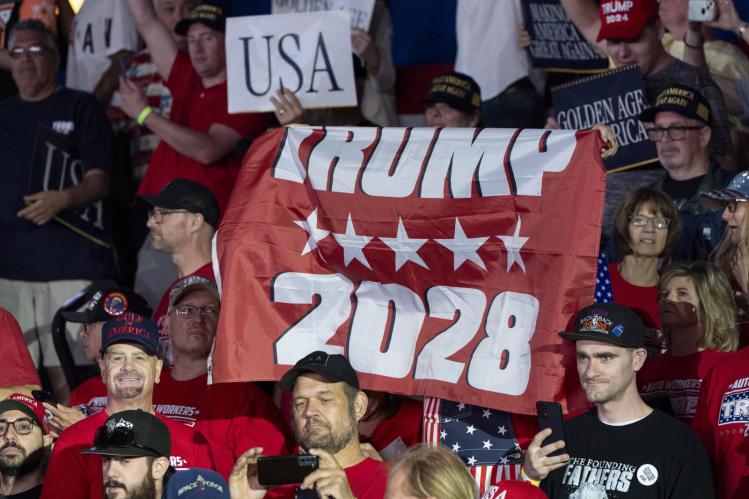
By now, there is not much left to say about Donald Trump. Anyone who denies that he’s ignorant, dishonest, vain, callous, greedy, and contemptuous of law and constitutional principle is either pretending or deluded. The former, mostly political columnists looking to tart up the plain truth in ceaseless pursuit of clicks, may be safely ignored. The latter make up approximately 40 percent of the electorate. They are a problem.
Through every absurdity, every outrage, every scandal, they have never wavered. Through two tax cuts that have transferred trillions of dollars from them to the top tax brackets, they have remained faithful. Through savage increases in health-insurance costs to themselves and their neighbors, they have not doubted. Despite his vile boasts about grabbing women’s genitals and his conviction for sexual assault (the judge called it “rape”), they love him still. They are spellbound.
This steadfast plurality did not come from nowhere. For more than a hundred years, in every corner of the country, in every medium, pro-business messaging, in almost inconceivable quantities, has flooded the consciousness of Americans, in the form of pamphlets, textbooks, planted news stories, subsidized scientific research, bespoke congressional testimony, radio and TV programs, and more.
Such highly partisan ideological saturation bombing was bound to have some effect. Still, there were limits to the persuasiveness of pro-business messaging. It was, after all, plainly false that business could be trusted to look after the interests of non-rich Americans, and many non-rich Americans figured that out. But then, in the sixties, the Republican Party received two enormous gifts: the Civil Rights Act and the counterculture of the young. Eagerly, Republicans responded with their “Southern strategy” and a “culture war.” Civil-rights enforcement became “big government” and resistance to it became support for “states’ rights.” Feminism, sex education, and gay rights became “attacks on the family.” Democrats responded to these cynical strategies in their usual clueless fashion, doubling down on court rulings rather than compromising and creating democratic forums in which to argue with their opponents and the public. The Republicans, meanwhile, were virtuosi of resentment, convincing the 40 percent that they were victims of “the elites”—as though they were not far more fundamentally victims of the economic elites the Republican Party exists above all to further enrich. From Chuck Colson to Roger Ailes to Steve Bannon, Republican political consultants have combined genius with mean-spiritedness in roughly equal proportions. And Democrats, despite such brilliant warnings as Thomas Frank’s What’s the Matter with Kansas?, have remained helpless victims.
It was, perhaps, difficult to know what to make of Trump at first. But in retrospect it’s clear that the Democrats’ response to Trump in his first term was disastrous. His supporters simply could not see the Mueller investigation or the first impeachment as adequate grounds for removal from office. The Democrats ignored that very widespread feeling rather than trying to understand it. Of course both the Trump campaign’s dalliance with Russian intelligence and Trump’s attempt to extort from Volodymyr Zelensky an investigation of Hunter Biden were disgraceful, but they were arguably venial rather than mortal sins. Trump’s base was convinced that Democrats were once again looking for substantive victories through legal maneuvering. They doubled down in support of Trump, which probably primed them to believe the “Stop the Steal” canard and stiffened the resistance of congressional Republicans to the second, more serious impeachment after January 6. So now we’re stuck with him.
Is he a fascist? If fascism is an ideology of racial or national supremacy, then Trump, however thuggish, is not a fascist. An ideology may be very primitive or confused, but there must be an idea in it somewhere. Trump appears not to have an idea in his head—he has rarely, if ever, put two coherent sentences together on any subject. “America First” is, like “Make America Great Again,” simply and solely a campaign slogan. He has never even begun to say what America means to him or why (or when) it was great. What could he know about America, anyway? He had only the narrowest experience of the country before campaigning for president: a corrupt New York City real-estate developer, a close associate of Roy Cohn (a figure at least as evil as Trump’s other close friend, Jeffrey Epstein), a high-living New York City and Palm Beach celebrity, and the host of a trashy popular TV show. He has no education and never reads, spending all his spare time watching Fox on TV and babbling on Truth Social.
If not fascism, what? I don’t think a single -ism defines the whole toxic stew, though several are mixed in. Project 2025 was a particularly raw version of market fundamentalism, certainly more radical than Hayek or even Friedman would countenance—they at least saw the point of government. Christian nationalism and Catholic integralism are well represented among his supporters and have figured heavily in his judicial selections, where they assort oddly with Federalist Society legal minimalism and originalism. His climate policy does not issue from skepticism about the science—he simply, corruptly sold his energy policy to the oil companies for a huge campaign contribution. And while his immigration policy is animated by nativism (along with a great deal of theatrical sadism), Trump’s motives, in this and all other respects, appear more mercenary than ideological. For example, sending untrained, inexperienced, fully armed ICE operatives into blue cities and assuring them that they have “absolute immunity” is probably intended, at least in part, to provoke protests that may provide an excuse for declaring a state of emergency, which he hopes will allow the executive branch to take control of the midterm elections. For none of these -isms has Trump articulated any rationale, and it’s very doubtful he could. Rather than a Maximum Leader, he is probably best thought of as a gangster with a very formidable organization—the U.S. government—behind him and a sure sense of what will appeal to that mesmerized 40 percent.
Will they like a bare-knuckled foreign policy? Let us hope they are more principled than the liberal intelligentsia: The Atlantic, for example, which assured us at great length that the indictment against Maduro was “legally sound,” or Foreign Affairs, which quickly assembled experts to speculate about “the difficult and dangerous path ahead for both the United States and Venezuela,” with little concern for whether it was legal to snatch Maduro in the first place. When Marjorie Taylor Greene says “This is wrong” and the usual liberal interventionist suspects say “Well…we’re afraid this may not succeed,” one understands yet again how little moral capital Democrats will bring to their fight—if they should ever begin to fight—for the soul of the 40 percent.
Trump’s “National Security Strategy 2025” is a mixture of glaring hypocrisy, selective history, and sheer truculence, along with generous helpings of hyperbolic praise for the wisdom and fortitude of “The President of Peace.” “We must rebuild an economy in which prosperity is broadly based and widely shared, not concentrated at the top.” Trump’s $4 trillion tax cuts, heavily weighted toward corporations and the ultrarich, should help with that. The document rejects “global domination” and promises to “set a high bar for what constitutes a justified intervention”—this a few months after illegally bombing Iran and a few weeks before illegally invading Venezuela. “The United States will insist on being treated fairly by other countries. We will no longer tolerate, and can no longer afford, free-riding, trade imbalances, predatory economic practices, and other impositions on our nation’s historic goodwill that disadvantage our interests.” We will, however, happily tolerate the International Monetary Fund and the World Bank continuing to wreck the economies of developing countries with “structural adjustment programs” imposed at the behest of Wall Street banks. “We want to ensure that the Western Hemisphere remains reasonably stable and well-governed enough to prevent and discourage mass migration to the United States.” No acknowledgment that U.S. support for brutally repressive regimes in Central America over several decades probably helped bring about the immigration crisis the Trump administration cynically exploits. About the single largest problem facing humanity, there is one sentence: “We reject the disastrous ‘climate change’ and ‘Net Zero’ ideologies that have so greatly harmed Europe, threaten the United States, and subsidize our adversaries.” Not “we reject because…”—they have no reasons. With a proudly anti-intellectual flourish, Trump gives away global economic supremacy to China and condemns many millions of late twenty-first century citizens to hunger, disease, and extreme weather.
What is original in the document is what may be worst in it. Adherence to international law has never been a strong suit of American foreign policy—on the contrary. But every preceding administration has at least expressed fealty to the ideal. Trump wants to kill it:
We stand for the sovereign rights of nations, against the sovereignty-sapping incursions of the most intrusive transnational organizations…. The United States will unapologetically protect our own sovereignty. This includes preventing its erosion by transnational and international organizations…. The United States will chart our own course in the world and determine our own destiny, free of outside interference.
Given Trump’s recent lawlessness, these passages amount to a declaration of criminal intent, an avowal that he has no more intention of obeying international law than domestic law. Is this brazenness preferable to decades of liberal (and conservative) hypocrisy about America’s devotion to the rule of law? I leave that question for the reader.
After the National Security Strategy document appeared, the editors of The New York Times interviewed Trump. The interview included this faintly ludicrous exchange:
Do you see any checks on your power on the world stage? Is there anything that could stop you if you wanted to?
Yeah, there is one thing. My own morality. My own mind. It’s the only thing that can stop me, and that’s very good.
Not international law?
I don’t need international law.
“My morality”? This is someone who, as a number of psychologists and other social scientists told Thomas B. Edsall in The New York Times early this year, with alarming plausibility, cannot tell right from wrong and is helpless before his impulses. He is someone who shut out Black tenants from his buildings, bribed politicians, stiffed contractors, cheated on several wives, regularly slanders opponents, and broke all records for presidential grift with his $400 million personal plane from a foreign tyranny, a stablecoin bought by those seeking his favor that enriched him by hundreds of millions of dollars, and a $7 billion luxury resort in Saudi Arabia. Someone who abruptly, without explanation, terminated aid programs that had saved millions of lives in poor countries. Perhaps worst of all, he lied and inflamed millions of followers in an attempt to steal a presidential election from the legitimate winner. He is, by many orders of magnitude, the most immoral, even psychopathic human being ever to occupy the presidency. If his morality is all that stands between us and the use of nuclear weapons, perhaps we should begin to wind up the earth’s affairs. Fortunately, his vanity also stands between us and extinction, which he may feel would be bad for his reputation.
“We are not permitted to despair of the commonwealth,” said Thomas Jefferson; and we may be sure Abraham Lincoln would have nodded his great head in somber assent. But we are not permitted to underestimate the difficulties, either. Democracy can survive an ignorant and inflamed electorate, but it cannot survive a permanently, systematically deluded one. When 51 percent of Republicans still believe that the 2020 election was stolen from Donald Trump, solely because he has said so thousands of times, the republic is in peril. Fifty-one percent of Republicans—tens of millions of people—have been misled on a colossal scale, not merely with respect to this one claim but, more fundamentally, with respect to the credibility of those making and transmitting this and other obviously false claims: about taxes, regulation, health insurance, climate change, immigration, vote suppression, and virtually every other policy question.
Those making the false claims—Trump and other Republican politicians—are a problem. But a more important problem is the media that transmit those claims uncritically, knowing—and they must know—that they are false, while at the same time mendaciously depicting the Republicans’ political opponents as not merely mistaken but irresponsible and disloyal. “If only the 40 percent would read The New York Times,” we may think to ourselves, “they would wake up!” But alas, Fox, Sinclair, Clear Channel, One America, Christian Broadcasting Network, and a slew of right-wing podcasts have thrown a mental cordon around the 40 percent. Our democratic impulse is to reach out to them—they are our fellow citizens, after all. But they seem lost to us, sleeping while their freedoms and ours are daily whittled away.
Breaking down the right-wing media’s Iron Curtain will be a very long-term project. The 40 percent will probably continue spellbound for quite a while. The immediate task is simply to defeat them electorally, to reverse the civic cataclysm they have unwittingly unleashed. The 60 percent—lazy, apathetic, complacent, fractious, disorganized, underfunded, gerrymandered—had better get our act together.


Excellent and frightening
ReplyDelete