
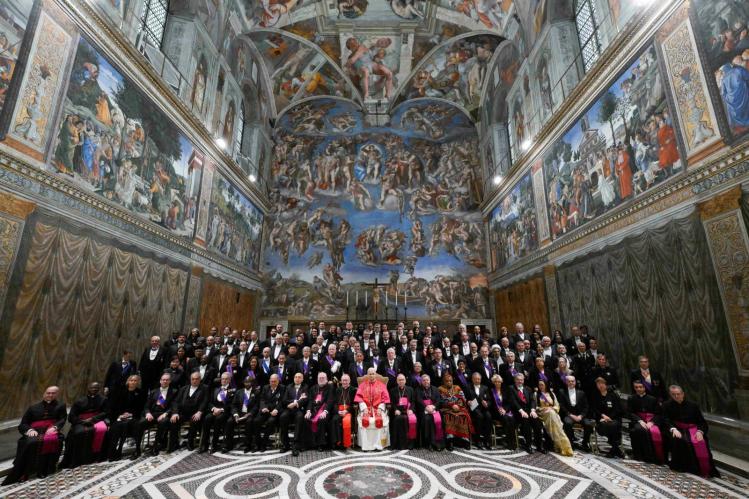
There were rumors that Leo XIV would travel to his home country this year, perhaps for a stop at the UN, among other places. But the U.S.-born pope will not be visiting the United States anytime soon, the Vatican recently confirmed. John Paul II and Benedict XVI visited their own native countries within a year of their elections (though Francis never went to Argentina). So far Leo has yet to travel in Europe, or even to other Italian cities, while his relationship with the city of Rome is still taking shape, with forthcoming visits to five parishes during Lent.
Among his many other tasks, Leo also finds himself having to navigate the shifting relationship between the United States and Europe, as well as the question of European identity, as Donald Trump dismantles the international order that has linked the continent to the U.S. for some seventy-five years. The United States simply isn’t the figurative “Europe outside Europe” that Europeans long liked to think it was. The shift was already detectable under Francis, but since the return of Trump and the election of Leo, the situation has become decidedly more complicated.
Leo’s election should be seen as part of the trajectory of the papacy’s decreasing identification with Europe and of the Church’s ever more global reach. While Pope Francis had very visible roots in Italian culture, the same cannot be said for his successor, who embodies a more profoundly post-Italian and post-European papacy. This marks a distance between the papacy and Europe, which for Catholicism is not just a continent, but which for many centuries has also been a point of reference for the cultural, political, and geographical imagination of the popes, including John Paul II and Benedict XVI.
In his first nine months as pope, Leo XIV—bishop of Rome, primate of Italy, and “Patriarch of the West”—has addressed the question of the role of Europe in the Church and in the world only marginally. Last May, he received the prelates of the COMECE (Commission of the Bishops’ Conferences of the European Union) permanent committee, where they reportedly discussed the issue of Europe’s rearmament. In a September exchange with journalists outside Castel Gandolfo, he said about the war in Ukraine: “If Europe were truly united, I believe it could do a lot.” When asked whether rearmament is necessary, he replied, “These are political matters, also influenced by external pressure on Europe. I prefer not to comment.” In December remarks to journalists, he said that the historical alliance between Europe and the United States may “unfortunately” be changing: “A huge change in what was for many, many years a true alliance between Europe and the United States.” Additionally, he said that some comments by President Trump suggest an effort “trying to break apart what I think needs to be an alliance today and in the future.” Allowing that some people in the United States may agree with that effort, Leo said: “I think many others would see things in a different way.”
Then, in a January speech to the diplomatic corps, Leo mentioned Europe in connection with the Americas: “We must not forget a subtle form of religious discrimination against Christians, which is spreading even in countries where they are in the majority, such as in Europe or the Americas. There, they are sometimes restricted in their ability to proclaim the truths of the Gospel for political or ideological reasons, especially when they defend the dignity of the weakest, the unborn, refugees and migrants, or promote the family.” And he spoke indirectly toward the tensions between the United States and Europe over Greenland: “In our time, the weakness of multilateralism is a particular cause for concern at the international level. A diplomacy that promotes dialogue and seeks consensus among all parties is being replaced by a diplomacy based on force, by either individuals or groups of allies.”
It’s estimated that by 2100, Europe’s share of the world population will have dropped from 12 percent to 6 percent. But the continent’s crisis is not merely demographic or the result of secularization; it’s also a crisis of political vocation. Europe is no longer seen, not even by many Europeans, as “our common home,” as Mikhail Gorbachev once called it. It’s even less a continuous space “from the Atlantic to the Urals,” as John Paul II mapped it. Both saw the future of Europe as unified, not as part of a system based on blocks and spheres of influence.
Further, the European Union no longer includes the United Kingdom, feels abandoned by the United States, and, especially since the start of the war in Ukraine, feels threatened by Moscow. Russia’s invasion of a sovereign state also has religious dimensions—the rift within the Orthodox churches between the Ecumenical Patriarchate of Constantinople and the Patriarchate of Moscow, primarily, but also the repercussions for Catholics in Ukraine and Europe, and on international and ecumenical relations. Though Leo seems to express an “Atlanticist” geopolitical view reminiscent of post-1945 American and European Catholicism, Europe still seems to be feeling orphaned in an increasingly English-speaking and post-European papacy—compounded by the projection of MAGA Catholicism onto the Old Continent, whose churches seem to lack a corresponding energy. Meanwhile, Giorgia Meloni’s government works to adjust to Trump’s unpredictable turns and outbursts, but that’s less the case with France and Germany.
Compared to his two predecessors, born and raised on the continent, Pope Francis had a less direct connection to Europe. But it remained an important point of reference, especially for his understanding of the relations between church and state, fundamentally different from the rise of integralism in right-wing U.S. Catholicism. In 2020, he entrusted a letter to Secretary of State Cardinal Pietro Parolin in which he spoke of his “dream of a Europe marked by a healthy secularism, where God and Caesar remain distinct but not opposed.”
It remains to be seen how Leo will navigate between an Anglo-American Catholicism that takes strident positions against Europe and a European Catholic Church incapable of expressing a distinct European voice (there is, after all, no real bishops’ conference at the continental level or something comparable to the CELAM in Latin America). European Catholicism faces the challenge of rediscovering itself as the old international order comes apart. The old question of what Vatican Ostpolitik should look like during the Soviet era became somewhat moot after the collapse of the Soviet Union. The new question is what Westpolitik should look like. Francis’s geopolitics coincided with the decline of a neoliberal order that had led to the economic, social, and environmental injustices he protested. But since Leo’s election, the breakdown of the system of relations between states and international institutions has only accelerated. For Leo, who seems to have a more traditional and less activist vision than Francis, this could prove challenging.
The situation that Europe and European Catholicism face at this moment also raises questions about access to ressourcement and tradition. The papacy rests on a tradition—theological, institutional, symbolic—born in Europe many centuries ago, and in its hostile approach to Europe, Trump’s MAGA movement is attacking this tradition. But the Vatican also understands that Trump has raised uncomfortable questions for Europe about its identity in a way no U.S. president has before—indeed, in a way that Europe itself hasn’t since the end of the Cold War.
A papacy that would push back directly and explicitly against Trump’s white nationalism and manipulative “Christianism” might also be read as the defense of a European liberal democracy, whose acceptance by Catholic teaching is full of qualifications and warnings. Leo’s papacy finds itself caught between the post-European and postcolonial manumission of global Catholicism, the aggressive anti-Europeanism of Trumpism, and the ongoing emancipation of the old continent from its Christian roots—at least in its European-Western form. (Though the number of adult baptisms is on the rise in some European countries, this will affect things at the ecclesial level more than at the political level, at least for the time being.) With the Trump administration working to undermine the European Union—a project to which the Vatican contributed after World War II—the U.S.-born Leo faces a complicated situation navigating the relationship between Europe and his native country.


No comments:
Post a Comment