
The Culture War Comes for Science
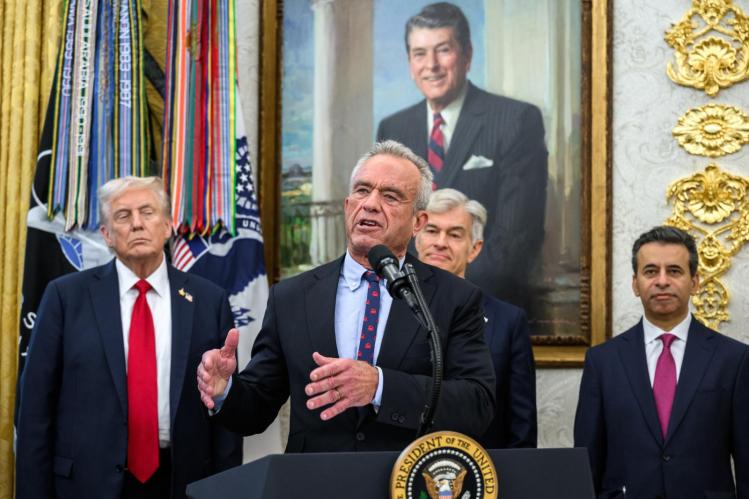
Almost immediately after President Trump returned to office, he moved aggressively to remake the federal science agencies, exerting tremendous pressure on the entire research enterprise in the process. The Trump administration has frozen federal research grants, slashed overhead costs, and laid off thousands of employees at “Democrat Agencies” (Trump’s phrase) like the Centers for Disease Control and Prevention (CDC), the Food and Drug Administration (FDA), and the National Institutes of Health (NIH).
These actions might look like an extreme form of a familiar right-wing ploy to shrink government, but the strategy is not really about the government’s size or “efficiency.” The administration’s actions have been disruptive and indiscriminate. But they have had little discernible effect on the overall federal budget, and real policy changes have been scattershot (in part because staff purges have left many agencies with severely diminished capacity). Policy does not appear to be the administration’s primary objective at all. Instead, exploiting a crisis of trust intensified by the Covid pandemic, the administration is taking aim at the mechanisms by which science policy has traditionally been implemented to fight the “woke-industrial complex.”
The first part of Trump’s punitive strategy has consisted in consolidating power in the executive branch, especially Russ Vought’s Office of Management and Budget, the office of Secretary of Health and Human Services Robert F. Kennedy Jr., and the now shuttered Department of Government Efficiency, while reducing professional staff inside the science agencies. This has sidelined agency and division heads, the traditional centers of bureaucratic power, as political decisions made elsewhere—in some cases without the relevant offices even being filled—have reshaped federal institutions.
The administration has also shifted control over research policy from bureaucrats to political appointees. For instance, an executive order issued in August instructs agencies to “designate one or more senior appointees to review discretionary awards on an annual basis” to ensure ideological compliance. No new grants may be made available without approval by political appointees, who are also empowered to halt grants deemed inconsistent with agency priorities.
Historically, bureaucratic tools such as grants, contracts, patent protections, indirect costs, and tax exemptions were used to execute science policy. This was a messy, sometimes acrimonious process that involved the White House, agencies, and Congress, with input from outside stakeholders. But the administration is now consolidating control over these tools and using them as leverage to bring scientists and universities to heel ideologically, as October’s “Compact for Academic Excellence in Higher Education” makes plain. Control of the NIH, already politically vulnerable from the pandemic, has proved a particularly formidable weapon since many universities, including elite ones like Harvard and Columbia, are substantially dependent on its research funding. MAGA has turned the soft power the federal government historically exercised over America’s research enterprise into hard power over its political enemies.
The sociologist Max Weber described bureaucracy as the routinization of charismatic authority through hierarchical institutions bound by impersonal rules. Today we have the reverse: bureaucratic mechanisms seized by a charismatic personality for overtly political ends.
But those who wish to restore the legitimacy and resilience of the American scientific enterprise must stand up from their defensive crouch and confront an uncomfortable truth. The social contract between science and society was wavering long before Trump’s return. At its best, this contract drove long-term public support for academic research that has benefited the nation in myriad ways, but at its worst, it has stifled democratic debate, impeded scientific progress, and protected entrenched interests. Rather than trying to merely restore an imperfect past, we should learn from it and begin renegotiating the social contract for American science.
When they arose in the late nineteenth century, research universities were financed through tuition and fees, private philanthropy, and some state funding. While there were many important federal scientific institutions at that time, they largely conducted their own research—surveying the country’s waterways, recording weather data, or studying infectious disease, for example. Federal science bureaus might consult or contract with academic scientists on discrete projects, but with some notable exceptions—such as the Department of Agriculture’s experiment stations—there was nothing akin to the modern-day system of federal research subsidies. Whatever its drawbacks, this older arrangement left universities (especially private ones) free to govern themselves. In the late nineteenth and early twentieth centuries, many academic scientists jealously guarded this independence, resisting entanglements with the state out of fear of politicization and a loss of control.
But everything changed after World War II. The astonishing and rapid development of the atom bomb, radar, and computing demonstrated what science and the state could accomplish together, galvanizing political support for federal science funding during peacetime. The prospect of generous government grants and contracts, combined with the promise of insulation from partisan meddling, proved far too attractive for scientists to resist, whatever their prewar misgivings.
The social contract for science solidified during this period. Congress would support research universities with taxpayer money but delegate decisions about what research to fund to scientist-administrators at federal agencies, who would draw on the advice of scientific peers. Science, though publicly funded, would remain self-governing. In return, it would drive economic growth, improve human health, and advance U.S. national-security interests.
This rationale was famously articulated by Vannevar Bush, President Roosevelt’s wartime science advisor, in his 1945 report, Science—The Endless Frontier. The “publicly and privately supported colleges, universities, and research institutes,” Bush wrote,
are the wellsprings of knowledge and understanding. As long as they are vigorous and healthy and their scientists are free to pursue the truth wherever it may lead, there will be a flow of new scientific knowledge to those who can apply it to practical problems in Government, in industry, or elsewhere.
This idea won broad bipartisan support in the coming years, when technical superiority over the Soviet Union was recognized as a geopolitical must.
From 1946 to 1970, federal research funding grew at four times the rate of the total federal budget, peaking at 35 percent of the government’s discretionary budget in 1964. Culturally, scientists came to enjoy unprecedented levels of prestige during these years, gracing the covers of national magazines, appearing at high-profile events and on news programs, and populating the corridors of political power. The moon landing was the most spectacular technical achievement of this partnership.
From World War II on, with some notable exceptions, Republicans like Bush were champions of federal science funding. A recent analysis from the journal Science showed that from 1980 to 2020, “despite occasional public skepticism of science, Republican lawmakers consistently provided robust funding, often exceeding Democrats.”
This consensus produced many benefits for both science and society. But the flaws inherent in the social contract for science were obscured by the shared interests of policymakers, scientists, and universities in preserving the status quo. In fact, the social contract for science rested on two powerful but fateful fictions.
The first was that science would remain self-governing. In reality, what scientists had gained in funding, prestige, and influence, they were losing in independence. Science agencies did enjoy discretion in distributing the growing federal funds allocated to them, and scientists working in universities generally remained free to choose their research topics and methods. But at the same time, academic science grew utterly dependent on the state and its priorities, creating a single point of political failure—which the Trump administration is now exploiting.
Bush had recognized this danger early on, initially resisting the use of grants to award funding. While contracts are a partnership between “independent bodies or individuals,” he said, grants imply “subservience,” “paternalism,” and “control.” He feared that the creation of a permanent bureaucracy for subsidizing universities would render scientists’ autonomy superficial—their federal patron would hold all the cards.
Ominous signs that Bush was onto something soon appeared. First, the McCarthy era gave the lie to the idea that scientists could remain entirely free of political controversy while ingratiating themselves into the highest echelons of power. Then, in the 1960s, many on the left began to criticize subtler forms of political control, as national-security imperatives came to shape the priorities of federal science funding indirectly, especially in the physical sciences. As historian Paul Forman puts it, though they maintained “the illusion of autonomy,” physicists during this period were “far more used by than using American society, far more exploited by than exploiting the new forms and terms of their social integration.”
Prominent scientists also grew concerned that the quality of research could be harmed by state dependence. Ballooning federal budgets, warned physicist Alvin M. Weinberg in 1961, created “a natural rush to spend dollars rather than thought,” encouraging scientists to pursue grants rather than scientific excellence. It also contributed to the bureaucratization of research: “Where large sums of public money are being spent, there must be many administrators who see to it that the money is spent wisely,” diverting scientists’ attention from research to administration and publicity. As Bush put it bluntly to Congress in 1963, the “broad program of government support of research…has been over-extended…. If the country pours enough money into research, it will inevitably support the trivial and mediocre.”
These concerns over science’s dependence on the state bleed into the second fiction underlying the social contract: that subsidizing academic science would inevitably produce societal benefits. This is how the contract was sold to the public. Of course, science, including what Bush called “basic scientific research,” does contribute to society in myriad ways: for instance, by stimulating technological innovations such as radio, radar, atomic energy, GPS, and pharmaceuticals. But, as Bush well knew, hardly all academic science produces—or is intended to produce—new technologies. Even when scientific research does enable such breakthroughs, it rarely does so in a linear way, nor are the results always purely beneficial—as illustrated by the atomic bomb.
It did not take long for the technological optimism implicit in the social contract to give way to popular disillusionment. During the 1960s, antiwar, antinuclear, and environmental movements called attention to harmful effects of science and technology. They protested what President Eisenhower had dubbed the “military-industrial complex,” with some demanding that universities divest from defense-research contracts. The economic crisis of the 1970s only deepened skepticism about the social benefits of federal science funding. President Carter’s science advisor Frank Press captured the public mood: “With all this great scientific leadership, people asked, how come the economy isn’t great? That’s when people began to blame the scientific community and think it was a mistake to have channeled all these resources into it.”
In response, Congress asserted itself more directly in the oversight of federal science. It prompted agencies to formalize their processes for awarding grants and contracts to avoid favoritism, placed limits on the Defense Department’s funding of academic science, and imposed new rules on research that posed ethical or security risks. This was an inflection point in the history of federal science, as the private sector would soon overtake the federal government as the primary source of research funding. Still, the reforms arguably improved the funding process and certainly made it more accountable. The substance of the contract between science and society was reaffirmed, and federal research budgets soon resumed their upward trajectory.
Today, the scientific establishment is again facing a legitimation crisis, except this time, the social contract may not survive. While the administration is exploiting—and greatly exacerbating—the problems besetting science, it did not create them. Whatever one thinks of the right-wing critique of “woke science,” the social and political priorities that shape the federal scientific enterprise—whether those of national security, cultural progressivism, or the MAHA movement—should be subject to democratic debate, not determined inside insulated bureaucracies. Moreover, concerns about the quality of scientific research—the subject of one of President Trump’s executive orders—are hardly the invention of today’s populist right.
Since the early 2000s, the failure to reproduce an alarming number of experiments and the growing incidence of research misconduct have caused scandal in fields that are heavily federally subsidized, such as biomedicine. At stake is not only science’s ability to produce reliable knowledge, but also its capacity to self-correct. Some scientists even wonder whether scientific progress is slowing down, with more resources required to produce declining benefits. There is no agreement about the extent of these problems or their precise cause, whether it’s “grantsmanship” or increasing bureaucratization or misaligned incentives. But the problems point to real issues with the way scientific research is organized today, including the unintended effects of its funding structure.
As in the 1970s, today’s crisis of scientific legitimacy is about much more than the quality of scientific research or the way research gets funded. A deeper disillusionment with the very idea that science is an unadulterated force for societal good is again palpable among large swaths of the public, though this time it’s concentrated more on the political right. Perhaps the clearest example of this is the rise of Robert F. Kennedy Jr.’s Make America Healthy Again movement and associated skepticism of food science, biomedical research, and pharmaceuticals, especially vaccines.
These dynamics were greatly inflamed by the politics of the Covid pandemic, including both the contested role of public-health officials and the controversial issue of Covid’s origins. Leave aside the (perhaps unresolvable) scientific question of whether SARS-CoV-2 originated in nature or in a laboratory. Nearly two-thirds of Americans believe it came from a Chinese lab, according to a 2023 poll, including a slim majority of Democrats and the vast majority of Republicans. This is an astonishing political fact, the implications of which should not be underestimated.
As with the advent of atomic physics, the disturbing realization that modern biology could have the capacity to trigger a pandemic resulting in the death of millions raises the question not of whether or how we should fund or regulate such research, but of who should be entrusted with this power in the first place. This is a moral and political question, not a technical one; ultimately, it can be adjudicated only through the democratic process, not inside expert bureaucracies. And yet—perhaps in part because of its unseemly association with a theory that scientific and media elites quickly dismissed as xenophobic misinformation—this question has scarcely been raised, much less answered, within the political arena.
In failing to grapple adequately with—or in some cases actively suppressing discussion of—real public concerns about the relationship between science and society, expert institutions left themselves vulnerable to the depredations of a demagogue who has successfully mobilized public discontent, promising to punish where the ordinary political process has failed.
More than a century ago, Weber predicted that the bureaucratization of ever-more domains of social life would culminate in an iron cage of rationality that stifles individual creativity and freedom. Out of this “polar night of icy darkness,” he prophesied, might emerge a charismatic personality promising to smash the iron cage. Seeing no viable alternative, Weber resigned himself to hoping for such a charismatic figure.
We must do better. Breaking the political doom loop of charismatic personality and impersonal bureaucracy will require renewing the social contract for science. We don’t have to start from scratch. We should begin by accepting the fictions of the old contract for what they are, while recognizing that they nevertheless contain important—and still widely accepted—truths.
First, science is necessary for technological innovations that benefit society, which is the main reason the government does—and should—fund it. The persistence of this belief helps explain why federal science budgets have remained relatively durable on Capitol Hill. While the administration’s strategy has been indiscriminate, many members of Congress—who represent states and districts with universities, colleges, and medical schools that depend on federal funding—know that cancer research and basic science should not be punished for the sins of “woke ideology.”
Second, science does depend upon free and autonomous institutions shielded from partisan meddling. The Trump administration’s effort to impose its ideological will on science has prompted rediscovery of the truth that such institutions are necessary for the flourishing not only of science, but also of liberal democracy itself. As Vannevar Bush urged long ago, universities and other independent institutions should engage the federal government not as supplicants but as equals—entangling themselves in the affairs of state only with circumspection and a healthy dose of pragmatic realism.
But independence, of course, can’t mean unaccountability. Federal scientific agencies and the institutions they fund are not—and have not been for eighty years—entirely autonomous. They should be made more accountable to the public, not through ritualistic punishment by executive fiat but through constructive reform executed by the institutions of representative democracy.
We need institutional innovations that enable us to balance scientific autonomy and democratic accountability more effectively than the bureaucracies of old. Constitutionally, Congress should incorporate Americans’ political values and concerns into the federal science policy process. The 1970s offer an object lesson in how legislative action can help improve the functioning of science agencies and shore up legitimacy by making them more democratically accountable.
But Congress is broken. In the twenty-first century, the “first branch” of government has consigned itself to acting as little more than an ATM for the executive branch. In the Trump era, it has proved unable or unwilling to exert its own distinctive constitutional powers, even in matters of grave national and international concern. As a result, in stark contrast to the 1970s, public discontent has not spurred a Congress-led program of reform but instead given way to a personality-driven program of destruction.
But long-term change can be effectuated and long-term damage mitigated only through legislative action. Congress created the agencies, has oversight over them, and still controls their budgets. It must play the leading role in a broader project of reforming—or, perhaps more accurately, rebuilding—scientific institutions that are effective, resilient, and worthy of the public’s trust.
This will involve deliberation, including deep disagreement and negotiation between a diverse set of stakeholders about both policy and the very nature of science and its relationship to the state. Ultimately, it will demand a moral and political language—a new vocabulary with which to articulate the place and purpose of federal scientific institutions in a democratic society. Whatever its flaws, the social contract between science and society that arose in the mid-twentieth century provided such a vocabulary, one that spoke to the needs—and the societal convictions—of our country at a critical moment in its history.
Eighty years later, we find ourselves at a different, but similarly pivotal, moment. The present chaos highlights the urgent need—and creates an opportunity—to begin drafting a new contract answerable to the needs of American society in the twenty-first century.


No comments:
Post a Comment