
Assisted suicide – what does it mean to be compassionate?
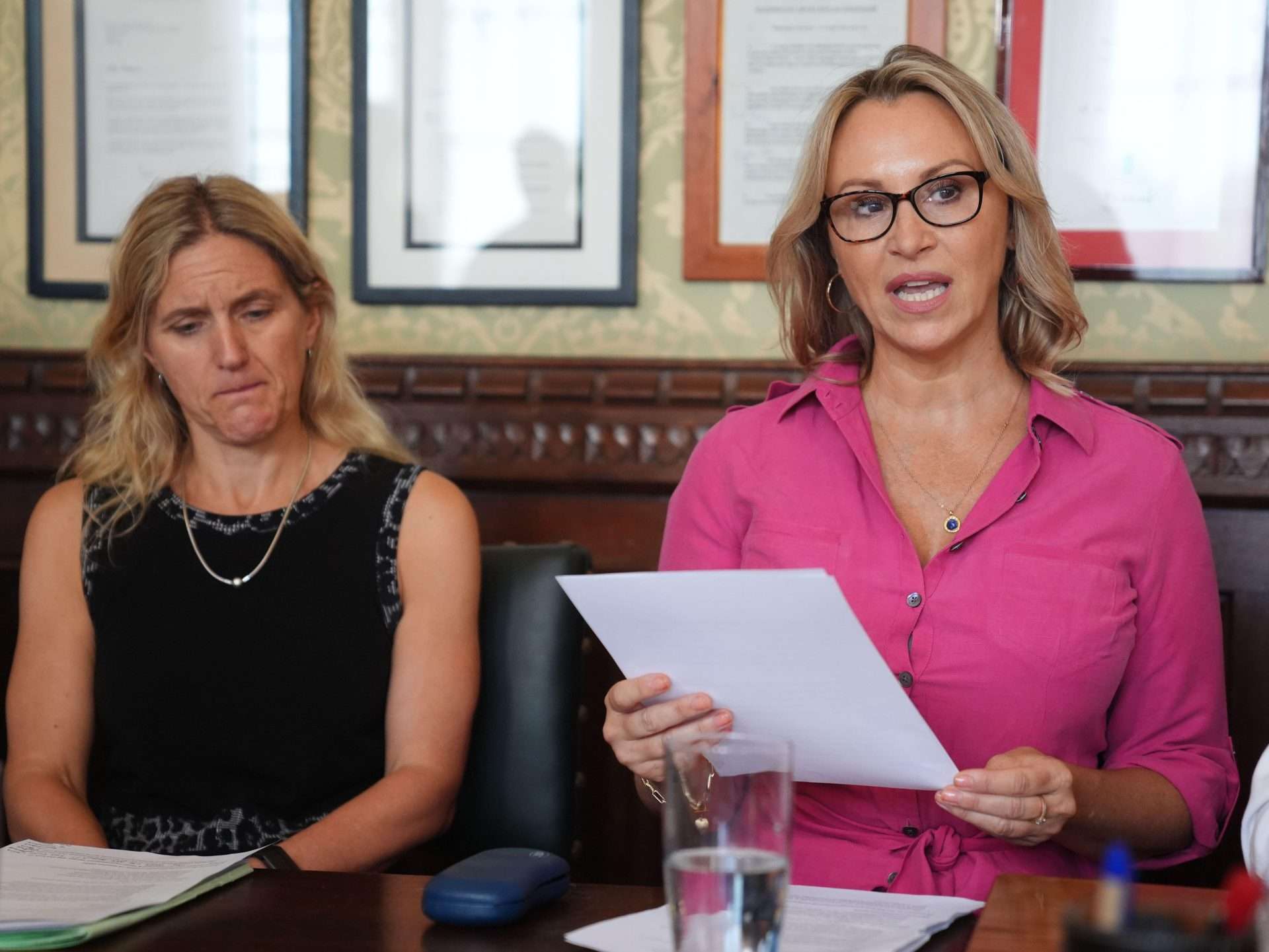
MP Kim Leadbeater (left) listens to campaigner and former presenter Sophie Blake, who has terminal cancer and campaigns for assisted dying, speaking at a press conference today in the Houses of Parliament in London, about tomorrow’s Terminally Ill Adults (End of Life) Bill Third Reading debate.
PA Images / Alamy Stock Photo
The testimonies of four writers approaching death challenge our suppositions about human autonomy, suffering and authentic living and dying
The assisted dying bill drawn up by Kim Leadbeater passed through its second reading in the House of Commons with a majority of 55 last November, but the final vote is expected to be significantly tighter when it returns to the Commons for its third reading, scheduled for this week.
Should Leadbeater’s bill become the law of the land, patients in England and Wales with less than six months to live who want to end their lives will be supplied with lethal drugs, subject to the agreement of two doctors and an expert panel including a senior lawyer, psychiatrist and social worker.
This legislation would put England and Wales on a par with a growing number of nations, including Belgium, the Netherlands, Spain, and, most notably, Canada. Canada’s increasingly liberal regulations governing assisted dying – some campaigners advocate that eligibility for medically assisted dying be extended to cover children under the age of 18 with an “irremediable medical condition” – illustrates how quickly legal and moral guard rails can be circumvented.
But what might look like a temporary political impasse is in fact an anthropological crisis: What does it mean to be human? And perhaps more importantly, what does it mean to be compassionate? The advocates and practitioners of assisted suicide make their case on the grounds of compassion: the legislation will alleviate needless suffering, they argue, ameliorating cumulative anxiety among loved ones, and serving the common good.
This compassion narrative presents a theological conundrum. If life is a personal possession, autonomy an inalienable right and freedom of choice the sine qua non of authentic living, then it follows logically that assisted suicide should be legally available to those of sound mind who wish to end their lives, whether because they are experiencing unbearable suffering or because they are old and sick and do not wish to be a burden on their families.
The case for the right to die with medical assistance has been
strengthened in the public mind by deeply moving stories of unremitting
pain, beyond the reach of even the best palliative care, shared by
potential assisted dying subjects themselves or by loving family and
friends. Who would not be moved by the voice of someone terminally ill
in unbearable agony imploring a doctor to administer a lethal drug?
But there is an alternative logic of compassion. It is grounded in
the understanding that life is a gift, that suffering can be redemptive,
and that a life that unfolds in a network of loving relationships
strengthens the greater commonwealth. I have seen it expressed in four
so-called “cancer diaries”, a genre that has gathered traction in recent
years. They have several things in common: they are all written by men –
two were married laymen and two were priests, all were prominent
writers of both theological and spiritual orientation; all were dying
from a terminal disease, rather than suffering from a sudden
incapacitating accident.
All four quote Henri Nouwen and confess to some indebtedness to his insights and approach to dying and death. Preoccupation with death was a leitmotif running through his life and work. In books such as In Memoriam (1980); A Letter of Consolation (1982); Beyond the Mirror: Reflections on Death and Life (1990) and Our Greatest Gift: A Meditation on Dying and Caring (1994), Nouwen recreated for contemporary Christians the medieval tradition of befriending one’s death, the ars moriendi, the strategy of holy dying. As he observes in Our Greatest Gift: “We can be healed from our fear of dying, not by a miraculous event that prevents us from dying, but by the healing experience of being a brother or sister of all humans – past, present, and future – who share with us the fragility of our existence. In this experience, we can taste the joy of being human as a foretaste of our communion with all people.”
It is by being present with the dying, our companions on the way, that we the living can find in their vulnerability and fragility, our hope, our expansive capacity to love, our flawed and yet glorious humanity. Compassion is a two-way street. In “Testing Unto Death”, the jottings from Donald Nicholl’s diary that became the concluding section of The Testing of Hearts (1997), he summarises his lifelong commitment to ecumenism and non-violence by speaking of the attraction of goodness as “the only way to draw others out of the world of injustice, violence, conflict and unhappiness. Not forcing others, but drawing them gracefully into communion with oneself and all creation.”
Nicholl – Yorkshire-born historian, teacher, husband and father – saw death as the ultimate portal to universal communion. Michael Paul Gallagher – Irish Jesuit, professor and author – observed in jottings conceived in “waves of fog”, Into Extra Time (2016), with focused poignancy that his dying “is a slow journey of letting go … I can only offer my numb road to His cross … a kenosis or pouring out, a self-emptying”. For Gallagher, dying is a new fully-enveloping intimacy with the suffering Christ.
The indefatigable Daniel O’Leary – priest, retreat giver and spiritual writer – for decades eschewed the clericalism that limits the charism of the presbyterate and proclaimed with evangelical fervour the shimmering brilliance of an evolving creation wherein God’s enfolding love is the kingdom among us. As he wrote a month before his death in January 2019 in Dancing to my Death, “There is a final all-embracing vision, a conviction that holds, sustains my courage in mornings and evenings of fear … It is the moment you know for sure, that the birth and death of everything, the sustaining and empowering of all that works towards good, the precious energy that creates, heals and quickens our souls – is LOVE.”
For O’Leary, death is the threshold we cross to sit forever “at the
altar table of our hearts”. Richard Gaillardetz – American theologian,
husband and father – his dying, recorded with searing candour in While I Breathe, I Hope: a Mystagogy of Dying,
published a few months after his death in November 2023, reminds us
that “if infirmity does anything, it reminds us that the autonomous self
is an illusion … There is a humbling grace that comes when we are left
only to receive the love of others with no possibility of
reciprocation.” Dying, Gaillardetz discovered, is a communal act
suffused with vulnerability and grace.
These four cancer diaries,
each written by someone I admired and whom I grieve for, are more than
their meditations and theologising. They are not emotionless treatises.
The muck, mire and viscera are not hidden. The agonies, fluctuating
moods, cries of despair and snippets of joy, are all on display. They
are witnesses to humanity in extremis: noble and vulnerable.
Michael W. Higgins is the author of many books and radio documentaries, including The Jesuit Mystique.


No comments:
Post a Comment