
Catholic women’s ordination campaigners welcome enthronement of Sarah Mullally as Archbishop of Canterbury
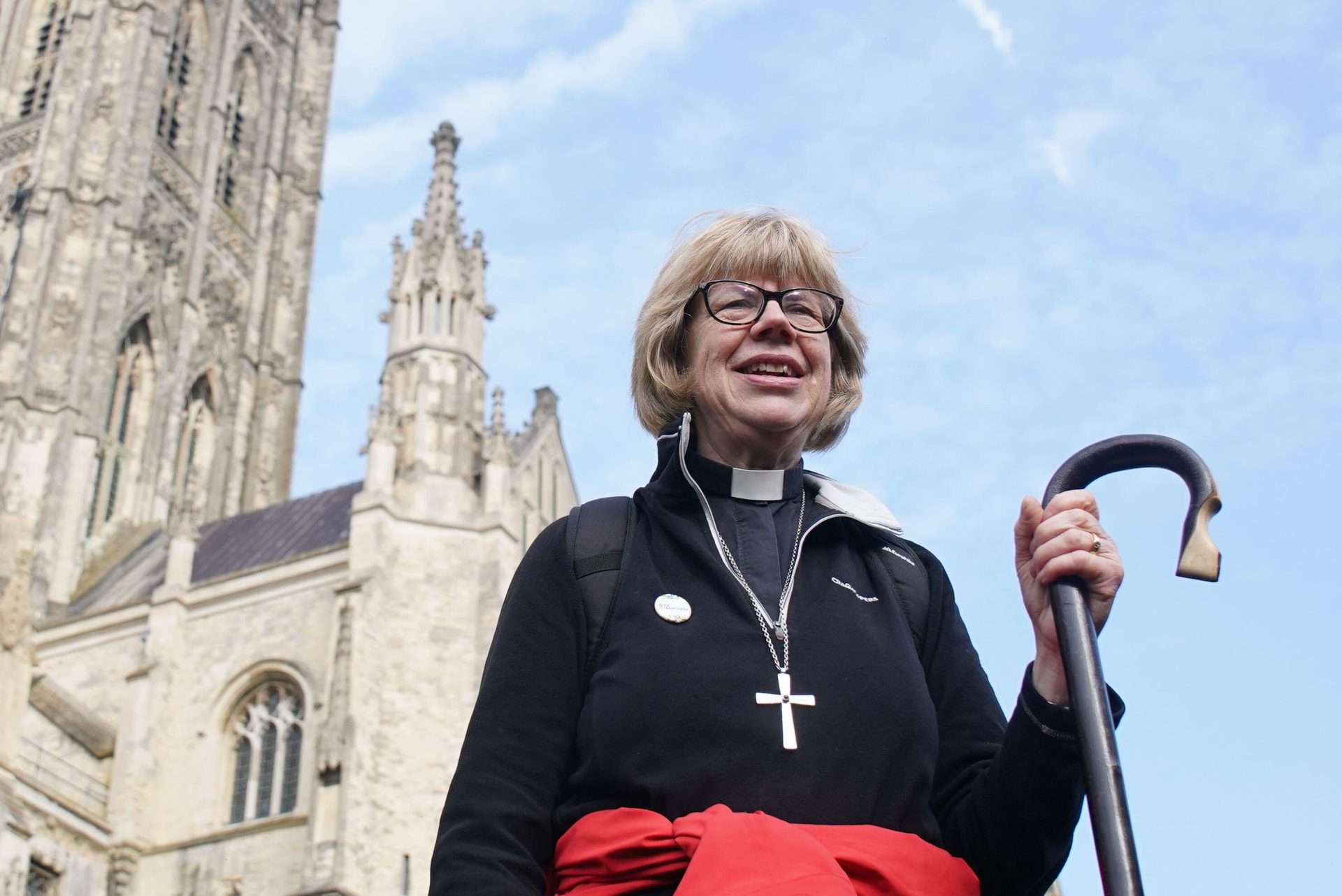
The Archbishop of Canterbury Dame Sarah Mullally at Canterbury Cathedral after an 87-mile pilgrimage from London to Canterbury Cathedral, ahead of her formal enthronement tomorrow.
PA Images/Alamy
Catholic Women’s Ordination and Women’s Ordination Worldwide offer ‘warmest congratulations’ to Dame Sarah Mullally ahead of installation tomorrow.
Campaigners for women priests and deacons in the Catholic Church extended their “warmest congratulations” to Dame Sarah Mullally as she prepares to be formally installed as the 106th Archbishop of Canterbury at Canterbury Cathedral tomorrow.
“We are deeply moved to see the gospel message of equality being reflected in the election of the first woman as the spiritual leader of the Church of England and the global Anglican Communion,” they said in a joint statement today.
“We join with Christians everywhere in delighting at this watershed moment after centuries of discrimination against women whose vocations to leadership were denied to placate those who prioritised patriarchal hierarchy over the teachings of Jesus.
“We recognise the bravery of WATCH members who campaign tirelessly to ensure that the glory of God can be fully represented by women also being chosen by their communities as spiritual leaders. We ask that the Anglican community also pray for us as we struggle against an institution dedicated to discriminating against women.
“We lament the fact that the Roman Catholic Church has become a bastion of bigotry where those opposed to women’s ordination can seek refuge. But we welcome the fact that more and more Catholic clerics, including senior leaders (Cardinal Hollerich on women’s ordination) are speaking out against the menace of misogyny that diminishes their own desire to serve the Church in the model of Jesus Christ.”
More than 2000 people are expected for the enthronement of Archbishop Mullally who arrived in Canterbury on foot on 22 March to bells and cheers, after a six-day pilgrimage from London.
She said the pilgrimage had been a “real joy” and that “it’s also a joy to know that we’re done”, and thanked fellow pilgrims and other well-wishers for their support.
Archbishop Mullally prayed for those affected by the meningitis outbreak in Kent during her pilgrimage, and the installation went ahead despite the outbreak.
She said, “To be welcomed into the city and diocese of Canterbury is an immense privilege, and I am grateful to be sharing in this moment with people of all ages and backgrounds from across the Church of England, the Anglican Communion, our nation and the world.
“Our world today needs the love, healing and hope that we find in Jesus Christ. I continue to pray that we renew our confidence in this good news, and recommit ourselves to sharing the joy of the Gospel.”
The guests at the installation will include faith leaders, charities, healthcare workers, school children, the Prince and Princess of Wales, Prime Minister Sir Keir Starmer and Leader of the Opposition Kemi Badenoch.
The enthronement is being held on the Feast of the Annunciation and reflects the theme of Mary saying yes to the calling of God and how “this offers hope for the Church and the world today”.
The congregation will include bishops and clergy from across the Church of England, and interfaith and ecumenical guests including delegations from the Holy See, the Ecumenical Patriarchate, the Coptic Orthodox Church, and all major Christian denominations.
Archbishop of Westminster Richard Moth will read from the Old Testament. Archbishop Mullally will wear the pastoral ring given to Archbishop Michael Ramsey in Rome by Pope Paul VI in 1966 as a “symbol of the strong ties between Anglicans and Catholics”.
Meanwhile, in Ireland the Association of Catholic Priests has appealed for a strong statement on the role of women In the Church, including “a call for a reconsideration of the teaching on female ordination”, to be made at October’s National Synodal Assembly.
In a statement, the leadership of the priests’ group challenged the Irish bishops as to whether “the overwhelming majority of the Catholic faithful in Ireland” would find some public episcopal support for their views on women and female ordination.
The ACP referred to a recent public discussion between Bishop Alan McGuckian of Down and Connor and journalist Martin O’Brien in Downpatrick where Bishop McGuckian, when asked if Pope Francis had opened the door to the female diaconate, responded: “I think it is shut and I think Francis should have said so.”
“We respectfully disagree,” the ACP responded.
Bishop McGuckian cited Catholic understanding of the sacramental nature of the bride groom and the bride which he said “is so rich and deep that we cannot easily set that aside. I don’t believe we can set it aside. I don’t think we need to”.
He did not believe women were second-class citizens in the Church because they cannot be ordained. “The power of Christianity is that we are on mission together and the fact that some of us are priests and some of us are not priests, that can’t be the big deal.”
However, according to the ACP the biblical symbolism of bride and groom needs to be freshly understood in a modern context, now accepted by Church teaching, which sees marriage as a reciprocal relationship between equals and “not one of hierarchical subordination”.
“Are not women, made in the image and likeness of God, capable of representing Jesus Christ as effectively as men? Is not the humanity of Christ of more basic significance than his male biological sex or his masculine gender?” the priests challenged.
While welcoming Bishop McGuckian’s willingness to speak in a public forum, they criticised bishops generally for too often taking “refuge in a kind of inscrutable silence when it comes to controversial matters”.


No comments:
Post a Comment