
5 American prelates remind us how things are supposed to be
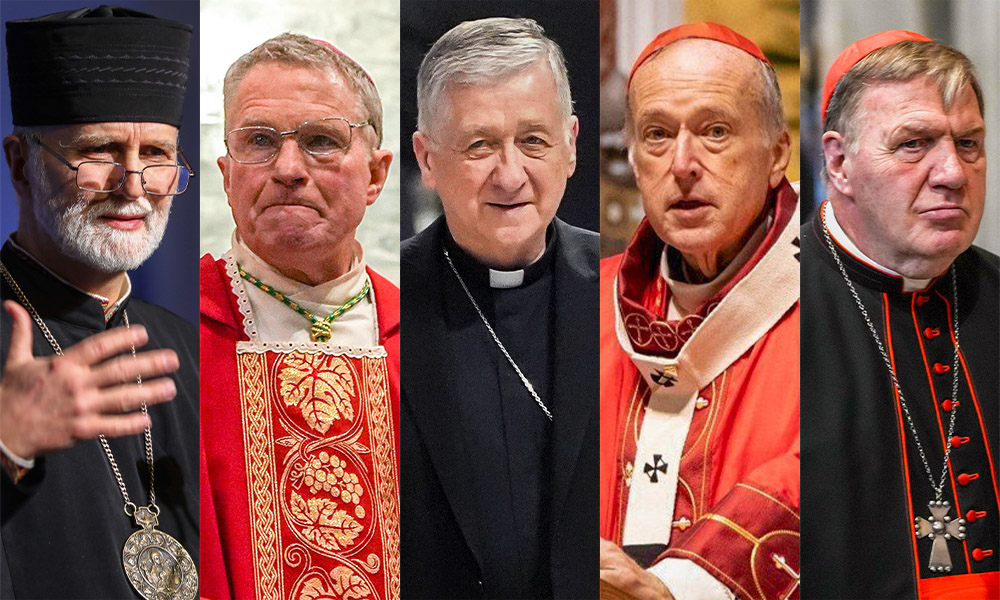
From left: Archbishop Borys Gudziak of the Ukrainian Catholic Archeparchy of Philadelphia (OSV News/Bob Roller); Archbishop Timothy Broglio of the U.S. Archdiocese for the Military Services (CNS/Lola Gomez); Cardinal Blase Cupich of Chicago (CNS/Lola Gomez); Cardinal Robert McElroy of Washington (OSV News/John Carroll Society/Christopher Newkumet); Cardinal Joseph Tobin of Newark, N.J. (CNS/Lola Gomez)

Join the Conversation
Send your thoughts to Letters to the Editor. Learn more
Five American prelates joined the public discussion of foreign policy in recent days. Archbishop Borys Gudziak of the Ukrainian Catholic Archeparchy of Philadelphia released a powerful video about the plight of the church in Ukraine. Archbishop Timothy Broglio of the Archdiocese for the Military Services questioned the morality of invading Greenland in an interview with the BBC. And the three residential U.S. cardinals, Blase Cupich of Chicago, Robert McElroy of Washington, and Joseph Tobin of Newark, New Jersey, issued a rare joint statement of principles that should guide U.S. foreign policy.
The video, the interview and the statement all reflect what Pope Leo XIV said about St. Augustine's book The City of God in a recent address to the diplomatic corps. "The City of God does not propose a political program. Instead, it offers valuable reflections on fundamental issues concerning social and political life, such as the search for a more just and peaceful coexistence among peoples," the pope said. "Augustine also warns of the grave dangers to political life arising from false representations of history, excessive nationalism and the distortion of the ideal of the political leader."
The video, titled, "No Priests Left" is a searing account of the situation of the Catholic Church in Ukraine. Keep a box of Kleenex at hand when you watch it. One priest recounts the torture he suffered. Another tells of being kidnapped and forced to walk across a minefield. All speak to the heroism and fidelity of their people. It is humbling. I can't find any words that do it justice; just watch it.
Broglio's comments about Greenland were stunning. The leader of the Archdiocese of the Military Services is not exactly a left-leaning prelate. Asked whether a military intervention in Greenland could be considered morally just, Broglio was succinct: "I cannot see any circumstances that it would." It is in the nature of his ministry that he speaks with a lot of military leaders. Those leaders are schooled in just war theory and I suspect the archbishop was channeling the generals in his comments.
The cardinals' statement explicitly echoes Leo's address to the diplomatic corps. Neither the pope nor the cardinals mentioned President Donald Trump by name, but the inference is clear. When Leo said, "A diplomacy that promotes dialogue and seeks consensus among all parties is being replaced by a diplomacy based on force, by either individuals or groups of allies," it is pretty clear Trump was among those replacing dialogue with force.
Deputy White House Chief of Staff Stephen Miller, in a frightening interview with CNN's Jake Tapper, couldn't have been clearer. "We live in a world, in a real world, Jake, that is governed by strength, that is governed by force, that is governed by power," he said. "These are the iron laws of the world that have existed since the beginning of time." You can always count on Miller to put the storm back into Sturm und Drang. The fact that this horrible man has such influence over the president of the United States is frightening.
The cardinals offered a different moral perspective, one that is neither Democratic or Republican but is distinctly Catholic. This paragraph could not be uttered in its entirety by any sitting member of Congress of either party:
Pope Leo also reiterates Catholic teaching that "the protection of the right to life constitutes the indispensable foundation for every other human right" and that abortion and euthanasia are destructive of that right. He points to the need for international aid to safeguard the most central elements of human dignity, which are under assault because of the movement by wealthy nations to reduce or eliminate their contributions to humanitarian foreign assistance programs. Finally, the Holy Father points to the increasing violations of conscience and religious freedom in the name of an ideological or religious purity that crushes freedom itself.
To borrow a phrase from my colleague David Gibson, director of the Center on Religion and Culture at Fordham University, in a recent New York Times' op-ed, you can say of the cardinals what Gibson said about the pope: "Leo is not looking for a fight with Mr. Trump; he is looking past him." They are calling Americans to embrace a foreign policy that is shaped by moral concerns, not just realpolitik. Theirs is the vision, shared by Democratic and Republican presidents since Franklin Roosevelt, of American leadership wedded to the promotion of democracy and the defense of human rights.
It is inconceivable that the cardinals would have issued this statement without the approbation of the Holy See. The fact that Vatican News published a news report about the statement eight minutes after it was released indicates there was some degree of coordination. With the retirement of New York Cardinal Timothy Dolan, these three men are the only cardinals leading dioceses in the U.S. Whatever the U.S. bishops' conference does and does not do, they will amplify the pope's teachings in the years ahead.
Coincidentally, The Economic Times' "word of the day" on Jan. 18 was palimpsest, and all three interventions are examples of that underused word. It means the recovery of something that was lost intentionally, as when "a manuscript page from which the original text has been scraped or washed off so that the surface can be reused for new writing. Despite the erasure, traces of the old text often remain faintly visible beneath the new one." The two archbishops and three cardinals are recalling truths that powerful people are trying to erase. Russian President Vladimir Putin wants to erase Ukrainian national identity and religious freedom. Trump wants to erase the bonds of NATO and the moral norms of diplomacy. The prelates remind us of what remains visible beneath the new narratives: Ukraine should be free; wars must be just; diplomacy is founded on dialogue. Hats off to the prelates for reminding the world of these truths.


No comments:
Post a Comment