
Handing on the Faith
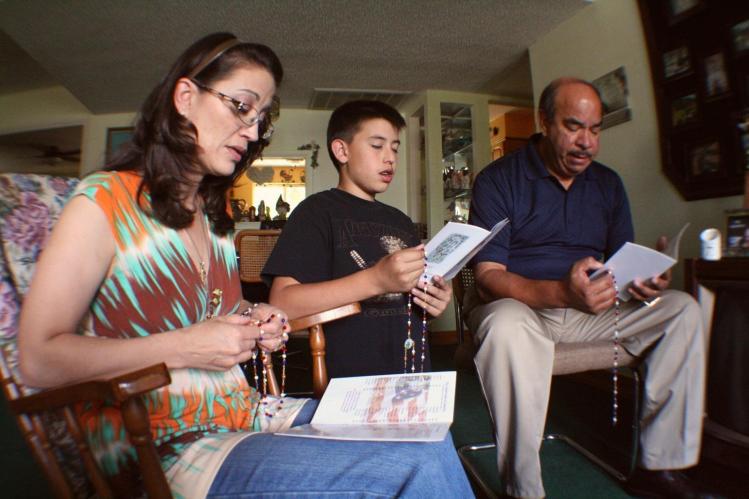
In Church Life Journal, Michael Rota and Stephen Bullivant have a useful analysis of why cradle Catholics continue to flee the Church in extraordinary numbers and what might stanch the exodus (“Religious Transmission: A Solution to the Church’s Biggest Problem”). They note that a big part of the problem is that even those who still identify as Catholic show up at weekly Mass only 11 percent of the time, which makes handing on the faith to the next generation almost impossible. “We are losing nine out of ten cradle Catholics,” they write, a rate of defection even higher than that of other troubled religious groups. Most of those leaving the Church end up identifying with the ever-growing number of religious “Nones.” Why this steady dwindling of the faithful? “Catholic parents are, for the most part, failing—failing to effectively hand on a life of faith to their children,” they argue.
The reasons for that failure are, to some extent, unsurprising. For one thing, the rate of interreligious marriage has increased among Catholics, as it has for most other Americans. Implicitly, that sends a mixed message to children about the centrality of Catholicism in a parent’s life. Similarly, homogeneous religious neighborhoods and subcultures have been replaced by a more religiously pluralistic and secular world. “Wavering Catholics of, say, 1925 would have experienced a strong pull towards Catholic belief and practice from a close group of Catholic extended family, Catholic friends, and (often) Catholic neighbors and co-workers,” Rota and Bullivant write. Today, after the suburbanization of America, those social pressures simply don’t exist. At the same time, American popular culture, once respectful and protective of traditional Christian belief, has been superseded by an antagonistic and often openly hostile cultural milieu. Obviously, the sexual revolution of the 1960s also had a major role in making traditional Christian sexual morality seem archaic, if not inimical to personal fulfillment. “The preambles of the faith and Christian morality are no longer the cultural default,” Rota and Bullivant write. “While the wider culture used to gently pull American youth towards traditional Christianity, the opposite is true today.” The recent Commonweal symposium on sociologist Christian Smith’s Why Religion Went Obsolete: The Demise of Traditional Faith in America covers much of this same ground.
If parents are ambivalent toward Catholic teaching, Rota and Bullivant observe, their children will inevitably be influenced by those feelings, and this will make a firm commitment to Catholicism all the more difficult. And if a family’s religious observance is limited to Sunday Mass, while neglecting prayer, the reading of Scripture, other sacraments and sacramentals, and other distinctive Catholic practices, there is little chance of children fashioning a stable Catholic identity.
In conclusion, Rota and Bullivant propose that passing on the faith requires that Catholics marry Catholics, remain married, pray with and talk to their children about religion, and send them to Catholic schools. It is equally important to situate the family in a community of Catholics “where they would pray together. Where they would learn in very concrete ways how to practice the faith in their homes with their children. And, crucially, where both parents and children would form strong bonds with other Catholics.” In other words, it takes a village.
Their proposal is a demanding one, and it reflects the universal call to holiness issued by the Second Vatican Council. Historically, of course, it might be fair to ask if this level of religious engagement—indeed, spiritual ambition—has ever been achieved by most Catholics. Outside of the sort of intentional communities one sometimes finds around conservative Catholic colleges, is it a realistic agenda for most Catholics in twenty-first-century America? It is tempting to see these well-meaning proposals as an effort to recreate the solidarity and boundaries of the Catholic subculture that thrived in the first sixty years of the last century, and there is a good deal of sociological truth in what Rota and Bullivant have to say.
Their account of what a cohesive Catholic community might look like describes much of the Catholic world of my grandparents and, to some extent, of my parents. My grandparents lived literally across the railroad tracks from one another in modest middle-class houses. My paternal grandfather was a bread salesman with an eighth-grade education. He was pious—he constantly fingered his rosary in church—and differential toward the clergy. My maternal grandfather was a lawyer and eventually a municipal judge. He had gone to a Jesuit college, and at least in private expressed a certain anticlerical skepticism. Once, when I was waxing romantic about Catholicism, he cautioned me: “You can’t believe everything they tell you.” Both men had married Catholics, as did my parents and my mother’s two sisters. (My father was an only child.) In order to marry one of my aunts, her future husband converted—a once-common demand. My mother’s family lived across the street from one of her mother’s sisters and down the road from another. Both were married to Irish Catholics. My father’s best man at my parents’ wedding was my mother’s cousin from across the street.
Thanks to the opportunities and affluence of the 1950s and ’60s, my father and uncles pursued careers that took their families away from a “close group of Catholic extended family, Catholic friends, and (often) Catholic neighbors.” My sense is that, while never repudiating their faith, they welcomed the distance from a sometimes-claustrophobic ethnic and religious environment. They had to make their way in a new and more multicultural America where Catholic enclaves were no longer the norm. How to pass the faith on to their children was no longer a question that answered itself. As Christian Smith notes in his new book, it is unlikely that even good evangelical programs can significantly combat the powerful cultural and economic forces that are driving Americans away from the churches.
I grew up in a leafy, predominantly Protestant Connecticut suburb. Initially, there was just one Catholic church in town, but eventually another was built as more Catholics migrated from New York City. Like most of the children of our Catholic neighbors, we were not sent to the small Catholic elementary school. The excellent public schools were a big draw. But there was another reason Catholic schooling was not an option. When my mother was twelve, her mother died, and she was sent to a Catholic boarding school for what proved to be a traumatic year. She either was unable or refused to learn French, the only language spoken during meals. As a consequence, she was often denied food, or so she claimed. In any event, Catholic schooling would not be a priority for her children. We would, of course, get religious instruction after Mass, where we were taught the Baltimore Catechism by black-robed nuns. There were five of us children and we went to confession regularly, attended Church in jackets and ties and dresses every Sunday, and were all confirmed. We fasted before Mass and ate fish sticks and canned tuna on Fridays, before those disciplines were abandoned. The Catholicism of my childhood was understood to be the bedrock of sexual morality and personal discipline. Religion, however, was rarely discussed and the Bible never opened or mentioned. We did not say grace at meals or recite the rosary. We sometimes saw our father saying his prayers on his knees before bed, and there was a crucifix on the nearby wall. But when religion was mentioned, it was the Church that was mentioned, not Jesus. In short, the Church was a source of authority, especially for our father, in an otherwise uncertain and threatening world. My mother’s attitude was more ambivalent and eventually indifferent. She was constantly pregnant for almost ten years, giving birth to five children. She eventually gave up going to Church, expressing exasperation with women she knew were using contraception but nevertheless received Communion. For her, you were either all in or simply outside the Church.
In short, our extended family was an almost textbook example of the transmission problems Rota and Bullivant describe. Two of my siblings and I married non-Catholics. My father did express reservations about my marrying a Jewish woman, but my parents never suggested I should marry only a Catholic. My two brothers married Protestants. That said, of the five of us, I am the only churchgoer. Our children, as well as my cousins, nieces, and nephews, few of whom benefited from the sort of sustained religious practices or community Rota and Bullivant celebrate, seem to have little interest in religion. Since I was ambivalent about certain Catholic moral teachings and appalled by the Church’s historical antisemitism, I suppose it was inevitable that my children would view my faith from a certain distance.
Still, I don’t see how contemporary Catholics, immersed in the world of modern American commerce and exposed to the depredations of an essentially anarchic popular culture, will be able to fold themselves back into the sort of religiously exclusive communities Rota and Bullivant envision. Nor am I sure that would be a good thing. The Church has long cast a skeptical eye on the sort of sectarianism implicit in walling off Catholics from the larger world. More than fifty years ago, in the wake of the Second Vatican Council, the novelist and critic Wilfrid Sheed, son of two of the last century’s greatest Catholic evangelists, made the following assessment of Catholicism’s prospects in this fiercely materialistic and individualistic society. “The one kind of society that the Church cannot adjust to is no society at all, i.e., a setup where community has become so fragmented that a communal religion is a fiction, sustained only by talk and make-news items in the press and television,” he wrote. “A religion is simply a society in one of its aspects, and if the American Catholic Church is scattered and confused right now (and even its best friends don’t deny it), consider the rest of America. The cure, if it comes, would include a cultural revolution affecting many things besides the Catholic Church.”
While I wait impatiently for that cultural revolution, I take some solace from the anthropologist Mary Douglas’s understanding of Catholicism’s traditional realism when it comes to the fragility of religious commitments. The universal call to holiness, so manifest in efforts at Catholic re-entrenchment, is a necessary spiritual exhortation. But to the degree that most of us fall far short of that goal, might such a high bar have propelled many tepid Catholics toward the exits? “Individuals should not all expect to play the same roles: in an organic system the head and the hands perform different functions,” Douglas wrote of the unappreciated benefits of hierarchical and ritualistic religious communities such as Catholicism.
Within this doctrinal form there is often the idea that great sanctity is exceptional. Yet thanks to the mystical incorporation of individuals, the sharing of grace evens up the inequities between people or over time, the spiritually well-endowed providing a welfare fund from which benefits flow to the rest. More honor for public formality allows less pressure on personal sanctity, more tolerance for compromise, and lower levels of spiritual aspiration.
Catholicism has always been a community that includes both the “spiritually well-endowed” and the spiritually impoverished, and I suspect that has been one of its attractions and great strengths. When it comes to the transmission of the faith, it can be an evasion to say you must first meet people where they are. But in the end, where else can you meet them?


No comments:
Post a Comment