
Will Pope Leo find the courage to condemn the Palestinian genocide?
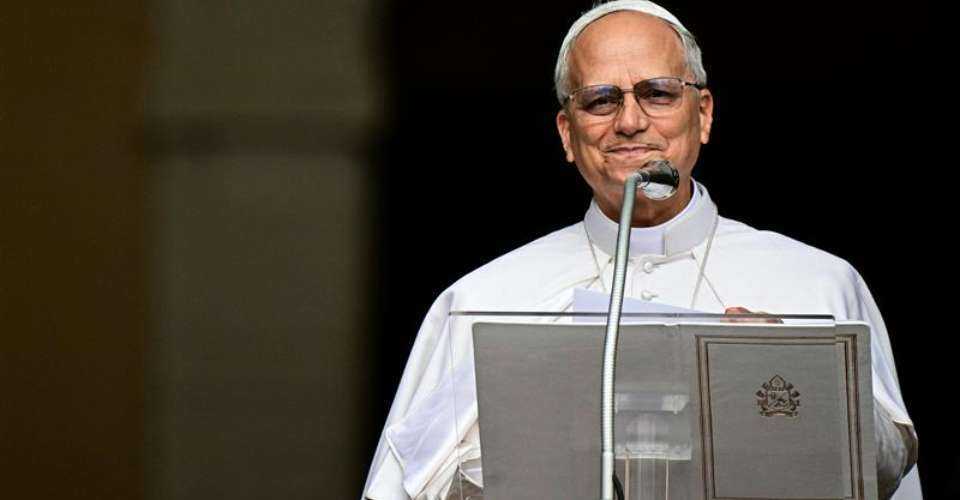
Pope Leo XIV addresses the crowd for the Angelus prayer in Piazza della Liberta (Liberty Square) in front of Palazzo Apostolico (Apostolic Palace) in the summer papal estate in Castel Gandolfo, 40 km southeast of Rome.
"We will not remain silent!" said Cardinal Pierbattista Pizzaballa, leader of the Roman Catholic Church in the Holy Land, in a July 18 interview with La Repubblica. "We have never been silent during these past months, and we do not intend to be now. We are not giving up," the Italian-born Franciscan, who is the Latin Patriarch of Jerusalem, told the Rome-based paper.
It was the day after the Israeli Defense Forces (IDF) attacked Holy Family Parish, the only Catholic church in Gaza. The attack, which the IDF claimed was an "accident,” killed at least three people and injured several others, including the parish priest. "The situation is desperate. Not just today and not only for the Christian community," the 60-year-old Pizzaballa said.
About 500 people, including 50 children with special needs, have been sheltering inside Holy Family for weeks to escape IDF attacks that have even targeted people waiting in line for food and water rations.
These events have occurred not only in the Gaza Strip but also in the West Bank, where radical Zionist settlers have violently besieged Palestinian villages in recent weeks. Most residents in these villages belong to the region's shrinking Christian community. Many have been living on this land for decades, if not centuries.

"I should not have to say this, but I'll say it anyway: the hospitals in Gaza are not equipped to treat all the wounded," said the Latin Patriarch, a former head of the Holy Land Franciscans.
From collective punishment to a full-blown genocide
The violent fighting now taking place in Gaza broke out on October 8, 2023, a day after Hamas, widely recognized as a terrorist organization and the current ruling government of the Palestinian State, savagely raided a number of Jewish kibbutzes, killing an estimated 1,139 people and taking more than 200 others hostage.
The international community immediately condemned Hamas, rightly so, but in the days and weeks that followed, the United Nations and many of its members also condemned Israel for retaliating in a grossly disproportionate manner. They accused Israel of carrying out collective punishment, which is a war crime under international law. As Israeli Prime Minister Benjamin Netanyahu ordered the IDF to intensify its attacks, and far-right Zionists in his government used dehumanizing language to define the Palestinians and vowed to totally destroy the Gaza Strip, international aid and relief agencies, including those connected to the United Nations, began speaking of a Palestinian or Gaza genocide.
Christian leaders, especially those of the Roman Catholic Church, have been careful, at least up till now, not to join this chorus. This is mainly because they are painfully aware of the long legacy of antisemitism that existed in their Church up until the Second Vatican Council (1962-65), where it was formally and definitively condemned in the landmark document Nostra Aetate.
And yet the specter of Catholic antisemitism still looms large, especially when it is coupled with the so-called silence of Pope Pius XII regarding the Holocaust during the World War II-era. (By the way, the Tridentine Mass perpetuated antisemitism and other "exclusionist" and "sectarian" views and doctrines that were denounced and/or redefined/developed at Vatican II; thus, its use today is completely inappropriate and in entirely contrast with the theology and ecclesiology of the post-conciliar Church.)
This ghost of Catholic antisemitism still casts such a long and dark shadow that it blurs the lines that separate the Jewish people from the State of Israel, to the point that Church officials, especially in the Vatican, are cautious about how they critique the state so they don’t appear anti-Semitic or anti-Jewish. This partly explains why they tend to avoid using words like genocide when describing what the IDF is doing in Gaza.
But the United Nations and many other countries have concluded that genocide is exactly what Netanyahu is trying to carry out.
"I can recognize a genocide when I see one," says Jewish expert on the Holocaust

They cite figures from the Gaza Health Ministry and other independent sources to support their claim. It is estimated that over 62,000 people have been killed in this conflict. 58,313 have been Palestinians – over half of them, women and children, civilians.
Even a leading Jewish professor who specializes in genocide studies recently said he had no choice but to recognize the same. "My inescapable conclusion has become that Israel is committing genocide against the Palestinian people," said Omer Bartov in an op-ed piece published on July 15 in the New York Times.
"Having grown up in a Zionist home, lived the first half of my life in Israel, served in the IDF as a soldier and officer and spent most of my career researching and writing on war crimes and the Holocaust, this was a painful conclusion to reach, and one that I resisted as long as I could," said Bartov, a professor of Holocaust and genocide studies at Brown University. "But I have been teaching classes on genocide for a quarter of a century. I can recognize one when I see one," he said.
The late Pope Francis was usually careful not to take a clear side in international conflicts. But he was a vocal critic of Israel's retaliatory attacks on the Palestinian population in Gaza and the West Bank. He never called it a genocide outright, but in Hope, a book-length interview released in English in early 2025, he pointed out that some international experts say that “what is happening in Gaza has the characteristics of a genocide.” Francis went on to say, “We should investigate carefully to assess whether this fits into the technical definition (of genocide) formulated by international jurists and organizations.”
Earlier, he had defined Israel's military assault on Gaza as an act of "terrorism". At one point, the Israeli Embassy to the Holy See publicly rebuked him after he also decried Israel for carrying out acts of "cruelty" against children. The embassy accused Francis of willfully ignoring the atrocities committed initially by Hamas.
The late pope symbolically underscored his opposition to Israel's attacks and support of the Palestinians by calling the Holy Family Church in Gaza almost every single evening, even during his long hospitalization before he died. He would offer his prayers and encouragement to the parish priest (a fellow Argentinian) and his parishioners.
Pope Leo continues to make a little use of his greatest advantage
What has been Leo XIV's response during these just over 10 weeks since he became Bishop of Rome? The soon-to-be 70-year-old American pope began his pontificate on May 8 by expressing a desire to promote and work tirelessly for peace in the Church and the world. He has done so proactively, gently encouraging people (including warring world leaders) to sit down together to meet and negotiate. He has preferred this approach over criticizing or condemning them. Francis also favored the carrot over the stick. However, without intending to compare the two men, the Jesuit pope has done so in a way that is much more forceful and passionate than the approach of the Augustinian pope.
And yet, Leo has a significant advantage over Francis in effectively conveying his words and messages to the entire world. The latter was limited in his linguistic skills, speaking only Spanish and Italian. But the former, who speaks fluent Italian, French, and Spanish, is also a native English speaker. He can convey his message in the world's current lingua franca. This is an invaluable resource.
Unfortunately, Leo, for some inexplicable reason, has not taken this opportunity. If he were to make his peace appeals in English instead of Italian, and especially if he did so with more passion than he has so far, he would be featured on all the major international news networks, not just the ones in English. It is extremely frustrating and perplexing that no one in the Vatican's Secretariat of State or its media department has made the case for him to do this.
The pope says the Church must use blunt language, but he has not
Pope Leo has been loath to condemn atrocities anywhere in the world. Yet in an address to foreign ambassadors at the beginning of his papal ministry, he said there were "three essential words that represent the pillars of the Church’s missionary activity and the aim of the Holy See’s diplomacy" – "peace", "justice", and "truth". He told them, "The Church can never be exempted from speaking the truth about humanity and the world, resorting whenever necessary to blunt language that may initially create misunderstanding... Truth, then, does not create division, but rather enables us to confront all the more resolutely the challenges of our time."
The American pope has avoided using blunt language, especially regarding the genocide happening in Palestine. He has only issued boilerplate statements expressing his "deep sadness." Since the July 17 attack on Holy Family Church, he has remained silent. Instead, the Secretary of State, Cardinal Pietro Parolin, sent a "telegram" to the Latin Patriarch of Jerusalem to convey the pope's sentiments. Who sends telegrams in the 21st century?
Disappointingly, Pope Leo's anodyne appeals and comments about tragedies sound less like the excoriations of Old Testament prophets and more like US politicians who support gun rights when confronted with school shootings. Like the latter, Leo has offered little more than "thoughts and prayers". He has been loath to condemn or criticize Israel for its brutal attacks against the Palestinian people. Arguably his most "forceful" comments came on the Feast of Corpus Christi.
"Alarming news continues to emerge from the Middle East, which includes people’s daily suffering, especially in Gaza and the other territories," the pope said... "Today more than ever, humanity cries out and calls for peace. This is a cry that requires responsibility and reason, and it must not be drowned out by the din of weapons or the rhetoric that incites conflict. Every member of the international community has a moral responsibility to stop the tragedy of war before it becomes an irreparable chasm," he continued.
Will the pope change course on Sunday?
"War does not solve problems; on the contrary, it amplifies them and inflicts deep wounds on the history of peoples, which take generations to heal. No armed victory can compensate for the pain of mothers, the fear of children, or stolen futures. May diplomacy silence the weapons! May nations chart their futures with works of peace, not with violence and bloodstained conflicts!"
Granted, Pope Leo has not had a public engagement since the July 17 attack on the Catholic parish in Gaza. However, he will have such a forum this coming Sunday when he gathers with the people near the papal summer residence at Castel Gandolfo, located in the hills outside Rome. Hopefully, he or his aides will come to the realization that this is a golden opportunity for him to make a heartfelt appeal for peace, denounce the aggressors of the atrocities, and – if he wishes – rightfully continue to encourage more exerted efforts toward peace negotiations.
But he must do this in English. And he must do so more forcefully and with greater passion than a principal reading out the daily announcements in a high school cafet


No comments:
Post a Comment