
A Church at the crossroads
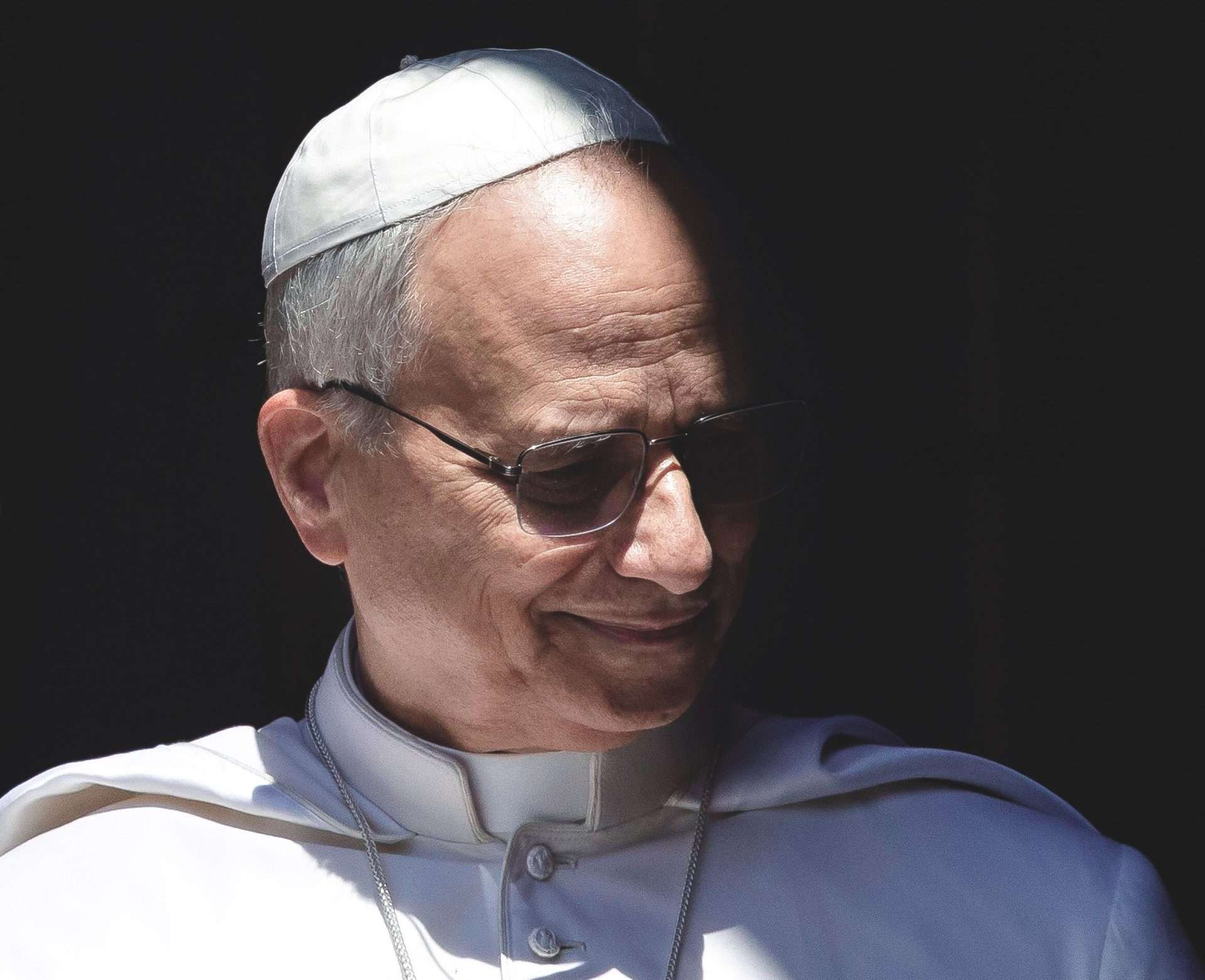
Pope Leo leads the Angelus on Sunday at his summer residence of Castel Gandolfo
Alamy/Sopa
In what direction will Pope Leo XIV take the Catholic Church? And who will follow his lead?
In the days following Robert Prevost’s election as Pope Leo XIV, the
world sought to understand this relatively unknown man. While his name
had emerged late in the game, few had expected him to be elected. In
many ways, Leo is a blank slate.
Slowly but surely, a picture emerged
of Robert Francis Prevost: a native of Chicago whose mosaical roots
chronicle the very best of the United States; a missionary who went off
to Peru, whose formative experiences with the people there taught him
what it means to be a pastor; a son of St Augustine who would inherit
the keys of St Peter.
Leo’s election as the 267th leader of the Catholic Church is a study in contrasts. The demure American pope versus the bombastic US president. The Vatican outsider who spent just a few years in the Roman Curia before taking control of the entire operation versus an entrenched bureaucracy eager to maintain its power. The humble Peruvian pastor versus the pomp and circumstance many still associate with the papacy.
How Leo will utilise the platform he’s been bestowed remains an open question. We know that he harbours deep concerns about modern life, worrying how rapid societal changes threaten those already living on the margins. We know he holds a sincere and abiding faith in Jesus Christ, praying the world finds the desperate peace it needs through the Gospels. In the months and years ahead, Leo will issue encyclicals, meet heads of state, and travel the globe. He will begin appointing new bishops, forming his own team of top advisers, and he will preach countless homilies. As the Catholic Church stands poised at this crossroads, what remains to be seen is who will follow him on the journey ahead.
Two images have stuck with me. In one, Prevost, in clerical black trousers and a white collar, is seated atop a donkey, presumably somewhere in Peru. A group of children flank him on either side. They are smiling, clearly delighted to be in the company of their pastor. Together, they are ascending a hill, mountains behind them, the children dressed in bright, festive colours. Prevost looks toward the camera, his bishop’s ring visible on his hand, and smiles. In many ways, his smile in that photo feels more spontaneous than the smiles captured at official papal events in the weeks following his election. It is the smile of a pastor, someone delighted to be among his people spreading the Gospel and living far from the grandeur of Rome.
The second is more recent, from fewer than 48 hours after his election. It was Saturday afternoon, and Leo had left the Vatican for the first time since becoming pope. He wanted to go on an unannounced visit to the hilltop town of Genazzano, about an hour’s drive outside of Rome. His purpose: to pray at the Shrine of the Mother of Good Counsel, an ancient image of the Virgin Mary that has been under the protection of the Augustinians since the fourteenth century.
After spending some time in prayer and in a private meeting with the community, he emerged on the streets to a crowded piazza full of locals eager to celebrate his surprise visit. Onlookers chanted his name and reached out their hands to greet him. After pausing for photos and embracing the townspeople, he made a brief address to the crowd. He told them that he wanted to visit this special place early on in his ministry, and he recalled a visit there after he was elected prior general of the Augustinian Order and he made his choice to “offer his life to the Church”.
He blessed the crowd, waved, and then boarded the passenger seat of
the van. Not unlike that photo of him atop a donkey in Peru, he was
again surrounded by his flock. But now, he was expected to shepherd the
entire world.
Christopher White is associate director and senior fellow at Georgetown University’s Initiative on Catholic Social Thought and Public Life; he was the Vatican correspondent for the National Catholic Reporter for four years. Below is an extract from his book Pope Leo XIV: Inside the Conclave and the Dawn of a New Papacy, published by Hodder & Stoughton, £14.99 (Tablet price, £13.49)
Prevost’s way: Those who have worked closely with Robert Prevost describe someone who is discreet, calm, thoughtful and unpretentious, emotionally adroit, an attentive listener, respectful of other views, a bridge-builder and peace-maker
His personality and leadership style are well suited to the kind of collaborative leadership that tends to drive change today
Few seemed more elated in Rome on the evening of the election of Pope Leo than Sr Nathalie Becquart, the French Xaverian religious sister who had devoted years of her life to helping Francis realise his dream of a synodal Church. The late pope appointed Becquart as the number two official at the Vatican’s synod office in 2021. For four years she travelled the globe as an ambassador for the cause, working tirelessly to promote synodality, perhaps nowhere more difficult than in the predominantly all-male Roman Curia.
Becquart had two major strikes against her as far as the Church’s top bureaucrats were concerned: she was a woman, and she was a non-Italian. But she had an advantage even some of them did not: she had the late pope’s backing. In the days after Francis died, Becquart was often seen praying near his body lying in state at St Peter’s Basilica. There was little doubt among onlookers that she was pleading, at least in part, for the continuation of the cause to which the two had been so committed.
Becquart was on her way home to the apartment in the Vatican’s Holy Office a few hours after the white smoke had appeared and the crowds had dispersed from the square. It’s likely that she was exhausted from the activity leading up to the conclave, from the stress and uncertainty that dominated during the interregnum, yet she must have felt buoyant given the nod of papal approval Leo offered the synodal project during his first words as pope. “To all your brothers and sisters of Rome, Italy, of all the world, we want to be a synodal Church,” he told the crowd from the balcony of St Peter’s.
Then, another sign. Standing near her, her former neighbour, garbed in his new white robes, was the newly elected Pope Leo XIV. “So glad to meet and congratulate our new synodal pope coming back to our palazzo,” Becquart later posted on social media, the selfie with the new pope showing tears streaming down her face.
A few days later, Becquart would reflect on Leo in the Vatican’s daily newspaper, L’Osservatore Romano: “I have observed a man with a great sense of listening – simple and discreet, calm and thoughtful – embodying the core attitudes of synodal spirituality: humility, humanity, trust, a search for unity as harmony in diversity, discernment, attentiveness to concrete situations and consideration of complexity, a desire to work for peace and communion, simplicity, and openness to the questions of the world.”
Her prayers had been answered. When he gathered the cardinals
together for their first meeting with the new pope, Leo chose as the
meeting space the Vatican’s synod hall, not the Apostolic Palace, where
the Pope typically meets with heads of Vatican departments. And while
Leo offered a formal address, it lasted just 15 minutes, leaving the
bulk of the meeting to questions, discussion, and shared discernment.
Cardinals had questions as to where and how the Church should head next.
For
two hours, they sought to find shared answers. “Walking with his
cardinals is a post-Francis sign of a more synodal papacy,” the British
theologian Anna Rowlands told me. “If Francis wanted a more synodal
Church, I suspect Leo XIV wants a more synodal papacy.”
Imagery associated with the papacy – adoring crowds chanting the pope’s name, regalia fit for a king, a literal throne – doesn’t necessarily convey the kinds of attributes typical of modern executives. But people who worked with Prevost in the past say that his personality and leadership style are well suited to the kind of collaborative leadership that tends to drive change today.
Susan Pascoe from Australia, who served as one of the moderators during the 2023 and 2024 synod decisions, concurs. During last October’s assembly, Cardinal Prevost was at her round table during the entire month, except there was no use of titles or honorifics. Participants at each table were asked what they would prefer to be called. When it was the cardinal’s turn to answer, he said simply, “Robert”.
“You do get insights into a person when you spend a month with them,
seated at a round table engaging in a methodology to give spaces for all
the voices to be heard, and in the process for the wisdom of the Holy
Spirit to emerge,” Pascoe told me.
As someone who has worked as a top
executive in Australia’s healthcare and education services, Pascoe
knows well what attributes a leader needs in order to bring people along
with them. She said Prevost displayed many of them during their time
together: “Emotionally adroit, unassuming, unpretentious, and
relational.”
Plus, she said, he possesses the kind of emotional intelligence a good leader needs. “He could definitely read the dynamic around the tables in which he participated and interacted according to the topic and conversation flow, rather than according to ecclesial status,” she said. “He was respectful of other views, listened attentively, and responded accordingly. His disposition led toward compassionate and non-judgmental responses.” She added: “He seems to be low ego, which I see as a leadership attribute, as the person can focus on the people and tasks at hand rather than positioning themselves for accolades or affirmation.”
When it comes to the role of women in church life, Cardinal Prevost fully supported inviting women into governance positions in the Curia, working closely with Becquart in the synod office and with Emilce Cuda, the secretary for the Pontifical Commission for Latin America. He also supported Francis’ decision to add women to the dicastery that vets potential bishops, saying in 2023, “Their opinion introduces another perspective and becomes an important contribution to the process.”
María Lía Zervino, the Argentinian former head of the World Union of Catholic Women’s Organisations and one of those women who served on that dicastery, had high praise for his leadership. “I’m convinced that he doesn’t need to learn how to work [with women], how to let them speak, to listen to them, to have them participate in decisions, because that’s what he does anyway,” Zervino said after Leo’s election, adding: “When you see someone who is balanced, peaceful and respectful and who welcomes what you say and is always ready to hear the other, you have faith in him.”
On the possibility of ordaining women priests, he has expressed more traditional positions, saying the “very significant and long tradition of the Church” on the issue is well-known and he has not expressed a desire to change it. While he voiced some fears about “clericalising women”, he has not taken a clear stand on the issue of restoring women to the diaconate, something Francis reopened but never decided upon. “Two commissions on women deacons indicate there is certainly openness to giving that question consideration,” he said at a press conference in 2023. Now, what happens to the work of those commissions is a decision for him to make.


No comments:
Post a Comment