
16 June 2020, The Tablet
Abuse scandal linked to status of women in Church


It is a ‘matter of urgency’ to have more women in leading positions: Cardinal Marx
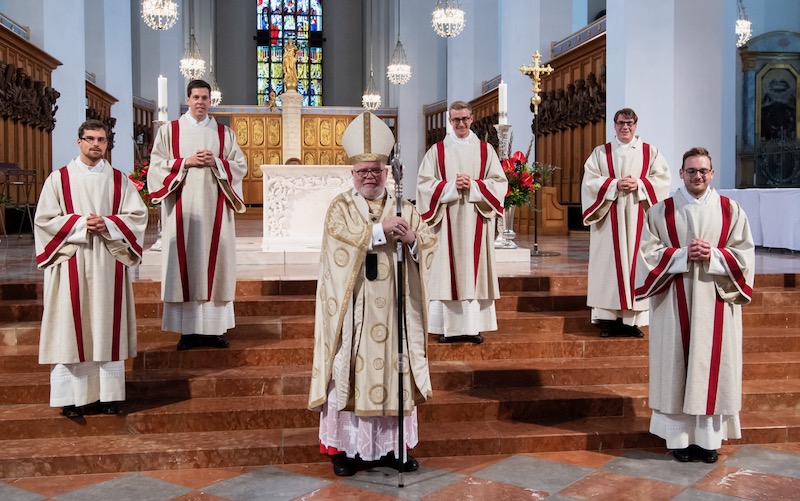
Cardinal
Reinhard Marx, Archbishop of Munich and Freising, with five candidates
for the priesthood, at their ordination May 2020.
Sven Hoppe/DPA/PA Images
Sven Hoppe/DPA/PA Images
“Changes in this field are really urgent and must be pressed ahead
with,” he warned. “We talk a lot about the Church’s new social form and
on no other point is this reflected more clearly”, Marx said last week.
He was commenting on the publication to a wider audience of an
address he held at the Council of Cardinal Advisors in Rome in December
2019. The secretariat of the German bishops’ conference published it as
part of a series it is producing on conference presidents.
In his 2019 address in Rome, Marx recalled that in the 2018 study of
clerical sexual abuse commissioned by the German bishops’ conference,
which showed that 3,677 children and adolescents had been abused by
1,670 priests between 1946 and 2014, clerical structures and a clerical
administration had been named as a factor in the massive abuse in the
Church and its cover-up.
“Women in leading positions in the Church – and this is precisely not a matter of women’s ordination – contribute towards breaking up closed male clerical circles and associations in the Church…For the sake of our credibility as a Church and our credibility as bishops, we must do everything we possibly can to get women to take up leading positions in the Church,” Marx wrote. “The developments and experiences of recent years in the Church in Germany – and probably worldwide – show us that for young people, both men and women, serving the Church has become less and less attractive. They simply do not believe that the Church will treat women as equals or really allow them to participate”.
In personnel development, the term “unconscious bias” (Marx uses the English words in inverted commas) is used to describe the unconscious preferment of candidates with whom one is more familiar than with others because, for example, they are of one’s own gender, he recalled.
The second important point was that women in leading positions in the Church needed role models to attract them to church service. “Particularly as far as public relations and press work are concerned, we have not yet succeeded in making women more visible. We must appoint press spokeswomen, for example, to make it clear that women, too, give the Church a face and can speak for it”.
Bishop Hans-Josef Becker of Paderborn is already advertising positions for women. His diocese offers part-time jobs, possibilities of working from home and the opportunity of sharing a leading position with dual authority – “in tandem”, as he puts it. He aims to improve on the 30 per cent of women in important positions that the bishops’ conference has made its aim.


No comments:
Post a Comment