
21 January 2020, The Tablet
Rome summit to examine clerical sex abuse


Fr Hans Zollner, the Church’s leading child protection expert, wants more systematic theology done on abuse crisis
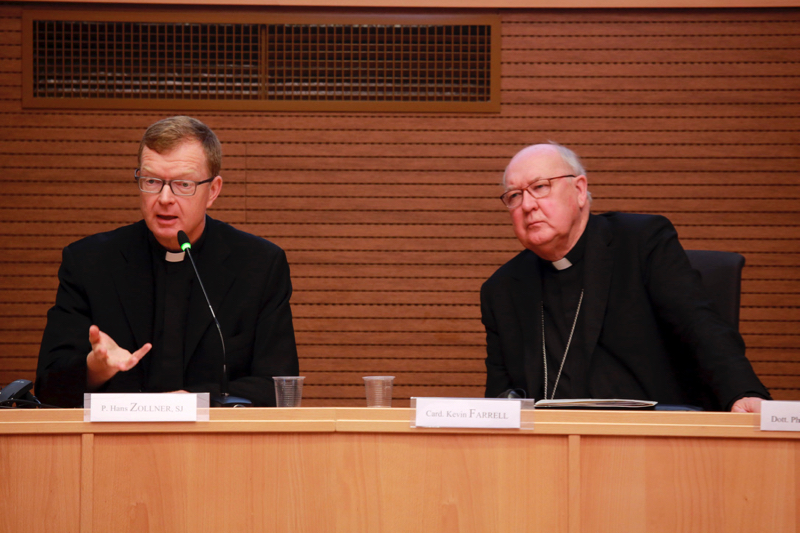
Hans Zollner, of
the Pontifical Gregorian University in Rome, pictured here with
Cardinal Farrell, at a child protection meeting last summer.
Photo: CNS/courtesy Dicastery for Laity, Family and Life
Photo: CNS/courtesy Dicastery for Laity, Family and Life
Rome
is to host a summit examining how the clerical sexual abuse crisis is
forcing the Church to go back to its core mission and re-think its model
of the priesthood.
The gathering of around 90 theologians
from across the world, hosted by the Centre for Child Protection at the
Pontifical Gregorian University, will look at the ecclesiological impact
of abuse, in a way that is not simply legal, or procedural. The 11-14
March meeting is to look clericalism, ecclesial reform and rediscovering
the mission of Jesus in Church structures.
At a theological level, the abuse of
children by priests, and the failure by bishops to respond adequately,
is doubly shocking because it betrays the Church’s mission. Historians
talk about it being the greatest crisis since the Reformation and for
organisers of the forthcoming summit, the response to abuse requires
deep soul searching about what it means to be the Church.
But Fr Hans Zollner, the centre's
director and the Church’s leading child protection expert, said that
while the abuse crisis has been under discussion in the Church for 35
years there has been “very little attempt to do systematic theology” on
it.
The aim, he said, was to bring
“theological expertise and creativity” alongside the legal, practical
and psychological work that had been done. Fr Zollner, a theologian and
psychologist who sits on the papal child protection commission, is
organising the gathering with a fellow Jesuit, Fr James Keenan, the
Canisius Professor of theology at Boston College and esteemed moral
theologian.
People may say: "Why are you dealing with
this in a theological way? You should follow the law properly. Why do
you spiritualise it again?” Zollner told The Tablet. “The
response is ‘no’, we are trying to bring this to the attention of our
faith, and reflection of the faith, a faith that says, first of all,
Jesus himself was a victim of violence, he identified with the most
vulnerable.”
He added: “What does our faith in Jesus
Christ tell us about how we should meet with survivors of abuse inside
and outside the Church? How do we talk about forgiveness in the face of
horrible crimes? How do we talk about healing?
“How do we understand the Church that has
shown to be for centuries a beacon of protection and support and care
of the most vulnerable but at the same time it has also been – as we
have seen in the last decades – a place where people have been taken
advantage of in a horrific way?”
The discussion points include “punishment
and reconciliation”, bringing justice to victims, moving the priesthood
away from clericalism to a ministry of service, “rediscovering Jesus in
ecclesiology” and seeing the Church’s mission as helping to guide
reform.
Church observers have pointed out that
the abuse crisis is hastening the end of a clericalist system that
placed protection of the institution as paramount, where priesthood was
idealised and leaders were unaccountable. Pope Francis has talked about
the clerical abuse scandal “purifying” the Church with the abuse crisis
seeing bishops resign, a cardinal put into jail and another removed from
the priesthood.
Senior bishops and Vatican leaders are
expected to be in the spotlight once again when a report into
ex-cardinal and ex-priest Theodore McCarrick is published in the coming
weeks.
The link between theology and
safeguarding was looked at by the Royal Commission into Institutional
Responses to Child Sexual Abuse in Australia, one of the most probing
state inquiries to have taken place. In their final report, the
commission sharply criticised clericalism but added that the Church’s
understanding that an “ontological change” takes place at priestly
ordination aggravated the problem. The commission also called for an end
to mandatory clerical celibacy.
The summit, which comes just over a year
after the Pope's landmark meeting to discuss the issue in the Vatican
last February, will be a chance for theologians, rather than secular
officials, to look at these questions, although they are likely to take a
more nuanced view than the royal commission.
Theologians from North America, Europe,
Africa, Asia and Latin America will attend the event, including four
delegates from Australia and Professor Paul Murray and Dr Marcus Pound
from the University of Durham in the UK.


No comments:
Post a Comment