
23 January 2020, The Tablet
A book and an unseemly ruckus in Rome


A distasteful dispute
over whether Benedict is a co-author or just a contributor to a book
defending priestly celibacy is being seen as part of a deliberate
strategy to undermine the reforms of Pope Francis – a plot into which the Pope Emeritus has been drawn unwittingly as an ally
Picture the scene. Over the first seven years of his papacy, the latest successor of St Peter makes a series of eye-catching reforms. He returns to live in the Vatican’s Apostolic Palace and decides to travel around in a chauffeur-driven limousine. He appoints new cardinals from Italy and wealthy dioceses in the United States and replaces the few women who hold senior roles in the Vatican with priests. The synod of bishops meetings are quietly muzzled, and the ordination of married men to serve in the Amazon region at the request of the local bishops, which his predecessor had permitted, is wound down. Friends of the retired Pope, whose pontificate had focused on missionary outreach to the world’s poorest, beg him to speak out. Yet he remains silent.
This role reversal is worth considering when reflecting on the “two popes” saga that has rocked the Vatican in recent days. As the drama over Emeritus Pope Benedict XVI and Cardinal Robert Sarah’s book was reaching fever pitch, I bumped into a cardinal a stone’s throw from St Peter’s Square. “This will pass,” he said of the unfolding drama. “But even if they wanted a new pope to ‘go back’, it’s not possible. Too much has happened.”
The dispute over whether Benedict is a co-author or merely a contributor to a book defending mandatory priestly celibacy is about much more than whether the Western Church could or should return to an earlier tradition of ordaining married men as priests. It goes to the heart of the reforms of the Francis pontificate, and the freedom of the Bishop of Rome to exercise the office of the papacy.
The book at the centre of the furore was the initiative of Cardinal Sarah, the Rome-based prelate who, in spite of his fervent protestations of loyalty, fiercely opposes the direction Francis wishes to take the Church. Since being appointed prefect of the Congregation of Divine Worship by Francis in November 2014, the 74-year-old Guinean cardinal has been publicly corrected by the Pope on more than one occasion for promulgating traditionalist views at odds with the teaching of the magisterium.
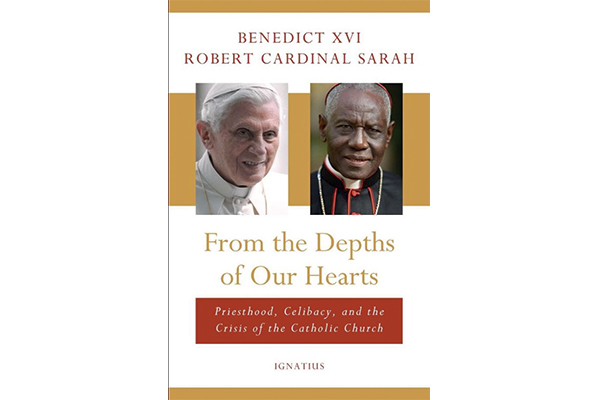
The controversy exploded on 12 January when extracts from Benedict and Sarah’s book From the Depths of Our Hearts: Priesthood, Celibacy, and the Crisis of the Catholic Church appeared in the French daily newspaper Le Figaro, two days before its publication in France by Fayard. In a joint introduction, the co-authors say they are following the example of St Augustine. “Indeed, like him”, Benedict and Sarah declare, “Silere non possum! I cannot keep silent!” They go on to make the incendiary claim that any opening to the ordination of married men would be a great danger to the Church, just as Benedict’s successor is considering whether to agree to the request of the bishops of the Amazon to allow married deacons to serve as priests.
Francis has defended priestly celibacy repeatedly, mindful that renouncing marriage for the Kingdom of God emulates the life of Christ and is held up as the ideal for discipleship by the Apostle Paul. All that Francis has done – like his predecessors John Paul II and Benedict XVI – is to hear sympathetically the case for the ordination of married men in some circumstances.
Some, however, see this as the thin end of the wedge. This is not about theology, it’s about trust. The book was seen to be a flagrant attempt to undermine the Amazon synod process by co-opting the authority of a retired Pope. With the front cover giving top billing to “Benedict XVI” as co-author, here was the retired Pope “breaking his silence” to speak out in defence of a threat to priestly celibacy.
Alarm bells were immediately raised in the Vatican. “Benedict, when writing theology, is always careful not to sign off with his papal name since his election as Pope,” one high-level source told me. “He always uses ‘Joseph Ratzinger-Benedict XVI’.” The source did not believe that the 92-year-old Pope Emeritus, who, though mentally alert, finds it increasingly difficult to write and speak, could ever have approved the front cover of the book or agreed to be a co-author.
On Tuesday 14 January, two days after the news of the book leaked, Archbishop Georg Gänswein, Benedict’s personal secretary as well as prefect of the papal household, issued a statement clarifying that the Pope Emeritus was not the co-writer. Benedict, he claimed, had not seen the front cover and had not authorised the book’s joint introduction and conclusion. He said he had asked Cardinal Sarah, “on the instructions of the Pope Emeritus”, to contact the publishers of the book and ask them to remove the name of Benedict XVI as co-author.
“It was a misunderstanding,” Gänswein concluded, “that does not cast doubt on the good faith of Cardinal Sarah.” Gänswein later debunked the claim swirling in Rome that Francis had called him to pressure him to distance the Pope Emeritus from the book. The book had been sent to Francis but he’d said nothing about it.
GAnswein’s version of events seemed to contradict that released a few
hours earlier by Cardinal Sarah. According to a detailed statement
issued by the cardinal, Benedict XVI had been fully informed of the
plans. Writing on Twitter, Sarah had added that he “solemnly affirms”
that the Pope Emeritus knew their project would take the form of a book.
He also took the extraordinary step of releasing (typed) letters from
Benedict XVI seeking to prove that he had agreed to their joint
collaboration. “I sincerely forgive all those who slander me,” he added
with a flourish. The letters do not mention joint authorship but they do
show that Benedict is now barely able to write his signature.
In spite of Benedict’s instructions, Fayard pushed ahead with the book, unchanged, while Ignatius Press, due to publish the English-language edition next month, has doubled down and is refusing to acquiesce to Benedict’s wishes.
Archbishop Carlo Maria Viganò, the most vociferous of the anti-Francis prelates, entered the fray, attacking Gänswein for “abusive and systematic control” of Benedict, and claiming that the Pope Emeritus once referred to his secretary as the “Gestapo”. Things were becoming vicious. Last Friday, after making a personal visit to Benedict, Sarah insisted there had been “no misunderstanding” between them, and denounced the “incessant, nauseating and deceptive controversies” around the book.
Fault lies on many sides. Archbishop Gänswein is Benedict XVI’s
gatekeeper, and it is he who facilitated the collaboration. The Pope
Emeritus is increasingly reliant on his closest aide as he becomes more
frail. Cardinal Sarah and his adviser, Nicolas Diat, the French
journalist and author, had secured an essay from Benedict for their
project, which the Pope Emeritus had told them they could use as they
saw fit.
But the claim that Benedict had agreed to be a co-author, and to be named as the joint author of its introduction and conclusion, is not backed up by a contract. When I asked Ignatius Press if Benedict had signed a contract to write a book, they referred me to Fayard, the French publisher, who told me they “never share this information”.
In his contribution to the book, Benedict sets out the case for clerical celibacy, drawing from Scripture and the Church’s tradition. Yet by appearing in the book he has lent his considerable theological stature to Cardinal Sarah’s less convincing arguments, which include the claim that married clerics would be “second-class” priests, and asserting “an ontological-sacramental link between the priesthood and celibacy”.
The Church’s teaching is that celibacy “is not demanded by the very nature of the priesthood, as is apparent from the practice of the early Church and from the traditions of the Eastern Churches” (Presbyterorum ordinis, 16), which Benedict himself confirmed by authorising the ordination of former Lutheran and Anglican married priests.
While Benedict is suggesting that the ordination of married men to the priesthood is undesirable, Sarah seems to be arguing that it is impossible. There is a theological chasm between the two positions. “Spaghetti with tomato sauce is the best thing there is,” is how one Rome source put it to me about priesthood and celibacy. “This does not prevent you from cooking many excellent dishes without tomato, and a married priest can, if God wishes, be holier than a celibate priest.”
Opponents of Francis, the same source added, are trying to “create
pretexts” to accuse the Pope of heresy when in reality this is a
“pastoral, non-dogmatic” question. This is not the first time Benedict
has been drawn into attempts to pit “the two popes” against one another.
Last year he wrote a distinctly patchy 6,000-word essay on the clerical
sexual abuse crisis, which few considered could have been written by a
Joseph Ratzinger still in his prime.
Ever since his election, Francis has faced resistance, something that any reform-minded figure can expect from inside a large institution of many millions of people. But the opposition to this Pope is relentless and public, with a small minority in open rebellion. They are furious that the first Latin American Pope is reforming the office of the papacy, and distrust his model of “servant leadership”.
More than holding a specific position and enforcing it, Francis has made his pontificate about opening processes, trusting in a living tradition that is rooted in an unchanging God. His free-wheeling, charismatic leadership, his tough decision-making and desire for the Church to give a voice to the poor, is a threat to the religious establishment. For that, he will never be forgiven.
Crucial to the strategy to undermine Francis is Benedict XVI, the Pope Emeritus, whom many see, incorrectly, as their best hope for ensuring the ancien regime lives on. His shock decision to resign destroyed those hopes but created an unprecedented scenario in the Church: two men living in the Vatican, wearing white and calling themselves “Pope”. For the most part, thanks to Francis’ magnanimity and Benedict’s loyalty to the papacy, the situation has been workable. But for opponents of the Pope, the temptation to set the temperamentally very different Benedict against Francis has proved irresistible.
There is a widespread sense in Rome, even among those who are less than enthusiastic about Francis’ reforms, that some of those close to the Pope Emeritus are trying to manipulate him. Benedict will be 93 in April, and is undoubtedly frail, and wherever one’s theological sympathies lie there is something distasteful about the wrestling over what he has written, or hasn’t written.
Yet part of the problem is of Benedict’s own making. Although he has pledged his loyalty to Francis, he has not remained “hidden” from the world, as he had promised. Time and again, he has made interventions that give the impression, whatever his intentions, that he still feels he must defend his legacy against an imagined attempt to undermine it. And he’s allowed himself to be associated with Francis’ opponents.
Many in Rome now believe it is time to have some clear legislation in
place when a pope retires. In February 2018 Pope Francis issued the
motu proprio “Learn to take your leave”, in which he argued that in
retirement church leaders must devise a “new plan of life, marked as
much as possible by austerity, humility, prayers of intercession, time
dedicated to reading, and willingness to provide simple pastoral
services”.
Perhaps something like these guidelines might be issued to cover any future “two popes” scenario. And an injunction to stay silent when your successor is facing a crucial decision might be added.
Picture the scene. Over the first seven years of his papacy, the latest successor of St Peter makes a series of eye-catching reforms. He returns to live in the Vatican’s Apostolic Palace and decides to travel around in a chauffeur-driven limousine. He appoints new cardinals from Italy and wealthy dioceses in the United States and replaces the few women who hold senior roles in the Vatican with priests. The synod of bishops meetings are quietly muzzled, and the ordination of married men to serve in the Amazon region at the request of the local bishops, which his predecessor had permitted, is wound down. Friends of the retired Pope, whose pontificate had focused on missionary outreach to the world’s poorest, beg him to speak out. Yet he remains silent.
This role reversal is worth considering when reflecting on the “two popes” saga that has rocked the Vatican in recent days. As the drama over Emeritus Pope Benedict XVI and Cardinal Robert Sarah’s book was reaching fever pitch, I bumped into a cardinal a stone’s throw from St Peter’s Square. “This will pass,” he said of the unfolding drama. “But even if they wanted a new pope to ‘go back’, it’s not possible. Too much has happened.”
The dispute over whether Benedict is a co-author or merely a contributor to a book defending mandatory priestly celibacy is about much more than whether the Western Church could or should return to an earlier tradition of ordaining married men as priests. It goes to the heart of the reforms of the Francis pontificate, and the freedom of the Bishop of Rome to exercise the office of the papacy.
The book at the centre of the furore was the initiative of Cardinal Sarah, the Rome-based prelate who, in spite of his fervent protestations of loyalty, fiercely opposes the direction Francis wishes to take the Church. Since being appointed prefect of the Congregation of Divine Worship by Francis in November 2014, the 74-year-old Guinean cardinal has been publicly corrected by the Pope on more than one occasion for promulgating traditionalist views at odds with the teaching of the magisterium.
The controversy exploded on 12 January when extracts from Benedict and Sarah’s book From the Depths of Our Hearts: Priesthood, Celibacy, and the Crisis of the Catholic Church appeared in the French daily newspaper Le Figaro, two days before its publication in France by Fayard. In a joint introduction, the co-authors say they are following the example of St Augustine. “Indeed, like him”, Benedict and Sarah declare, “Silere non possum! I cannot keep silent!” They go on to make the incendiary claim that any opening to the ordination of married men would be a great danger to the Church, just as Benedict’s successor is considering whether to agree to the request of the bishops of the Amazon to allow married deacons to serve as priests.
Francis has defended priestly celibacy repeatedly, mindful that renouncing marriage for the Kingdom of God emulates the life of Christ and is held up as the ideal for discipleship by the Apostle Paul. All that Francis has done – like his predecessors John Paul II and Benedict XVI – is to hear sympathetically the case for the ordination of married men in some circumstances.
Some, however, see this as the thin end of the wedge. This is not about theology, it’s about trust. The book was seen to be a flagrant attempt to undermine the Amazon synod process by co-opting the authority of a retired Pope. With the front cover giving top billing to “Benedict XVI” as co-author, here was the retired Pope “breaking his silence” to speak out in defence of a threat to priestly celibacy.
Alarm bells were immediately raised in the Vatican. “Benedict, when writing theology, is always careful not to sign off with his papal name since his election as Pope,” one high-level source told me. “He always uses ‘Joseph Ratzinger-Benedict XVI’.” The source did not believe that the 92-year-old Pope Emeritus, who, though mentally alert, finds it increasingly difficult to write and speak, could ever have approved the front cover of the book or agreed to be a co-author.
On Tuesday 14 January, two days after the news of the book leaked, Archbishop Georg Gänswein, Benedict’s personal secretary as well as prefect of the papal household, issued a statement clarifying that the Pope Emeritus was not the co-writer. Benedict, he claimed, had not seen the front cover and had not authorised the book’s joint introduction and conclusion. He said he had asked Cardinal Sarah, “on the instructions of the Pope Emeritus”, to contact the publishers of the book and ask them to remove the name of Benedict XVI as co-author.
“It was a misunderstanding,” Gänswein concluded, “that does not cast doubt on the good faith of Cardinal Sarah.” Gänswein later debunked the claim swirling in Rome that Francis had called him to pressure him to distance the Pope Emeritus from the book. The book had been sent to Francis but he’d said nothing about it.
In spite of Benedict’s instructions, Fayard pushed ahead with the book, unchanged, while Ignatius Press, due to publish the English-language edition next month, has doubled down and is refusing to acquiesce to Benedict’s wishes.
Archbishop Carlo Maria Viganò, the most vociferous of the anti-Francis prelates, entered the fray, attacking Gänswein for “abusive and systematic control” of Benedict, and claiming that the Pope Emeritus once referred to his secretary as the “Gestapo”. Things were becoming vicious. Last Friday, after making a personal visit to Benedict, Sarah insisted there had been “no misunderstanding” between them, and denounced the “incessant, nauseating and deceptive controversies” around the book.
But the claim that Benedict had agreed to be a co-author, and to be named as the joint author of its introduction and conclusion, is not backed up by a contract. When I asked Ignatius Press if Benedict had signed a contract to write a book, they referred me to Fayard, the French publisher, who told me they “never share this information”.
In his contribution to the book, Benedict sets out the case for clerical celibacy, drawing from Scripture and the Church’s tradition. Yet by appearing in the book he has lent his considerable theological stature to Cardinal Sarah’s less convincing arguments, which include the claim that married clerics would be “second-class” priests, and asserting “an ontological-sacramental link between the priesthood and celibacy”.
The Church’s teaching is that celibacy “is not demanded by the very nature of the priesthood, as is apparent from the practice of the early Church and from the traditions of the Eastern Churches” (Presbyterorum ordinis, 16), which Benedict himself confirmed by authorising the ordination of former Lutheran and Anglican married priests.
While Benedict is suggesting that the ordination of married men to the priesthood is undesirable, Sarah seems to be arguing that it is impossible. There is a theological chasm between the two positions. “Spaghetti with tomato sauce is the best thing there is,” is how one Rome source put it to me about priesthood and celibacy. “This does not prevent you from cooking many excellent dishes without tomato, and a married priest can, if God wishes, be holier than a celibate priest.”
Ever since his election, Francis has faced resistance, something that any reform-minded figure can expect from inside a large institution of many millions of people. But the opposition to this Pope is relentless and public, with a small minority in open rebellion. They are furious that the first Latin American Pope is reforming the office of the papacy, and distrust his model of “servant leadership”.
More than holding a specific position and enforcing it, Francis has made his pontificate about opening processes, trusting in a living tradition that is rooted in an unchanging God. His free-wheeling, charismatic leadership, his tough decision-making and desire for the Church to give a voice to the poor, is a threat to the religious establishment. For that, he will never be forgiven.
Crucial to the strategy to undermine Francis is Benedict XVI, the Pope Emeritus, whom many see, incorrectly, as their best hope for ensuring the ancien regime lives on. His shock decision to resign destroyed those hopes but created an unprecedented scenario in the Church: two men living in the Vatican, wearing white and calling themselves “Pope”. For the most part, thanks to Francis’ magnanimity and Benedict’s loyalty to the papacy, the situation has been workable. But for opponents of the Pope, the temptation to set the temperamentally very different Benedict against Francis has proved irresistible.
There is a widespread sense in Rome, even among those who are less than enthusiastic about Francis’ reforms, that some of those close to the Pope Emeritus are trying to manipulate him. Benedict will be 93 in April, and is undoubtedly frail, and wherever one’s theological sympathies lie there is something distasteful about the wrestling over what he has written, or hasn’t written.
Yet part of the problem is of Benedict’s own making. Although he has pledged his loyalty to Francis, he has not remained “hidden” from the world, as he had promised. Time and again, he has made interventions that give the impression, whatever his intentions, that he still feels he must defend his legacy against an imagined attempt to undermine it. And he’s allowed himself to be associated with Francis’ opponents.
Perhaps something like these guidelines might be issued to cover any future “two popes” scenario. And an injunction to stay silent when your successor is facing a crucial decision might be added.


No comments:
Post a Comment