
Under siege in a changed land
The Tablet
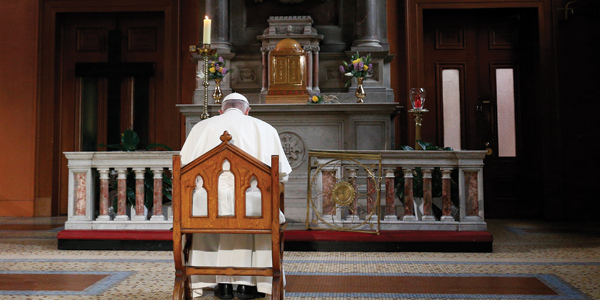
Pope Francis prays in front of a
candle in memory of victims of sexual abuse as he visits St Mary's
Pro-Cathedral in Dublin
The Pope in Ireland / Analysis
The Pope's itinerarySaturday 25 August to Sunday 26 August 2018
Click on the links to see the complete text of all six of his speeches and of his act of penance and his homily
SaturdayDublin Castle
St Mary’s Pro-CathedralCapuchin Fathers’ day centre
Croke Park for the World Meeting of Families
SundayKnock Shrine, County Mayo
Phoenix Park, Dublin: farewell Mass
Convent of the Dominican Sisters, Dublin, to meet the bishops
Francis’ trip to Ireland last weekend was the toughest and most difficult of his pontificate. Over the course of an intense 32-hour visit, the 81-year-old Pope came face to face with the rawness, anger and deep wounds caused by the crisis. No doubt it was inevitable that the issue of the sexual abuse of children by priests and its cover-up by church leaders would hang over events. However, there are questions over how well briefed the Pope had been about the scandal in Ireland; the wisdom of combining a papal visit with the World Meeting of Families; and how the opponents of Francis are seeking to exploit the abuse issue to undermine his papacy.
Last Sunday morning, the second and final day of the visit, Francis arrived at a wet and windy Phoenix Park and, after a brief tour of the ground in his Popemobile, processed up to the specially constructed altar where he would celebrate the Mass. As the penitential rite began, the Pope pulled out some handwritten notes, from which he read out a heartfelt plea in his native Spanish for forgiveness for abuse – including in Church-run mother and baby homes – and its cover-up.
Yet apologies, as Francis found out, are not enough in Ireland. Abuse survivors were quick to criticise him for offering words rather than action. Within hours of his arrival, the Pope found himself with the minister for children, Katherine Zappone, at the president's residence. Zappone had proposed to her partner, Ann Louise Gilligan (who has since died) live on Irish television, when the result of the referendum on same-sex marriage in Ireland was announced. Speaking in Italian, Zappone briefed Francis about the horrific discovery of a mass grave at the Church-run Tuam mother and baby home, now under state investigation. She has since sent Francis a memo on the scandal, which the Pope said he would study.
The sheer scale of the abuse, which included the forced removal from their families of single mothers, came as a surprise to Francis; his apology on Sunday was one that he had drafted mid-trip after meeting survivors on Saturday evening. On the plane back to Rome, he told journalists he had not been aware of the Magdalene laundries, home to single mothers who were forced to live in slave-like conditions and who had their children put up for adoption. His remarks left people wondering who had been briefing him on the situation in Ireland in advance of his visit.
Meanwhile, many of the hundreds of thousands of believers who had come to Phoenix Park felt disconnected from a papal visit so dominated by abuse and by the failures of the institutional Church. Many of them rose at the crack of dawn to brave pelting rain and driving winds to make their way to Phoenix Park – a sign of the resilience of ordinary believers in Ireland. But just as they were waking up to make their way to the papal Mass, a devastating memo was released from Archbishop Carlo Maria Viganò, a former papal ambassador to the United States, alleging that Francis had been told about the sexual misconduct claims against former Cardinal – now Archbishop – Theodore McCarrick, and calling on him to resign, along with other “cardinals and bishops who covered up McCarrick’s abuses”. It was an unprecedented broadside by a senior cleric in the Church on a Pope, designed to cause maximum damage.
Francis told reporters on his in-flight press conference on his return to Rome: “I will not say a single word” about Archbishop Viganò’s 11-page testimony, which includes an allegation that he had met Francis to discuss the McCarrick allegations in June 2013, and rails against “homosexual networks” in the Church.
Although the archbishop is aligned with critics of the Pope and has faced his own questions over handling abuse, it may be difficult for Francis in the long run to simply ignore what has been alleged. A key claim by Viganò is whether Benedict XVI placed sanctions on McCarrick, ordering him to live in prayer and penance in 2009 or 2010. These appear to have been largely unenforced, but did Francis know about them?
How different things are today from 39 years ago when more than a million people turned out in Phoenix Park for a Mass with John Paul II, in what was the biggest gathering of people in Irish history. While organisers had predicted 500,000 would attend on Sunday, estimates afterwards put the number at around 200,000.
The weather, security and organisational hurdles contributed to the lower than expected numbers, as did anger about abuse. More fundamentally, the Church is struggling to connect with the younger generation. “How can I believe there is a God when my uncle was abused by a priest?” Aoife Monaghan, 22, asked me last weekend.
There is a palpable feeling of betrayal amongst many in Ireland, where the Church played such a dominant role for such a long time. That is no longer the case, as Ireland’s Prime Minister, Leo Varadkar, told the Pope, citing laws allowing for divorce and same-sex marriage and the referendum in May that has paved the way for legal abortions. “The Ireland of the twenty-first century is a very different place today than it was in the past,” the Taoiseach said in a speech at Dublin Castle last Saturday.
Varadkar said the state had relied on the Church for welfare, education, and healthcare, and took responsibility on behalf of the state for past abuses. He accepted that both the Church and the state were responsible for the horrors of the mother and baby homes, and the Magdalene laundries. The Taoiseach’s diplomatic but hard-hitting speech showed that, wherever the Pope looked in Ireland, there were difficulties. The magic of the papacy just did not seem to connect with people, and while the welcome he received everywhere was warm, it was notably low-key.
The unrelenting focus on abuse meant that the organisers may be regretting that the Pope did not spend more time in Ireland and did not include a trip north of the border.
A visit to Northern Ireland would have placed attention on peace and reconciliation, the challenge of Brexit and on much-needed encouragement to politicians to put aside differences for the common good. Stormont, the devolved assembly of Northern Ireland, has been without a government for 19 months.
One reason why Francis opted against travelling north was to ensure that the focus of his visit stayed on the World Meeting of Families, a Vatican-sponsored event that takes place every three years. However, in the end, any impact the gathering might have made in the media was drowned out by the reaction to abuse. The difficulty is that, whenever Francis attends these gatherings, it is his visit to the country that dominates. His 2015 attendance at the World Meeting of Families in Philadelphia became a neglected add-on to his trip to the United States, rather than the highlight. It seems wise that the 2021 gathering will not require the Pope to travel anywhere; it was announced last week that it will take place in Rome.
After covering papal visits for a decade across the world, I have noticed that – perhaps surprisingly – organisational and logistical problems seem more prevalent in developed countries than poorer ones. Papal visits to the conflict-ridden Central African Republic and to the congested, chaotic streets of Dhaka, Bangladesh and Yangon in Myanmar, seemed to go more smoothly than those to Poland and Ireland. It is also in developing countries that a papal visit can have more of an impact and is less likely to be mired in controversy.
On his way home, the Pope adopted an upbeat tone as he finished off the papal press conference, telling journalists that he had “found so much faith in Ireland”. He added: “The Irish have suffered so much from the scandals, but they know how to distinguish the truth from half-truths.” There is a resilience in ordinary Irish believers, who have braved an unending storm of scandal. The Catholic faith, which played such a vital role in keeping Irish identity alive under British rule, is still interwoven into the character of the country.
“It may seem a paradox for me to say in the same breath that the faith in Ireland is strong and that faith in Ireland is fragile,” the Archbishop of Dublin, Diarmuid Martin, said on Sunday at Phoenix Park.
“There is an intrinsic fragility in faith.” In his speech at Dublin Castle, Varadkar told the Pope that modern Ireland was “still a country with faith and spirit and values,” and called for a “new covenant” between the Church and the Irish state.
Most people in Ireland would welcome an end to the protection of the institution at the expense of the Gospel message, and a Church that was more closely connected to the early Irish missionaries, such as St Patrick and St Columban, than a nineteenth-century hierarchical model.
When John Paul II came to Ireland, he was greeted by massive, triumphant crowds in a country where 90 per cent of people attended Mass weekly. Francis came to Ireland and found a humbled Church, one where the testimonies of abuse survivors, he said, “made me suffer a lot”. The second visit by a pope to Ireland was far less successful than the first, in 1979. But the hope from Francis and the Vatican is that a period of suffering might eventually give birth to a new chapter of Irish faith – less successful in worldly terms, but more faithful to the Gospel.


No comments:
Post a Comment