
29 August 2018
The Tablet
The grace of celibacy
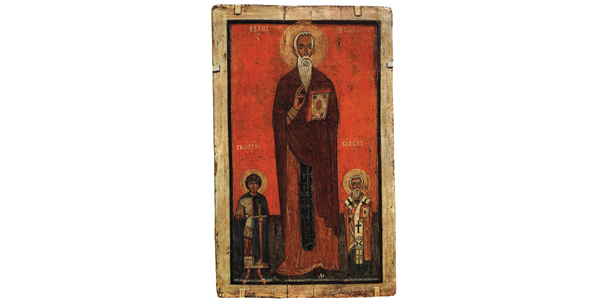
An icon showing St John Climacus flanked by St George and St Blaise
Clerical abuse
In 2009 Hungarian television broadcast a courageous documentary
entitled Confessors and Traitors about Hungary’s Catholic Church under
Communism. After Mátyás Rákosi seized power in 1945, the Church was
subject to fierce persecution. It brought forth confessors and martyrs.The integrity of faith was kept alive in small pockets of believers, often driven underground, while the institutional Church was gradually brought to heel by an atheist government. Through a mixture of incentives and threats, seminaries and monasteries were infiltrated. Episcopal sees were filled with loyalists reporting to the state. Fear did its work, as did ambition and indolence.
By 1989, when Communist rule ceased, Hungary’s Church was compromised. How badly, no one knew: many were tempted to resist retrospection and look ahead, to let bygones be bygones. Confessors and Traitors insists that this is not an option. In the film, the Benedictine monk and bishop Asztrik Várszegi, Archabbot of Pannonhalma, calls for determined engagement with the past, “the way a watercourse must be cleared of obstructions to permit new impetus and flow”. Only thus, he goes on, “can trust in the Church be restored. We cannot preach the Gospel truly until we are again found trust-worthy.”
An analogous challenge faces the Church as a whole as we strive to come to terms with a harrowing catalogue of misconduct and abuse. It is not only a matter of bringing individual cases to justice – vital though that is. It is a matter of seeking healing for the ecclesial body, which has carried this legacy as a pollutant for far too long. People are calling for action, for heads on platters. The prevailing sentiment, understandably, is one of anger. Anger, prudently channelled, can serve righteousness. But it can also blind.
I perceive a certain dull-sightedness in much that is said about celibacy. Celibacy is widely considered to be at the root of the problem. There are those who think it an impossible requirement, a dehumanising regimen that will naturally repel those of sound inclinations and attract others whose intimate lives are troubled. We should be wary of such assumptions. They are at odds with very many luminous examples of joyful, integral, fruitful celibate lives: I hope every Catholic has known some such. Further, there is the risk that we lean only on purely secular notions of sexuality and sexual pathology, forgetting that celibacy pertains to the order of grace and posits the whole person’s chaste transformation in Christ.
Grace builds on nature, by all means. Any vocational discernment must first ascertain if sufficient aptitude exists for consecration in freedom. It is irresponsible to let someone undertake a sacred commitment he or she does not have the resources to keep. Yet it would be wrong to see celibacy just as a function of natural disposition. I wonder, indeed, whether we have not come to take it too much for granted, as part of the package of priestly or religious life?
In the early Church, celibacy was viewed as a sign of the eschaton. In his treatise On the Incarnation, St Athanasius adduces chastity as proof of Christ’s power to restore human nature in a way unthinkable without divine intervention: “Who has destroyed the passions in men’s souls to the point of rendering fornicators chaste, […] to give courage to those held in the grip of fear?” “Who”, he goes on, “has considered that virginity is not an impossible virtue for man?” Only Christ! To vow oneself to this virtue is an immense, heroic proposition. Do we prepare our seminarians and novices for it? I fear we have often failed.
How are men and women best assisted to prepare for celibacy? Not chiefly by lectures and study, though these can help. The crucial thing is to help them develop the courage to face the deepest strands of their being and to put these into words. Before I joined the monastery, a monk told me: “The monastic life is unbearable if you do not have someone to whom you can say absolutely everything.” I can confirm the truth of that claim.
We must be able to speak humbly, frankly, even about our desires, to work out what they mean, to direct them in healthy ways. Monastic tradition offers a wealth of lived wisdom. The Fathers recorded long disquisitions on porneia, or lust. We may be surprised at their preparedness to call a spade a spade, to name the twistedness of wayward impulses. We will be no less struck by their stress on the potentially Godward orientation of our desires, recoverable by grace.
“Everything”, says St John Climacus, “is possible for the believer. I have watched impure souls mad for physical love but turning what they know of such love into a reason for penance and transferring the same capacity for love to the Lord. I have watched them master fear so as to drive themselves unsparingly towards the love of God.” Anyone tempted to dismiss this statement as cheap sublimation might read it in context – and discover that Climacus had few illusions about sinful humanity’s potential for perversion. What he helps us realise is that “perversion” and “conversion” are cognate nouns.
If we believe we are created in God’s image, that this image extends even to embodied desire, the direction and hallowing of desire becomes a key ascetic task, with the potential to open our whole being to the transforming power of grace. We should not be naive. But neither should we lose hope. What matters is to be truthful.
Sr Emmanuelle, commonly regarded as a saint for her long ministry among ragpickers in Cairo, wrote her autobiography for posthumous publication. It came out just after her death in 2008, at three weeks short of 100. Sr Emmanuelle voices her conviction that, “when the naked truth of a human life is told, God is revealed between the lines”. She is unsparing with herself and speaks openly, not least about her struggles with celibacy. She relates an experience that occurred when she was well into middle age, a seasoned Religious: “From head to toe my body was live embers.”
it was more than she could bear. She could not pray. She could not think. She did not know what to do. At last she went to see an old nun: “I put my burning hands into her cool hands and murmured, ‘I can’t do this anymore, I’m worn out.’ I raised my downbeat eyes towards hers. They had the translucency of a wellspring. I felt myself reborn to innocence.” Their dialogue was brief and essential. The old nun knew. She said, “You’re being tried by fire. That’s good for a Religious. Fire purifies metal, and tests it.”
The remedies she proposed were simple: “We shall seek together. You must pray, but act, too. Help yourself, and heaven will help. Now you see only your difficulty. Open your heart to the hurt of others, and your own wound will be healed.” Sr Emmanuelle refers to this trial as a turning point in her life of discipleship. But what would have happened had she tried to keep the fire under a lid?
Neither John Climacus nor Sr Emmanuelle provide blueprints. But they set standards to which we should dare to aspire. A standard, first of all, of honesty and fidelity, of readiness to seek help, to struggle, to trust grace, to believe that holiness is possible; a standard, too, of conversation. How many priests and Religious speak with their bishop, superior, or director at this level? How many bishops, superiors, or directors would be prepared for such exchange? To become trust-worthy, we must learn to entrust ourselves. No structural reform can do that for us. No amount of cerebral training can heal the heart’s wound, only the experience of being fully known.
If we would clear the watercourse of grace in the Church, it is not enough to stop the occurrence of abuse – though this is paramount. The body needs to be purified and re-oxygenised. Decades after writing On the Incarnation, St Athanasius composed his best-known work, the Life of Antony. Antony of Egypt, the founder of monasticism, lived to be 105. Each day he would say to himself, “Today I begin.” He summed up his spiritual testament to his brethren in the words, “Let Christ be the air you breathe.”
Those are words of life for the present, words to meditate on, to live by.
Dom Erik Varden OCSO is Abbot of Mount Saint Bernard Abbey in Leicestershire. His book, The Shattering of Loneliness, will be published by Bloomsbury Continuum on 20 September at £10.99 (Tablet +44 (0)20 7799 4064 price, £9.89).


No comments:
Post a Comment