
22 August 2018 | by Sarah Mac Donald
Hopes and fears as Francis flies in
The Tablet
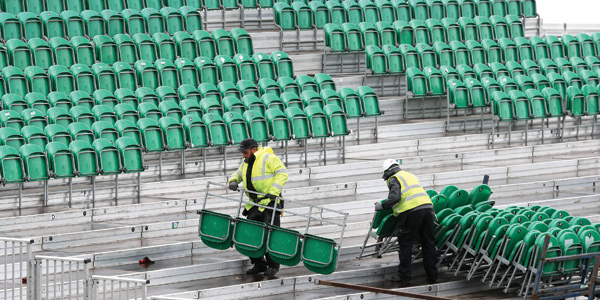
Seats are installed at Phoenix Park, Dublin, for the Pope’s closing Mass on Sunday
The Pope in Ireland
Up until Wednesday of this week, Knock Shrine had looked pretty much like it always does every August. For nine days, from14 August, the annual influx of 150,000 pilgrims attending the national novena thronged the holy site. Then, as the last speakers left on Wednesday evening and the pilgrims ebbed away, the shrine switched to “build” mode, and suddenly it looked like something out of an episode of the BBC’s Big Build or RTÉ’s Operation Transformation. By first thing Sunday morning, it had to be ready for the gathering and welcoming ceremony for a special pilgrim. Pope Francis is due to arrive at 9.50 a.m.
Fr Richard Gibbons is the rector of Knock Shrine. Speaking ahead of the arrival of the Pope, the 48-year-old, a native of Louisburgh, Co. Mayo, told me there was “a great atmosphere of expectancy”. But as “a working shrine”, staff have also had to manage its normal day-to-day running and that of the parish, with Masses to celebrate, baptisms to do, and funerals and weddings to arrange, literally up to the last moment.
The visit of the Pope to Knock is a fully ticketed event, with just 45,000 places allotted. They were booked out in a matter of hours. Some 450,000 came when John Paul II visited in 1979, but, as Fr Richard underlines, 40 years ago the shrine and its environs were much less developed and had fewer buildings, there was no parkland surrounding it as there is today and, most significantly, health and safety protocols were a flimsier affair.
While the media will be focused on Pope Francis and the closing Mass of the World Meeting of Families (WMOF) in the Phoenix Park on Sunday afternoon, Fr Gibbons says Knock does not feel overshadowed by the capital. “The celebration of the World Meeting of Families in Dublin is the most important element of the visit; we are just delighted that Pope Francis is coming to Knock at all, even if it is for a short visit.”
Fr Gibbons hopes the 45 minutes Francis will spend at the shrine will re-anchor it in the national and international imagination. He believes Knock’s apparition will resonate with the Pope from Argentina, who is known to have great devotion to Our Lady and to St Joseph. “The apparition lends itself to the World Meeting of Families because, as a predecessor of mine said, ‘When Our Lady came to Knock, she brought the family with her – St Joseph, St John the Evangelist and the Lamb of God representing Our Lord.’”
For Fr Richard, there is the added bonus that Pope Francis will fly into Knock Airport, now known as Ireland West Airport, which lies 15 miles from the shrine. It opened in 1986 following the tireless efforts of the parish priest at the time, Mgr James Horan, who defied political scorn to see through his vision of linking this remote part of Ireland to the rest of the world. “I think James Horan would be absolutely thrilled to know that his project at the airport has seen the biggest pilgrim of all landing – it’s a great legacy.”
In Northern Ireland, the first direct train from Derry to Dublin for many decades departs on Sunday at 5.40 a.m. to get pilgrims down south in good time to see Pope Francis in his Popemobile at 2.30 p.m. navigate the scores of enclosures holding half a million people before he celebrates Mass. When it is all over, these Derry pilgrims are due to arrive back home at 1.40 a.m. on Monday. It will be a spectacularly long day for them but, according to Donal McKeown, the Bishop of Derry, “there seems to be plenty of enthusiasm to be part of an historical event. It was the city parishes in Derry that contacted Translink to charter the train.” Other Derry pilgrims will travel by bus or car.
The bishop himself is in Dublin for the week giving inputs at the youth space at the WMOF Congress in the Royal Dublin Society. In a year that marks the twentieth anniversary of both the Good Friday Agreement and the Omagh atrocity, Bishop McKeown told me he had “no idea whether the Pope will make much reference to the North”. He believes that the family has been “a very important resource” in helping the people of Northern Ireland process their anguish and loss, whether caused by violence, accident, illness or suicide.
“Anything that supports committed family and community relationships is exceptionally relevant. Much of the legacy of the conflict is not unique to here – broken homes and hearts, people witnessing violence, people not having the chance or permission to grieve for certain deaths. You find that in many parts of Britain and the Republic,” said McKeown, hinting at some disappointment over the lack of Irish-specific elements in the planned WMOF progamme that would be relevant to the people of Northern Ireland. “I am not sure how much this is meant to be a world meeting, organised by the Vatican and hosted in Dublin, with only a modicum of Irish-specific elements. The North is and has been, generally, far from the minds of most people in the Republic. And that would apply in church circles as well.”
McKeown hopes that the Pope’s visit will encourage those who are actively involved in the Church to face the future with trust, believing that the Church in Ireland has a valuable contribution to play in a modern diverse society. In Derry, the Churches have long played a significant role as one partner among others in civic society. He also hopes Pope Francis will encourage lay Catholics to work for better human relationships in a society that is becoming more fragmented, plagued by what the head of the Royal College of General Practitioners in Northern Ireland recently described as “an epidemic of loneliness”. We should continue to believe in the value and the possibility of responsible, committed relationships, he said.
Redemptorist priest Tony Flannery – who was censured by the Vatican in 2012 – will be among the 500,000 people in the Phoenix Park at the papal Mass. “It is an historic event and I hope Francis gets a real welcome. By going to the papal Mass, it is me doing my little bit to give him a welcome,” he explained. Fr Flannery was one of the theologians and campaigners who gathered in Trinity College Dublin ahead of the official opening of the WMOF Congress to discuss some of the topics the Pope is unlikely to hear discussed this weekend. He was intending to speak about the unjust procedures used by the Congregation for the Doctrine of Faith (CDF) when investigating theologians who have come under suspicion. He is disappointed at the failure of the Irish hierarchy to make the censuring in recent years of up to six Irish priests by the CDF one of the issues to be raised during the papal visit.
Flannery’s views on the plight of silenced priests are echoed in a survey conducted by the Association of Catholic Priests (ACP) of 1,396 people who made 2,288 submissions on what issues they would like to be put to Pope Francis. Their opinions were gathered at four regional meetings held by the ACP in July as well as through the association’s website. The issue that was highlighted most by people was the need for an equal role for women in the Church, and a protest by Women’s Ordination Worldwide is planned at the entrance to the Phoenix Park on Sunday afternoon. That is the paradox of Irish Catholicism today, which still has one of the highest levels of weekly Mass attendance in Europe but one of the most questioning bodies of believers within the global Church, routinely challenging core church teachings, as the referendums on same-sex marriage and abortion have demonstrated.
Another issue that featured strongly in the ACP survey was the Church’s teachings and attitudes to LGBT people. A conference taking place in parallel to the WMOF in Dublin and organised by Anthony Murphy of the conservative Lumen Fidei Institute was due to launch a book by Fr David Marsden arguing that gay men are not suitable to be priests, while Gerard van den Aardweg was to give a paper on “The Prevention of Homosexuality in the Family”. Cardinal Raymond Leo Burke, Murphy explained, was due to make an appearance at the conference via video link and would speak about the challenges facing the family and the growing presence of Islam in Europe. Speaking in the wake of the grand jury report into sexual abuse by priests in the American state of Pennsylvania, Murphy told me, “How could [Archbishop of Washington Cardinal Donald] Wuerl even consider giving a lecture on ‘the welfare of the family’? If he comes to Dublin he will simply further harm his own reputation and do serious damage to the credibility of the Church.” Cardinal Wuerl has since announced that he will not be attending the WMOF.
Though the LGBT issue was to the fore ahead of the opening of WMOF 2018, the issue which was expected to dominate discussions throughout the congress was clerical abuse, thanks to the new string of revelations concerning the US Church. Questions over whether or not the Pope would actually meet any survivors of clerical abuse while in Ireland contributed to the anger of victims and this was compounded by the revelation by former Irish president Mary McAleese of an attempt in 2003 by the former Vatican Secretary of State, Cardinal Angelo Sodano, to negotiate a deal to prevent church documents being passed to Irish state investigators.
The charade that prelates are incapable of mistakes, of immoral or criminal acts, has to be abandoned, according to abuse survivor and victims’ champion Marie Collins, who says: “Clericalism is a great part of it, and the fear that if the truth is admitted then the entire edifice of the Church will crumble.” She warns that all those who stood by and stayed silent while knowing or suspecting that abuse was taking place “are complicit and should be called to explain themselves”.
Another Redemptorist priest, Gerry Moloney, the former editor of Reality magazine, said in a tweet that he marvels at how so many still keep the faith “despite the evil of clericalism and all the times the Church has hurt people and continues to do so”.
In Cork, most of the elderly members of the community of the Missionary Sisters of Our Lady of Apostles will be watching the papal Mass on television. Provincial Sr Kathleen McGarvey told me she hopes all the revelations of abuse “will help the Church and all of us to be more humble, less institutional, less sacramentalised, less hierarchical and more Christlike – to be more true to the Gospel that we are called to proclaim. I hope the visit of the Pope is an opportunity for us, as Church in Ireland, to grow and to commit ourselves to being an instrument of even greater good in the world.”


No comments:
Post a Comment