
Traditionalists and progressivists: the two prodigal sons of the Synod
THE TABLET BLOG
23 October 2014
by Ed Rennie
 Reading through the five temptations Pope Francis spoke of
in his speech at the end of the two-week Synod on the Family it became
clear to me that ultimately our temptations broadly fall into two
categories: of the prodigal son who left his Father’s house, and the
other who stayed.
Reading through the five temptations Pope Francis spoke of
in his speech at the end of the two-week Synod on the Family it became
clear to me that ultimately our temptations broadly fall into two
categories: of the prodigal son who left his Father’s house, and the
other who stayed.But they are both lost.
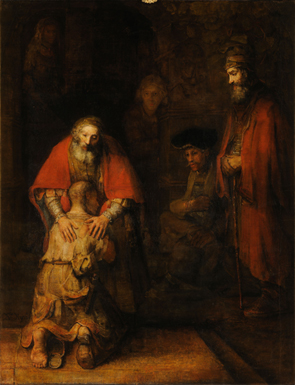
Two books by Henri Nouwen can help us understand the challenge we face as the Church in the modern world, The Return of the Prodigal Son and The Wounded Healer. In The Return, meditating on Rembrandt’s famous painting of the scene (left), Nouwen articulates how all of us are disloyal to our faith, firstly by rebelling against what is taught as the boundaries which we must not trespass, and secondly by remaining obedient to these boundaries but losing the loving heart of mercy for which the boundaries are there as a support.
In The Wounded Healer, Nouwen reflects on the reality that the Catholic Church has lost and is still losing its authority in the modern world because people no longer tend to adhere to traditional structures of authority. What this generation will respond to is an authority of tangible compassion that is rooted in the overwhelming experience of God’s gratuitous love and mercy, the authority that comes from the interior awareness that we too are in some way as wounded as those we seek to witness to.
Fr Alan Fudge used to preach that the moment of the Prodigal Son’s conversion comes not when he “comes to his senses” and hatches his plan to return to the Father, but when he experiences his Father’s merciful and thoroughly undeserved loving embrace. Is this not true for us? We experience transformation and reconciliation with God not when we wearily trudge back to the confessional, but rather when the words of comfort and absolution are spoken, when we experience the undeserved merciful love of God. St Therese of Lisieux taught us that “Everything is Grace!” The son who remained and hardened his heart against his Father’s grace cannot accept the mercy his Father has shown to the brother he no longer recognises. He is just as lost as his brother, if anything more so, because he has not “come to his senses” and realised his rebellion, nor the love his Father offers him in response.
While the synod was ongoing it was clear to see the sin of the second son apparent in some of those “traditionalists” who objected to the heartfelt and merciful approach that was being sought. The disloyalty to the current Pope was as naked as the disloyalty that the “progressivists” showed to his predecessor. Arguably this new disloyalty is worse, because it is the “traditionalists” who have always sought to defend and proclaim the primacy and authority of the Pope. Given that this was a pastoral synod and not a doctrinal one, doctrine would not nor could not be changed as a result. To then claim some kind of underhand conspiracy by Pope Francis to change doctrine by covert means is to abandon the very faith that tells us the Pope is chosen by God.
In his closing speech the Pope remarked that it was not adequate to “welcome” the lost, but to go and find them. Those who would reject this approach perhaps need to beware the sin of the son who remains in his Father’s house and is yet lost.
Above: Rembrandt's The Return of the Prodigal Son, housed at the Hermitage in St Petersburg/Google Cultural Institute


No comments:
Post a Comment