
Francis’ condemnation of death penalty shows Christianity’s counter-cultural approach to punishment
THE TABLET
24 October 2014
by Christopher Lamb
Yesterday Britain released one of its longest serving prisoners, Harry Roberts, who shot dead three policemen in 1966.At the time of his sentencing, the trial judge recommended he serve a minimum 30-year tariff and suggested Roberts might never be freed. Understandably his release has been condemned by police representatives.
In a strange coincidence, on the day Roberts left prison, Pope Francis addressed representatives of the International Association of Penal Law where he said life imprisonment was “a hidden death penalty” and said capital punishment should be abolished.
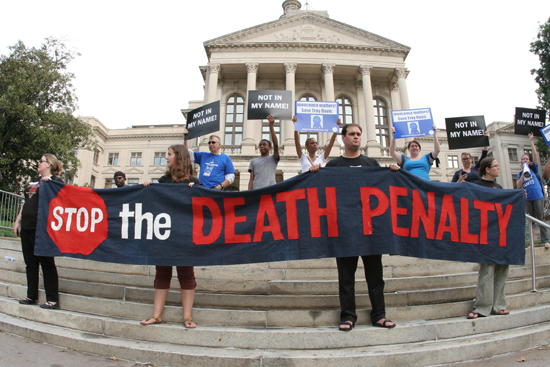
"All Christians and people of good will are thus called today to struggle not only for abolition of the death penalty, whether it be legal or illegal and in all its forms, but also to improve prison conditions, out of respect for the human dignity of persons deprived of their liberty,” the Pope said. “And this, I connect with life imprisonment," he said.
 The
Church’s catechism, as the Pope pointed out, does not exclude the use
of the death penalty as long as it is the only way of “effectively
defending human lives against the unjust aggressor”.
The
Church’s catechism, as the Pope pointed out, does not exclude the use
of the death penalty as long as it is the only way of “effectively
defending human lives against the unjust aggressor”.But Francis explained that such circumstances are “rare, if not practically non-existent” given the advances in contemporary societies in protecting people from dangerous criminals.
He went on to criticise the tendency in some societies to overuse punishment, offering up "sacrificial victims, accused of the disgraces that strike the community”.
On this point the Pope appears to be echoing the ideas of René Girard, the French anthropologist, who argues that sacrificial scapegoating is an integral part of human societies. Girard stresses, however, that the gospels seek to overturn this process, as Christ was the ultimate, innocent scapegoat.
Pope Francis’ condemnation of the death penalty is not really new (St John Paul II frequently called for an end to capital punishment.)
Yet he appears to be subtly developing the catechism in this area, placing himself alongside those who work on the “peripheries” opposing the death penalty. Sr Helen Prejean, whose work on death row in Louisiana in the United States was turned into a film Dead Man Walking, springs to mind.
There will be others, particularly in the US, who may feel uncomfortable about the Pope’s remarks. They will argue that it is up to legislators and not the Bishop of Rome to work out how best to protect citizens and tailor punishments.
Roberts’ release will also be viewed with suspicion, and many people are asking whether he is truly contrite for his crimes. How can we forgive an individual who has not repented?
On the other hand, Pope Francis is asking for an examination of conscience over how modern societies treat prisoners. The desire to punish and condemn comes easily, but with prisons overcrowded to breaking point, is this working?
The Christian approach, as the Pope is showing, is a counter-cultural one. It is perhaps best summed up by the late Lord Longford, the prison reformer and Tablet trustee, who when asked about his work with convicted criminals said: “Hate the sin, love the sinner.”


No comments:
Post a Comment