
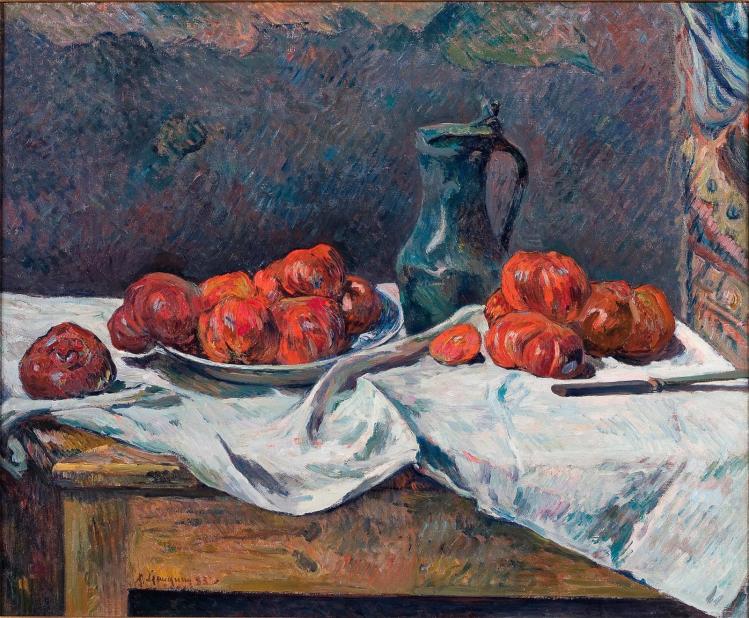
Last year, in a gift shop, I saw a tea towel that said, “I planted seeds and they actually grew. Now that’s another freaking thing I have to deal with.” I’m not usually one for quippy home ware, but I bought it and gave it to my husband for Father’s Day. Every March he throws himself into garden planning with the pent-up energy of a kindergartener kept inside by too many rainy days. But by the time butternut-squash vines have overspilled their bed and the tomato stalks have grown together into a tangled mass and the air is thick with humidity and bugs, the chilly spring magic of the planting has long worn off. The harvest is plentiful, but the laborers are over it.
There is something that feels of-the-moment about being jaded in the face of an unmitigated good. I happened to pull out the towel a few weeks ago, the same day we sang Psalm 95 at Mass for the third Sunday of Lent: “If today you hear God’s voice, harden not your hearts.” The psalm recalls the Israelites wandering in the desert, having escaped the hell of slavery for the parched also-hell of the wilderness. The joy of exodus has given way to cynicism. Cynicism, we should note, isn’t the same thing as pessimism. It’s a form of self-reproach. Whereas pessimism looks to the future and expects failure, cynicism recoils with shame at the memory of joy. What idiots we were to believe with such sincerity in the goodness of what we once felt. Cynicism is the prevailing mood of our present age, not because things are worse than they’ve ever been but because, a generation into the mass adoption of social media, our opinions live forever in public space, ready to stand as evidence that we once sincerely loved the things that have since let us down. In a cynical age, earnestness is a liability. Better to harden our hearts from the jump than to look back from the desert and realize with humiliation how naïve we once were.
As a somewhat attentive Mass-going child, I was beguiled by the Old Testament writers’ fixation on the plasticity of the heart—the heart of stone, the heart of flesh. I imagined an organ enveloped in gray Nintendo bricks giving way to something pink and fragile, like the stillborn puppy that Roger coaxes back to life in 101 Dalmatians. Both images disturbed me: the heart of stone for its coldness; the heart of flesh for its soft, pulsing vulnerability, ready to die of exposure at any moment. I was born with a heart defect, and it’s possible that my annual trips to the pediatric cardiologist—gummy electrodes pinched across my flat chest, the woosh-woosh of blood flowing the wrong way through my unsealed ventricular wall—were informing something here. My porous heart seemed to be causing me a world of trouble. But it was clear that to God, this vulnerable thing was preferable to the calcified alternative.
Who would harden their hearts at the voice of God? Probably me, if I’m being honest. A friend recently convinced me to take an improv class. I cannot account for the moment of insanity that led me to say yes. For eight consecutive Tuesdays from January through March, I would spend the day filled with simmering dread until evening came, at which point I would get in my car and drive from my home (in a boring part of the city) to class at an indie bookstore-slash-venue (in a cool part of the city) as the hosts of All Things Considered narrated the day’s horrors through my radio. ICE raids and murdered innocents, deported mothers and imprisoned children. A capricious war. A girls’ school bombed. Inevitably, I would begin to entertain the question of what business I had playing at a time like this, as if refusing comedy would somehow take away the sins of the world.
It will not surprise you to learn that world-weary cynicism is not an ideal way to enter into the practice of improv. In a 2016 essay, Rebecca Solnit wrote that cynicism “takes pride more than anything in not being fooled and not being foolish.” Improv, on the other hand, requires a kind of kenotic self-emptying into the present, a total abandonment of the usual modes of self-protective, ironic participation that would allow, say, me to insist later on that I was neither foolish nor fooled. “Everything is a gift,” our instructor would repeat. Our objective was to receive every movement, every expression, every word from our scene partner as a treasure and commit to them with gratitude. It was something like contemplation, an observation my friend made after the first class but that I refused to understand until this very moment. And nothing is more fatal to contemplation than cynicism.
Christ comes to the hard-hearted, the ones for whom every gift feels like a burden. He dares us to rejoice. I doubt that Jesus’ companions, sobbing in the garden or hyperventilating in the upper room, laid eyes on their risen friend and felt at once the kind of victorious elation that hindsight has taught us to associate with Easter. As difficult as it is to mourn, it’s easier than the alternative: being wrenched out of mourning by the impossible gift. I imagine there was at least one disciple who, upon hearing the news, pressed her fingers to her throbbing temples and sighed, “Now that’s another freaking thing I have to deal with.” But it’s true: the tomato is ripe for picking, the face of the other is before us, and Christ is risen from the dead. Alleluia, alleluia.
No comments:
Post a Comment