
My First Protest
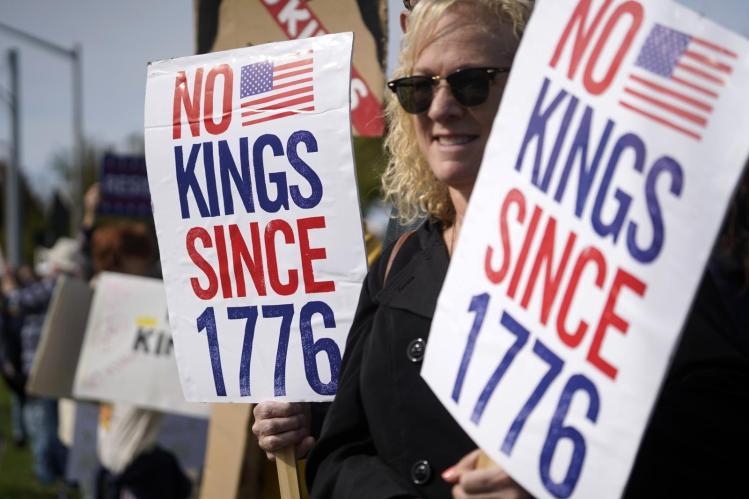
“Tall, white, moderate guys like you need to do more!” My wife and I have had our share of fights. But this was the first time she was mad at me for my politics. About a week before the latest “No Kings” protest, she was mad that I wasn’t angry enough about the state of our country. “I am angry about it,” I pleaded. “And I have been for ten years, and back in 2016 I blogged about it all the time, and even placed a major op-ed right before the election.” “We’ve had enough op-eds,” she persisted. When I asked what someone like me could do—a mild-mannered humanities professor in the suburbs—she pressed me to figure out which issue is making me mad enough that I would join the protest.
A protest? I’d never done that. Protests have always inspired me, but they’re for other people: prophets, activists, those with fire in their bellies. With respect to social change, I have embodied the problem of the well-meaning moderate. And boy, do I have moderate bona fides. I have voted for candidates from three political parties, including Republicans. Many years ago, when I was discerning my talents and skills to see which potential careers they matched, near the top of the list was “seeing multiple sides of an issue.” I’m moderate about policies and procedures, and I’m also moderate about temperament. A girlfriend once broke up with me for under-reacting to a situation.
As a professional discussion “moderator,” I say “on one hand…on the other hand” all day long. But through teaching about social movements, I’ve had to reckon with the historical problem presented by moderates. I’ve taught Martin Luther King’s “Letter from Birmingham Jail” for years, sometimes pairing it with Nina Simone’s protest song “Mississippi Goddam” or Gwendolyn Brooks’s poem about Little Rock in 1957. Every time I hear Simone prod moderates for going “too slow,” I fear she’s singing to me.
In between the marital argument and the protest, I had a class about the influence of the Bible in politics and social movements. We listened to the bit of King’s “mountaintop speech” when he interprets Jesus’ parable of the Good Samaritan. Everyone’s heard the apocalyptic end of the speech, but most students haven’t heard the meditative middle.
God commands us to love our neighbor, but determining the extent of this love is the challenge. The parable can be heard as a call to roadside mercy for a person not like you along life’s road to Jericho. Beyond that, King imagines what’s in the minds of those passers-by who don’t stop to help. Instead of vilifying them, he guesses that they are well-meaning people—even good people. Probably they are simply afraid. Perhaps some are on their way to help at the “structural level,” he suggests, to organize a “Jericho Road Improvement Association.” As I listened to King’s speech, I recalled my time as an elected official on my town’s governing board, literally debating road-improvement projects. He was talking to me.
When we listen to Gwendolyn Brooks’s poem in class, I always show photographs of the tense integration of schools in Little Rock. This time, I fixated on something I had never considered before: the faces of the white National Guard soldiers deployed to Arkansas’s state capital. It wasn’t the various expressions on their faces that interested me—it was that I could see their faces at all. And badges with their names. Now I was ready to make my first protest sign.
It will sound silly to you if you’re not a moderate, but making the sign felt awkward. Am I really doing this? Am I a protester? I texted some friends for feedback on the sign’s wording. One draft said, “White Moderate’s First Protest,” to which a friend replied, “No one’s confused that you’re white.” So I settled on: “Suburban Dad’s First Protest—NO MASKED POLICE!” I didn’t have a very thick marker, so my sign wouldn’t be legible from far. But that was kind of a relief to me. I didn’t even like writing my demand in ALL CAPS—it felt too aggressive. What a coward I was! If I felt nervous writing in all caps, how did my Latino neighbors feel walking down the street?
It was a fall Saturday, so I threw on my gameday Notre Dame hoodie and left to meet my wife in a neighboring town with a large and vibrant Latino population. These are my neighbors, in fear on the road to Jericho, while I go safely to my many well-meant meetings. And speaking of normie suburban life, I had to make a quick stop at the high-school sideline, where we suburban dads gather to discuss our kids and our hoped-for vacations. When another dad learned I was leaving the game early for a “No Kings” protest, he was taken aback. “What does it matter?... What do you hope to achieve?... Are these deportations any worse than under Obama?... Which media can you even trust anymore?”
His questions reminded me of Hannah Arendt’s warning about the attitude that takes over on the path to authoritarianism: cynicism about everything, lack of faith in anything. But another of the dads, who is Black, disagreed strongly and calmly: “Protest does matter. History shows that.” Only white moderates seem not to get this.
Driving from the soccer game to the park where the protest would be, I passed by a fancy country club: the Trump National Golf Club Westchester. I rarely notice it, but that day it called to mind all the undocumented workers who used to be happily employed there, some of whom were known to the Trump family by name. They were all fired in 2019, to head off charges of hypocrisy during Trump’s fight for a border wall. More recently, one of them was wrongfully deported to Mexico, despite having many prior positive reports from ICE officers and four children who are U.S. citizens—the oldest a Marine. None of that mattered. On September 15, Alejandro Juarez was detained and, without a hearing, dropped at the Mexican border and told to walk home. He now prays at his parents’ home shrine to Our Lady of Guadalupe, asking to be reunited with his wife and children so that he can continue to work the two jobs, seven days a week, that supported them here in Westchester County. Today, I’d be protesting for neighbors like him.
My wife met me at the park and, though she didn’t say so, I think she was a tiny bit surprised that I showed up. I had made her a sign too: “DEMOCRACIES DON’T HAVE MASKED POLICE.” (I seemed to be more comfortable writing in all-caps for a sign someone else would hold.)
The protest was the most patriotic experience I’ve had in years. My Republican parents and friends would have felt right at home there: American flags everywhere, kids playing, speeches about our freedoms, folksy singalongs. Behind us stood a row of local police with little to do except help some elderly folks get across the parking lot. One of the cops saw my sign and smiled. They understand how masked agents erode the social trust necessary for citizens to have faith in their own regular police.
Near the end of the protest, I noticed another guy with a Notre Dame shirt on. We chatted about the game later that night, how we would crush Southern Cal, and swapped our class years and a couple of campus anecdotes. “I like your sign,” he said. “It’s my first protest too.” Just a couple of white moderate suburban dads out here. We’re sorry that we’re late to get off the sidelines, but there are a lot more of us coming.
No comments:
Post a Comment