
The New Climate ‘Realism’
It’s possible to acclimate to pain. Even when treated with analgesic drugs, chronic pain can raise our tolerance for general discomfort. To a point, the capacity to tolerate pain likely confers an evolutionary advantage: more robust, pain-tolerant humans end up living long, miserable lives and dominating the gene pool.
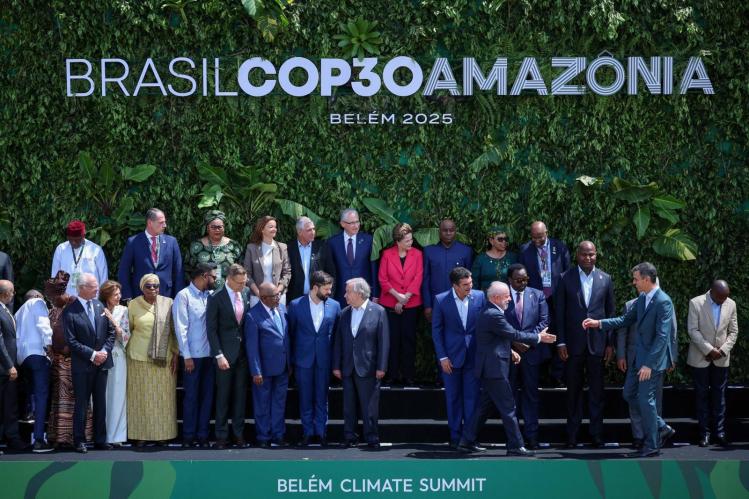
But how far can we push this at the whole-species level? Should a shrug and a “meh—we’ll get used to it” be policy options when we’re facing what many consider an existential threat? Shapers of climate policy may find out soon enough. The COP30 climate summit opened in Belém, Brazil, on November 10 against the backdrop of a new spirit of “climate realism” that prioritizes literal acclimation to climate change.
Participants at COP30—the latest iteration of the United Nations Framework Convention on Climate Change (UNFCCC)—have been quibbling over the soporific details of CO2 emissions goals and the meticulously parsed language of final declarations and pledges, as they had during the previous twenty-nine meetings. Meanwhile, the hopes of many at home were lower than ever. Delegates arrived in Brazil amid growing skepticism that these annual gatherings will ever accomplish what the UNFCC charged the “Congress of Parties” with accomplishing in Rio de Janeiro in 1992: namely, halting anthropogenic warming. Indeed, there’s a growing sense that this goal needs to be rethought.
Is climate instability more a reality to which we can adapt than a dystopia to be avoided at all costs? Axios reported recently that a projection by RystadEnergy analysts sets the most probable temperature increase in the coming years at 1.8 to 2.1 degrees Celsius over preindustrial temperatures—well above the 1.5-degree marker that emerged as a target in climate talks over the last decade. But, despite the best intentions of COP participants, what was once a doomsday scenario is now being reframed as just another ongoing hassle we’ll be muddling through for generations to come.
This “realism” is no doubt in part a coping mechanism prompted by the reelection of Donald Trump, which buoyed the fossil-fuel industry. The annual CERAWeek conference this past March—a kind of anti-COP summit where traditional energy executives strategize—announced the birth of a “sober-minded pragmatism” surrounding the transition to renewable energy. “We’re seeing some reality come back in the conversation,” noted Chevron CEO Mike Wirth.
Of course, this should be expected from an industry still peddling a fuel source whose initial competitor was whale blubber. But less vested interests, such as the Council on Foreign Relations, a think tank that publishes the journal Foreign Affairs, are also on board. It launched its “Climate Realism Initiative” in the wake of CERAWeek and just in time for Earth Day 2025. It’s an effort to set “a novel, pragmatic course for U.S. energy and climate policy that is”—here’s that word again—“realistic in forecasting climate impacts and U.S. leverage.”
Onto this “realist” stage has also wandered Microsoft founder, tech billionaire, and philanthropist Bill Gates. His ominously titled “memo,” “Three Tough Truths about Climate,” was published on his website just before the COP summit. Gates is no outsider to climate discussions, having launched the Breakthrough Energy investment platform ten years ago to accelerate the transition to renewable energy (and, presumably, to make a few bucks in the process). His 2022 book, How to Avoid the Climate Disaster, was a New York Times bestseller and afforded him credibility on climate policy.
Gates’s newfound heterodoxy will rattle a few activist and NGO cages, as he’s clearly aware. He’s thrashing at the sacred cows of international climate policy, including corporate “net-zero” CO2 campaigns and “Nationally Determined Contributions.” The three truths, paraphrased, read like overt challenges to an entrenched cadre of policy wonks: 1) things are bad, yes, but it’s not literally the end of the world; 2) we’re too focused on reducing CO2 emissions and global temperature and thus underserving the positive goal of increasing human well-being; and 3) making people at the margins healthy and prosperous (even by means of fossil fuels) will permit them to adapt to a warming planet.
It would be tempting—especially for Catholics inspired by Pope Francis and his monumental encyclical Laudato si’—to dismiss Gates’s musings as just another example of the technocratic paradigm that the pontiff revisited with similar skepticism in his follow-up exhortation, Laudate Deum (see my “More than a Sequel” in this magazine last year). But that would be too flippant. Gates lands far short of the mark of economists like Julian Simon, who thinks unfettered capitalist innovation will solve any problem it creates. And there’s a tacit nod to Pope Francis in Gates’s admonition that the world’s dispossessed have to see their lives improved by the fight against climate change. Even if he doesn’t reference the profound connection Francis drew between “the cry of the earth” and “the cry of the poor,” Gates does at least suggest that the poor should be beneficiaries of climate policy, not mere bystanders.
Moreover, Gates’s sanguine approach to climate issues—forgoing doomsday scenarios for a focus on overall well-being—does have some empirical merit. Even the arguably meager efforts made against climate change have succeeded in ways we rarely acknowledge. Gates points to forecasting from the International Energy Agency which suggests that, in the past ten years alone, projected future greenhouse gas emissions have been cut by forty percent. However much we might fret over whether “net zero” emissions can be achieved by mid-century, this is no small feat.
Even though he has the highest profile, Gates is not the only commentator frustrated with the status quo as represented by the annual COP summits. Jessica F. Green, a political scientist at the University of Toronto, has recently raised her own cogent concerns surrounding the COP process and its preoccupation with emissions. In a recent book and an even more recent article in Foreign Affairs (apparently unaffiliated with the Climate Realism Initiative), she argues that the UNFCCC should at best “remain a platform for data collection and information and technology sharing” but by no means serve as the only—or even the best—vehicle for ushering in an economy based on renewable energy. It is, in fact, “teetering on the brink of irrelevance.” Given Gates’s name, stature, and net worth, his memo was no doubt on the minds and lips of COP30 participants; it’s lamentable voices such as Green’s don’t command the same level of attention.
Gates, in fact, neglects important disputes in environmental economics. He focuses on, for example, “bringing the green premium to zero”—i.e., making renewable energy as cheap as fossil fuels. But cost is just one factor in a system-wide conversion to solar, wind, hydrogen, and their kin. As Brett Christophers has recently argued, the real issue now is comparative profitability. The costs of fossil fuels and renewables are already close to parity. But entrepreneurs weighing entrance into the renewable energy market don’t ask themselves, “Are costs low enough for me to be a solar-panel manufacturer rather than a cigar-chomping oil baron?” They ask themselves, “Do I want to make solar panels or open a restaurant?” Capital chases profit. As long as a chain of trendy Asian-fusion bistros is a more lucrative investment than a solar-panel firm, renewables will suffer.
Even more salient problems in Gates’s memo lie in the way it silently glosses over dissenting views. Gates is throwing his weight behind what’s called in policy circles the “adaptation” option. Reducing emissions, the story goes, has been modestly successful. And we’re now learning—through carbon capture, artificial albedo enhancement (bolstering the planet’s ability to reflect heat back into space), and other forms of geoengineering—how to mitigate the adverse effects of greenhouse gases already emitted. But neither reduction nor mitigation is likely to get us below targeted temperature ceilings. It’s time, the adapters argue, to turn to plan C and acclimate to a warmer planet by, for example, developing crops with a higher tolerance for extreme heat—and maybe people with that genetic trait, too.
Gates raises the ante on adaptation by suggesting it is integral to economic development in low-income nations. “Development,” he argues, “doesn’t depend on helping people adapt to a warmer climate—development is adaptation.” He cites modeling from the Climate Impact Lab at the University of Chicago that projects that climate-change-related deaths in low-income countries are cut in half when we factor in the anticipated economic growth that would come from some use of fossil fuels. In other words, it’s not climate change alone killing those at the economic margins; it’s also the poverty and underdevelopment that put them at the economic margins in the first place. Take away the obligation to spend limited resources on renewables, and they (as well as we) are better off than if they tried to leapfrog the dirty energy industry entirely.
There is an undeniable appeal to this line of reasoning, and nations aspiring to overcome large pockets of poverty have already voiced agreement. In Al Gore’s 2015 documentary An Inconvenient Sequel (a follow-up to 2006’s An Inconvenient Truth), Piyush Goyal, India’s then–Minister of State for Energy and Power, resisted Gore’s proposal that India forgo new coal-powered plants. “I’ll do the same thing [the U.S. is doing] after 150 years—after I’ve used my coal, after I’ve got my people jobs, after I’ve created my infrastructure and highways and roads.” Christiana Figueres, UN Executive Secretary who presided over COP21, concurred: “India’s concern is not just the existence of that [sustainable] technology, but access…. Fossil fuels have been paraded in front of them for 150 years—now we’re saying, ‘This parade—it’s done. Now we have to build a different parade for you.’”
But the shift to adaptation advocated by Gates and others has happened largely behind the scenes, without ethical scrutiny or discussion. To those who are skeptical, it must surely sound like a conversation they were never part of is suddenly coming to an end. The grounds for dissent from adaptation are as much moral as they are practical—much like the question of whether a patient should adapt to pain or confront its causes. When it comes to mitigation, the ethics of geoengineering have been the topic of sustained debate, but the disputes over adaptation and “commodified resilience” are just beginning.
Perhaps most frustrating in Gates’s proposal is the tacit exemption of the profligate lifestyles of the citizens of wealthy nations. Granting a modest carbon footprint to those in the Global South who have never had one should be coupled with a lighter overall footprint in the more developed world. This was the core of Pope Francis’s message in in Laudato si’:
We know how unsustainable is the behavior of those who constantly consume and destroy, while others are not yet able to live in a way worthy of their human dignity. That is why the time has come to accept decreased growth in some parts of the world, in order to provide resources for other places to experience healthy growth.
The pontiff goes on to note that even his predecessor, Benedict XVI—who could scarcely be mistaken for a radical environmentalist—noted that “technologically advanced societies must be prepared to encourage more sober lifestyles.”
No one is suggesting Westerners sleep in unheated homes on straw mats while subsisting on coarse porridge and card games. There are ample models of rich, fulfilling lives lived without every last carbon-fueled extravagance (see, for example, the work of Kate Soper). Shouldn’t the consumer excess that has us throwing away perfectly good phones for nearly identical ones (save for an infusion of AI from energy-plundering data centers) at least be on the negotiating table? Weren’t those net-zero emissions and carbon-footprint goals—now apparently outmoded by a new “realism”—intended in part to get us to look at our own lives with a sobriety that Microsoft and Apple could never foster?
While it would be a mischaracterization to attribute to Gates the naïve hope that technology will salvage our current lifestyles from the worst ravages of climate change, he is leaving much out of the equation that Pope Francis struggled to put back in. We can transform institutions and even socioeconomic systems, but unless and until we’re prepared to transform ourselves and the way we inhabit God’s creation, little of true substance will change. It’s a message lost on the annual COP summits and well-intentioned critics like Gates alike.


No comments:
Post a Comment