
Recovering Our Vision of the Poor
“The Lord,” the psalmist proclaims, “hears the cry of the poor.” We, by contrast, have lost our hearing. As fallen creatures, of course, deafness to the vulnerable is a chronic condition, but it has worsened in recent decades, reaching a low point in the second Trump administration.
President Trump’s “One Big Beautiful Bill,” in particular, demonstrates the extent to which we have disappeared the poor and flipped the logic of Matthew 25. Our rejection of the sick and hungry, our oppression of the imprisoned and the foreigner, these are our rejection and oppression of Christ. Instead of food stamps for the hungry, tax cuts for the rich. Instead of IRS audits of millionaire tax evaders, worthiness checks for those in need of Medicaid. Instead of welcome for the poor and huddled masses, Gold Cards for wealthy foreigners willing to buy American residency. In the face of poverty, Trump declares “The homeless have to move out IMMEDIATELY,” and calls in men with guns to move them.
Not only do we refuse help to our own poor citizens, but we also refuse those suffering in foreign countries, and we vilify, harass, and kidnap those who have come to our land in need. Cuts to foreign aid, food stamps, and Medicaid help fund massive increases for ICE, so that poor immigrants looking for work at Home Depot can be rounded up and sent to Alligator Alcatraz. Meanwhile, refugees from Haiti and Venezuela may end up in a concentration camp in El Salvador or a war zone in South Sudan. The poor are abandoned while Changpeng Zhao, a multibillionaire money launder, is granted a pardon so he can make more money for those who already have too much. We proudly invert the words of Mary’s Magnificat: we cast down the lowly and lift up the mighty!
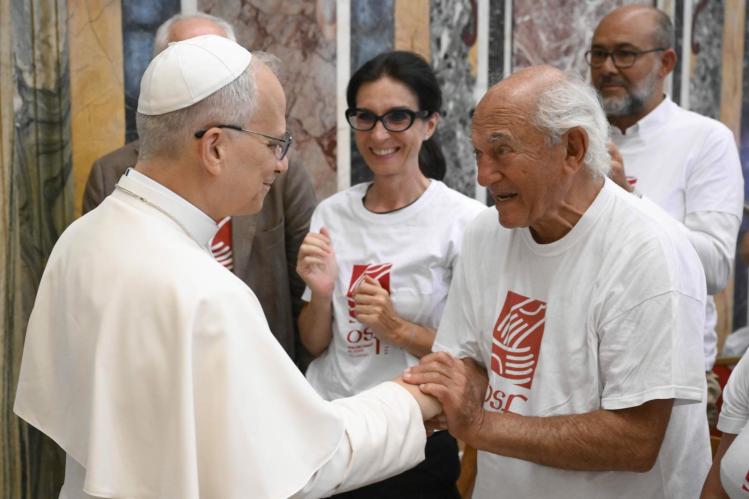
In the face of this deafness, Pope Leo XIV has cried out on behalf of the poor and called us to account. In Dilexi te, he returns us to the tradition, summoning Scripture, the Church Fathers, the saints, and the Magisterium to exhort us to open our ears to the needy. He calls us to “the primacy of attention to the poor in the life and mission of every Christian.” A core Augustinian insight is that there is no love without attention, and that what we attend to discloses our loves. The poor, Christ told us, will always be with us. What matters is that Christians see them as Christ sees them—a blessing and a grace, not a burden to be means-tested. Jesus does not investigate whether the captive, the blind, and the oppressed have been looking for work before he liberates them.
We are also meant to see the poor as a sacrament of the Lord. One can never fully inhabit the meaning and force of Matthew 25: “What you have done to the least of these, you have done to me.” Just as with the Eucharist, Jesus does not mean this as a mere symbol. “This is my body” and “you have done to me” are not metaphors. Just as we blaspheme Christ if we are negligent with his sacramental body, so too we blaspheme when we are negligent with the poor. The host and the poor are both Christ. In the Eucharist, Christ is for us; in the poor Christ allows us to be for him. As Leo teaches, we must “perpetuate the Eucharist through love and attention to the poor.”
The Trump administration sees things differently. The poor are not to be fed, sheltered, and welcomed; they are to be neglected, means-tested, and turned away. This radical inversion of Christian teaching on the poor can be understood as a kind of re-paganization, a return to pre-Christian ways of seeing.
Leo summons us back to the words of the Church Fathers as a reminder of how essential and transformative Christian attention to the poor has been in the past and must be in the future. The Christian conversion of the Mediterranean basin included the very invention of the category of the poor: “a new social category” created by the early Church’s bishops, as Charles T. Mathewes argues in A Theology of Public Life.
Of course, there were impoverished people before then—the cities were filled with them—but they were categorized as turba, the Latin for “crowd.” When a Roman governor referred to the turba, he meant an undifferentiated mob that, depending on the situation, needed to be gathered, punished, entertained, or dispersed. As with the centurions then, so with masked ICE agents and National Guard deployments now.
When a third-century bishop talked about the pauperi, he was referring to the same people as the Roman governor’s turba, but as individual people to be cared for and loved, not a throng to be managed. For the bishops, who were forming a new social vision in a collapsing empire, transforming the turba into pauperi was enacting Matthew 25. Christians must see in each pauper Christ calling for us to feed, clothe, nurture, heal, visit, and welcome him. Augustine and John Chrysostom, both of whom Leo highlights in his exhortation, announced this inversion of values from the pulpit, and it was lived out in the streets and alleys of Hippo and Constantinople.
Mary gloried that God “has cast down the mighty from their thrones and lifted up the lowly. He has filled the hungry with good things and the rich he has sent away empty.” Christians have never fully lived out Mary’s words, but the early Church did go some way to lifting the lowly and lowering the mighty. For Mathewes, “the ascription of ‘the poor’ became more fundamental than that of ‘citizen’ at this time.” Why? Because “a human being’s impoverishment is a more important fact about her or him than whether she or he is a member of the same political community as you yourself are.” Jesus didn’t care whether a person happened to be a citizen (he never was himself), and he proclaimed the rich cursed. His interest in the poor was so strong that he not only declared them blessed; he became homeless in Bethlehem, a refugee in Egypt, thirsty and naked on the cross.
In Christianity’s transformed vision of the poor, we find a distinction between the pilgrim city and the earthly city. For Augustine, these were two essential communities founded by two loves. The earthly city is egocentric and serves the self; the pilgrim city is theocentric and serves God. But God is not egocentric himself, and he does not need. He wants us to give to those who need as our primary way of giving to him. Works of mercy for others, according to Augustine, “are thus acts of worship for God.” In the words of the Augustinian Leo, “Charity is not optional but a requirement of true worship.” We reach God by reaching out to the impoverished and neglected. “If you do not love your brother whom you see,” Augustine wrote, “how can you love God, whom you do not see?” The heart of a Christian politics is the work of sheltering, feeding, and welcoming—precisely the opposite of the ethnonationalist agenda figures like J. D. Vance have attempted to associate with Christianity.
The language of Rome’s elite citizen class, which managed and oppressed the crowd, obfuscated the reality of God’s preferential identification with the poor. Scripture revealed this reality to Christians, who, Mathewes writes, “changed that language in order to render that reality more fully visible.” The language of MAGA and its self-serving orders of love obfuscates again, concealing that reality and the poor themselves. American Christians are repaganizing themselves and calling it Christian.
Secularization is, understandably, often construed in terms of the decline of religious participation and belief, but these are just two of religion’s essential features. A Catholic who believes and goes to Mass but is unshaped by Matthew 25 and sees the poor as a blight to be hidden away has also undergone a kind of de-Christianization.
To disappear the poor is, in this sense, to secularize. As Leo insists, “love for the Lord, then, is one with love for the poor,” and this love is at “the burning heart of the Church’s mission.” If we lose this burning mission, we end up “replacing it with the wisdom of this world.” For the world proclaims the centrality of the rich and powerful, it makes “our strength our norm of justice” (Wisdom 2:11). As Gustavo Gutiérrez explains, “the poor person has priority not because he or she is necessarily better than others from the moral or religious point of view, but because God is God.” Prioritizing the poor is prioritizing God, and those who claim to do that latter must do the former.
Jesus’ parable of Lazarus, the poor beggar invisible to the rich man, reflects the attitude toward the poor now prevalent throughout our society. The challenge we face is how to reappear the poor and thereby re-Christianize ourselves, our attention, and our politics. What has become invisible must be made visible again. Our vision must be turned outward from our disordered loves toward the blessed poor regardless of borders.
This requires a conversion and an enlargement of soul. For political theorist David Walsh this transformation would mean that “what had appeared so important is no longer so, what had previously only been of minor significance assumes the central role…. [T]he whole scale of measurements undergoes a modification whose consequences ripple through the whole structure of our thought and way of life.” This is what happened when, for early Christians, the turba became the pauperi, and it is what Leo calls for today.
That this transformation occurred first in the Roman Empire should give us hope that it can happen again in our time. Yet the situation is now worse because it is often Christians who are disappearing the poor. The rich man, in Jesus’ parable, asks that Lazarus be sent to warn his brothers, but Abraham tells him that they would not listen even to a man risen from the dead. In the same way, we ignore Christ, a man risen from the dead. In recent years, we have been ignoring his vicar too. Pope Francis called for a social conversion toward the marginalized, but he went largely unheeded.
In Dilexi te, the call continues. We are asked to enact love for the poor in our personal lives but also in our social and political lives. We live in “an economy that kills” and need to realize that “commitment to the poor” requires “removing the social and structural causes of poverty.”
This commitment requires a whole Church conversion. In this Augustinian moment, our bishops and pastors must become like St. Thomas of Villanova, OSA, called the father to the poor. Too often they have been instead the father to the suburban upper-middle class. Laypeople likewise need to reorient their lives and giving to serve those who lack. As Leo reminds us, Christian life requires not only that I advocate for economic and political change, but that I actively serve the poor myself. I cannot defer feeding, clothing, visiting, and welcoming to government. I too must be a missionary to and with the poor.
Of course, private almsgiving, Leo writes, “does not absolve the competent authorities of their responsibilities or eliminate the duty of government institutions to care for the poor.” We should center our politics on those Bartolome de las Casas has called “the smallest and the most forgotten”—whether they be the Venezuelan murdered on a boat, the migrant seized from his home as his children are zip-tied, or the homeless people chased out by the National Guard.
Ecclesial conversion should lead to a political conversion to the poor. The nightmarish Trump era has led to a revival of Catholic political theory but not one guided by a revival of Catholic political practice. Catholic theorists should base their politics on the works of mercy and develop political programs centered around feeding the hungry and welcoming the foreigner.
Pope Leo calls us to the kind of love that, in Augustine’s words, “has the hands to help others, feet to hasten to the poor and needy, eyes to see misery and want, and ears to hear the sighs and sorrows of men.” Leo, looking back to the foundation of the mendicant orders, points to their insistence on “an individual and communal conversion to the logic of the Kingdom.”
Social conversions are as hard to anticipate as personal ones. But we must find a way to reorient our social preferences away from the likes of Elon Musk and Jeff Bezos and toward the weak and impoverished. In our thoughts and actions, our prayer and our service, our voting and our advocacy, we must remember the smallest and most forgotten, or we too may find ourselves like the rich man in the parable of Lazarus: cut off from God’s kingdom by an unbridgeable chasm of our own making.
No comments:
Post a Comment