
John Henry Newman, Influencer
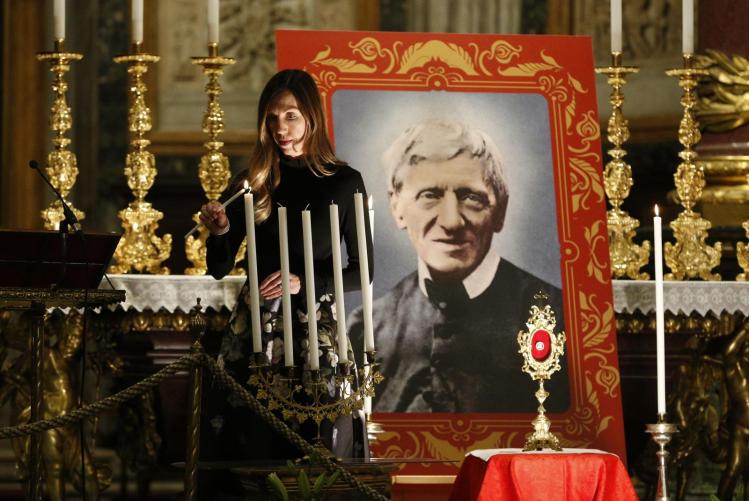
When the news broke that John Henry Newman would be declared the thirty-eighth Doctor of the Church, I was planning a new course around his work. I had decided to call it “The Ethics of Influence.” Its premise, as my students at Notre Dame will learn in the spring, is that Newman’s example can be a balm for our beleaguered and battle-worn digital age.
Newman was a self-described “controversialist,” and he held the view—radical at the time—that the spread of truth in our world depends on “personal influence.” My idea was to place Newman’s lifelong quest to understand the nature of personal influence alongside today’s influence gurus peddling persuasion tips and tricks. I also wanted to pair his insights with research on our declining in-person social interactions and the attendant rise of online influencers and parasocial (one-sided) relationships. I imagined Newman as an unlikely Virgil, guiding students through the inferno that is the contemporary information ecosystem—where impersonal technologies masquerade as miracle cures for what they, in fact, tend to exacerbate: loneliness, lack of connection, loss of intimacy.
It felt a bit uncomfortable placing Newman—not just a Cardinal but a saint to boot—alongside podcasters, TikTokers, and, going back to the progenitors of influencer culture, twentieth-century works like How to Win Friends and Influence People. Hearing that “Doctor of the Universal Church” would be added to Newman’s chain of honorifics made me wonder if the combination wasn’t downright perverse.
After all, his focus on personal influence does not typically make the list of reasons Newman matters today. Pope Leo’s announcement did not mention it. He noted instead that Newman “contributed decisively to the renewal of theology and to the understanding of the development of Christian doctrine.” True enough. Newman’s 1845 Essay on the Development of Doctrine has had an immense impact. The “essay,” really a lengthy and ornate tome, echoes throughout Dei Verbum and other Vatican II documents. In essence, it provides a self-understanding and purpose for the Church in the modern world, explaining how its teachings can grow and deepen without becoming corrupted or compromised.
Nevertheless, after returning to Newman’s works, I stuck with the plan. I decided that if Newman himself were at the formal ceremony on November 1st, he would not take offense if he were also named Doctor Influentiae—doctor of influence. I doubt he would even take the title of “influencer” as a slight to his theological stature. “Doctor,” I remembered, comes from the Latin docere, which means “to teach.” And I think Newman would welcome the recognition that what he taught was inseparable from how he taught it.
Partly, but only partly, he taught through literary means. James Joyce called him “the greatest of English prose writers.” As a poet, he inspired the well-known hymn “Lead, Kindly Light” and Edward Elgar’s oratorio The Dream of Gerontius. He is the first novelist to be canonized as a saint. Even in his minor works, he shines in unexpected ways, including as what Ian Ker calls “one of the great satirical writers in the English language.”
But Newman’s lifelong inquiry into the nature and dynamics of human influence went beyond the literary. He is more properly understood alongside the Danish philosopher Søren Kierkegaard than with the other greats of Victorian letters, like John Ruskin or Thomas Carlyle. Like his contemporary Kierkegaard, Newman stumbled upon insights about what it means to touch the core being of his readers that led him away from typically plodding, philosophical prose.
Newman put it unforgettably:
Deductions have no power of persuasion. The heart is commonly reached, not through the reason, but through the imagination, by means of direct impressions, by the testimony of facts and events, by history, by description. Persons influence us, voices melt us, looks subdue us, deeds inflame us. Many a man will live and die upon a dogma: no man will be a martyr for a conclusion.
To fully realize the truth of that statement, Newman had to invent new ways of writing.
Newman discovered “personal influence” early in his career while leading the push for renewal in Anglicanism known as the Oxford Movement. Members of the movement, also called “Tractarians,” published scores of theological treatises in tract or pamphlet form. As Newman understood it, the goal of these tracts was not to share the theories of “a board of safe, sound, sensible men.” They relied instead on what he called “the principle of personality.” Not for nothing were those in the early movement called “Newmanites.”
Newman further formulated his ideas about personal influence in his early sermons, including one from 1841 titled “Personal Influence, the Means of Propagating the Truth.” In it, Newman stated that truth “has been upheld in the world not as a system, not by books, not by argument, nor by temporal power, but by…personal influence.”
This insight, gained while Newman was still an Anglican, became a touchstone for him throughout his life. It informed the way he engaged in a debate in the press with his chief antagonist, Charles Kingsley. It especially shaped his decision to write, in a response to Kingsley, a meticulously detailed defense of his conversion and changed views on religious matters. In his notoriously difficult but brilliant late work of religious epistemology, An Essay in Aid of a Grammar of Assent, Newman returned to the same core ideas again. He invented a new technical vocabulary to elaborate and explain them, using terms like “real assent” (the experiential and imaginative grasp of a truth) and the “illative sense” (what allows us to be certain of what we cannot prove).
Newman’s insights were so prescient that in many ways our post-truth era is just now catching up. For example, a study published during the pandemic looked at how to bridge divides on moral issues. A group of scholars analyzed the rhetoric around polarizing issues: YouTube comments on videos related to abortion, conversations about guns, reactions to New York Times op-eds, and political debates on CNN and Fox News. The researchers found that most people imagine facts and statistics will foster respect for an otherwise unfavored position. But that approach, they found, is much less effective than we think; it is better to start with personal experience. When it comes to divisive moral issues, personal experiences feel truer than facts, and it is only after I have come to see someone’s personal experience that I then come to care about the fact or statistics he or she wants to share with me.
The power of personal influence makes us ripe for exploitation, of course, and we must be aware of that fact to make good decisions. But it does little good to wish our minds to be otherwise than they are, or to pretend that we can make them otherwise. As Newman would say, “We must take the constitution of the human mind as we find it, and not as we may judge it ought to be.”
It is precisely here, in accepting our limits, that an “ethic of influence” can begin. One limit concerns how many people we can realistically reach in our finite lives. For Newman, we can be “satisfied with the humblest and most obscure” lot in life when we recognize that “we may be instruments of much good” in the world, even though “we could scarcely in any situation be direct instruments of good to any besides those who personally know us, who ever must form a small circle.”
Contrast this ethic of influence with the ethic-less influence specialists of today. They tend to decompose influence down into a factor they can measure and, above all, maximize. Far from being direct instruments of good—leading to deep personal change, for example—today’s influencers are experts on gaining their followers’ compliance: triggering an affirmative response to a specific request. Like this post, subscribe to this podcast, buy this product. In these cases, the only answer to the question, “What kind of influence do you want to have?” is “more.”
Still, we might ask where exactly to draw the line. Or, to put it another way, how far can we “scale” personal influence in Newman’s sense without losing his ethic? It’s clear that for Newman, personal influence happens “heart to heart.” (His motto was cor ad cor loquitur, “heart speaks to heart.”) And yet, personal influence is not necessarily face-to-face. Here, it’s important to remember that Newman’s age was one of rapidly expanding communication technology in its own right. Industrial printing meant more and cheaper books, expanded access to education, and a new mass-reading public. Newman worried that printing could lead to an illusion of knowledge, since it can create “an indefinite multiplication and circulation” of ideas that nevertheless have “nothing of a personal nature.”
Strictly speaking, I don’t think even Doctor Newman knew the answer to the question of scale, of when personal influence turns into mass manipulation. But he also didn’t wait to find out. Even though he worried about printing, he used it brilliantly. In this regard, I think of him a little like Fred Rogers in the 1960s, embracing the new medium of television to give a “neighborhood expression of care” to “each child.” It wasn’t a proven approach. It was more like, using Newman’s preferred term, an “essay” or attempt.
Personal influence is the humble way, but it is, undoubtedly, the slow way, too. Now more than ever, the deck seems worryingly stacked against the truth. In our information ecosystem, an overwhelming number of falsehoods travel further and faster than Newman ever could have imagined. Doctor Newman would likely assure us that “personal influence” will win out. Indeed, according to him, over the long run, it is the only thing that ever has. Eventually, as he declared in his sermon on personal influence, “the powers of the world, its counsels, and its efforts (vigorous as they seemed to be in the race), lose ground, and slow-paced Truth overtakes it.”


No comments:
Post a Comment