
The Pope, the King, and the Archbishop of Canterbury
The scene was extraordinary: the pope praying with a divorced British monarch and his divorced second wife beneath the Sistine Chapel’s spectacular frescoes. The archbishop of York, Stephen Cottrell, processed into the chapel alongside Pope Leo XIV to the dais where King Charles III, regarded by Anglicans as the Supreme Governor of the Church of England, was seated with Queen Camilla. The midday service was the first time a pope and a monarch had prayed together since a previous King of England had insisted on remarrying without papal approval five hundred years ago.
The state visit was rich in symbolism. Following the prayer service, the king and queen attended an ecumenical celebration at the Basilica of St Paul Outside the Walls, where Charles was accorded the title “Royal Confrater” and presented with a wooden seat adorned with his coat of arms and a Latin inscription from the Gospel of John, Ut Unum Sint (“That they may be one”). In return, the dean and canons of the College of St. George Windsor, with the approval of the king, offered Leo the title of “Papal Confrater” of St. George’s Chapel at Windsor Castle. Leo accepted.
During the ecumenical celebration, Cardinal James Harvey, archpriest of the basilica, said the significance of the king’s visit represented “a soul-stirring new chapter in the long history of relations” between the two Churches, while a spokesman for Buckingham Palace described the mutual gifts of confraternity as “recognitions of spiritual fellowship and are deeply symbolic of the journey the Church of England…and the Roman Catholic Church have traveled over the past five hundred years.” In addition to these symbols of spiritual fellowship, the pair exchanged knighthoods.
These gestures were no historic aberration; they were the culmination of decades of gradual rapprochement between popes, senior Anglican clergy, and the British monarchy, especially in the decades since the Second Vatican Council. During her seventy-year reign, Queen Elizabeth II met four popes, but she never prayed with any of them. (She met Pope Pius XII as princess.) Pope Benedict XVI and Archbishop of Canterbury Rowan Williams prayed together in 2010 at the shrine of Edward the Confessor at Westminster Abbey, and Pope Francis regularly referred to Justin Welby, Williams’s successor, as “my brother.”
This week’s visit—which had been scheduled for spring but was delayed due to Francis’s failing health—takes the relationship between the Holy See, the Crown, and the Church of England to a new level. Progress has come from a pragmatic focus on shared present concerns rather than picking at historical grievances. Charles’s trip, then, can be understood as an attempt to further boost ecumenical relations, strengthen the position of the Church of England, and use the seventy-six-year-old monarch’s soft power to advance faith-based alliances and other issues closest to his heart. Private conversations between King Charles and Leo, for instance, reportedly focused on environmental protection and the fight against poverty, as well as other matters of common interest. A spokesman for the king said closer relations between the two Churches are a “bulwark against those promoting conflict, division and tyranny.”
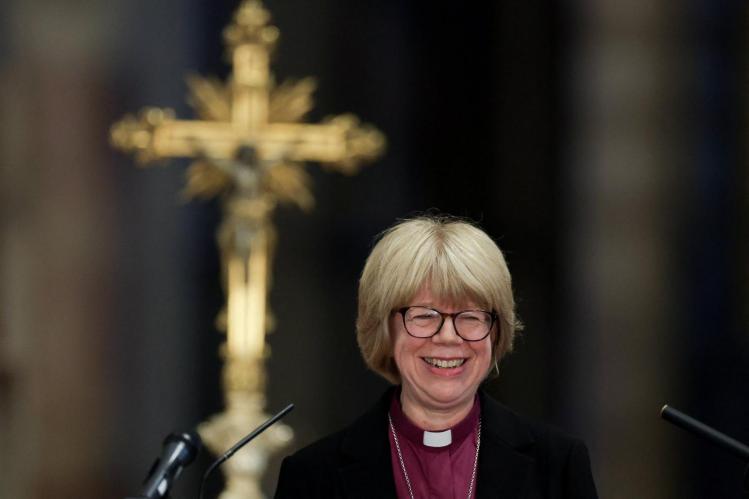
The public display of fraternity was historic, and the timing of it was fortuitous. Absent from the proceedings was the Rt. Revd. and Rt. Hon. Dame Sarah Mullally, the 106th archbishop of Canterbury, who will be installed in a ceremony at Canterbury Cathedral in March. Currently the bishop of London, Mullally will be the first woman to be the most senior bishop in the Church of England and the so-called first among equals of the wider international Anglican Communion, only thirty-one years after the Church of England started ordaining female priests and only eight years after it consecrated its first female bishop. She was appointed to the position after Archbishop Welby’s sudden resignation earlier this year in the wake of an abuse scandal. (Archbishop Cottrell has taken on many of the duties of the archbishop of Canterbury in the interim.) Mullally’s presence in Rome would have likely taken attention away from the ecumenical significance of King Charles’s visit, and her appointment could somewhat complicate the relationship between the Church of England and the Vatican.
Because Pope Leo XIII declared Anglican orders null and void in 1896 and because St. John Paul II wrote that women’s ordination is an impossibility, any Anglican cleric is a layperson in the eyes of Rome. A female Anglican cleric is doubly so. So far in his papacy, Pope Leo has seemed more cautious than Francis and more concerned about alienating conservative Catholics. Would he have processed and led such a high-profile service alongside a female archbishop? It’s entirely possible he would have, but because Mullally has yet to be installed, Leo didn’t have to make that decision. Yet.
As The New York Times reported, the secretary of the Vatican’s Dicastery for Promoting Christian Unity acknowledged that, while the ordination of Anglican women was a “potential problem” between the Churches, it “is more urgent that we stay together, that we dialogue and that we continue to walk together.” The archbishop of Canterbury’s representative to the Holy See stated that the archbishop-designate is likely to meet with Leo once she steps into her role: “The development of having female clergy and female bishops in the Church of England is one that is recognized as a matter for the Church of England by the Catholic Church,” he said.
Indeed, initial reactions from Catholic leaders to the archbishop-designate’s appointment were cordial and respectful. Cardinal Kurt Koch, Prefect of the Dicastery for Promoting Christian Unity, offered his congratulations and prayed “that the Lord will bless you with the gifts you need for the very demanding ministry to which you have now been called, equipping you to be an instrument of communion and unity for the faithful among whom you will serve.” Koch also noted that nearly sixty years of Catholic-Anglican theological dialogue had fostered “mutual understanding and affection” and expressed hope that the closeness between the two Churches seen after the death of Francis would continue. Mullally was one of ten Anglican representatives who attended Francis’s funeral.
At the national and local level, Cardinal Vincent Nichols, archbishop of Westminster, wrote:
On behalf of the Catholic Bishops’ Conference of England and Wales, I welcome the news of the appointment of Bishop Sarah Mullally as the next Archbishop of Canterbury. She will bring many personal gifts and experience to her new role.… Together we will be responsive to the prayer of Jesus that we “may all be one” (John 17:21).”
That same prayer was etched in the chair presented to King Charles during the ecumenical celebration in Rome.
In the official dialogue bodies, Catholic prelates are no strangers to being paired with female counterparts. At the parish level, Catholic and Anglican clergy often share a platform at civic events, alongside representatives of other faiths. These leaders’ faces are usually far more familiar to their communities than those of the bishop or archbishop. And friendships between Catholics and Anglicans happen unselfconsciously in a way that would have been far less likely sixty years ago. Mullally’s appointment will not change this, especially if the successor to Cardinal Nichols, who turns eighty next month, continues Nichols’s ecumenical openness.
The most overt opposition Mullally has faced so far (besides the predictable misogynistic slop shared across social media), has come from conservative Anglicans. On the day her appointment was announced, Archbishop Laurent Mbanda, Primate of Rwanda and Chairman of the Primates Council of the conservative Global Fellowship of Confessing Anglicans (Gafcon), expressed his “sorrow” at the election not just of a woman but also of someone who “promoted unbiblical and revisionist teachings regarding marriage and sexual morality.” (Mullally was involved in the creation of prayers to bless same-sex relationships within a Church of England church service.)
As head of the Gafcon Primates Council, Mbanda has since announced
the formation of a renamed Global Anglican Communion that will be led
by someone other than the archbishop of Canterbury. Ironically, he took
his stand a day before the Church of England bishops announced they
were pausing
their deliberations on permitting “standalone” services of gay
blessings, a move which removed some of the teeth from conservatives’
criticisms.
Bishop Mullally is used to working with people who do
not recognize her ordination. Within the Church of England there are
enclaves of Anglo-Catholics and conservative
Evangelicals that do not. There are an estimated 439 parishes where
Mullally would not be able to preside at Communion or an ordination,
though the so-called “flying bishops” who minister to these parishes
serve under the authority of diocesan bishops, including Mullally. One
priest who does not recognize the ordination of women noted that in
London, Mullally “would always attend the ordination of deacons and sit
in [the] choir and welcome the newly ordained.” Is this a triumph of
Anglican “living with difference,” a frustrated failure, or a quiet
assertion of authority?
Following her appointment, Mullally wrote:
I hope I have learned how to work even with those who cannot accept my role as bishop or priest—and to do so in a way that is respectful, allowing me to do all I can to support them in their ministry as fellow Christians. This approach will not change when I become Archbishop.
It remains to be seen whether this strategy will work nationally or whether some Anglo-Catholics will head to Rome. If the Vatican appears too ready to receive them, that could upset Church of England leaders, much as Pope Benedict’s 2009 creation of personal ordinariates for disaffected Anglicans irked Anglican bishops.
One urgent issue in Mullally’s inbox is to ensure she and the institutional Church are publicly on top of safeguarding. Safeguarding has proved the Achilles’ heel of the Church of England and the Catholic Church, costing them public trust, cash, and clergy, and today, their safeguarding teams in London share practice and learning. The need to respond promptly, respectfully, and thoroughly to people who bring allegations was the bar that caused Welby to stumble, even though he oversaw many changes aimed at preventing future abuse. In the diocese of London, Mullally has made safeguarding a diocesan priority and grown its safeguarding team from two to nine people. This is another matter of common concern between her and Leo, who recently met with survivors of clergy sexual abuse at the Vatican.
Those who have worked with Mullally have described her as highly competent, compassionate, and empathetic, a leader keen not to inflame tensions and get things done. Here she and Pope Leo, who has been described as cautious and measured, may find in each other a kindred spirit, coming in the wake of intellectuals Benedict XVI and Williams, and the outgoing—and sometimes outspoken—Francis and Welby.
How Pope Leo and the first female archbishop of Canterbury work together will be closely watched. Opportunities for high-profile collaboration may be sidestepped for now. Mullally’s time in office will be shorter than most of her predecessors’—she will have six years in office before reaching retirement age at seventy. If she trips up, critics may attribute it to her gender. If she does well, she may prompt reflection about the potential of women who wish to serve the Church at the highest levels. Leo, before becoming pope, welcomed Francis’s appointment of three women to the dicastery for selecting bishops, which he led. If Leo did, in time, in the right setting, wish to lead a service or pray with Mullally, well, as the extraordinary scene of a British monarch praying with a pope in Rome recently showed, stranger things have happened.


No comments:
Post a Comment