
Magnificent Obsessions
The shock-and-awe tactics of President Donald Trump’s frenetic first months in office should not make Democrats forget their part in putting him there. Last November, they lost everything: the presidency, both houses of Congress, key battleground states, the majority of voters. And it wasn’t just because they were on the wrong side of issues like immigration and grocery-store prices. The Republicans won because Donald Trump was able to remake their party—or at least its image. To turn the tables on the MAGA movement, the Democratic Party also needs a thoroughgoing remake, not just a facelift based on focus groups. That means revisiting the transformation of the Democratic coalition that occurred between 1968 and 1972 and looking again at who was welcomed into the party’s new coalition and who was shown the door.
After the passage of the landmark Civil Rights Act of 1964, it was obvious to President Lyndon B. Johnson and other Democratic Party leaders that the old Roosevelt coalition was doomed. But the actual transformation was triggered by the unrest at the 1968 Democratic National Convention in Chicago, during which millions of voters watched on television as the police of Mayor Richard J. Daley battled anti–Vietnam War protestors and other young activists representing a menu of countercultural causes. As Bill Clinton later wrote in the first volume of his memoirs, the conflict that played out in the streets of Chicago was really a clash between generations, social classes, and moral cultures:
The kids and their supporters saw the mayor and the cops as authoritarian, ignorant, violent bigots. The mayor and his largely blue-collar ethnic police force saw the kids as foul-mouthed, immoral, unpatriotic, softer upper-class kids who were too spoiled to appreciate authority, too selfish to appreciate what it takes to hold society together, too cowardly to serve in Vietnam.
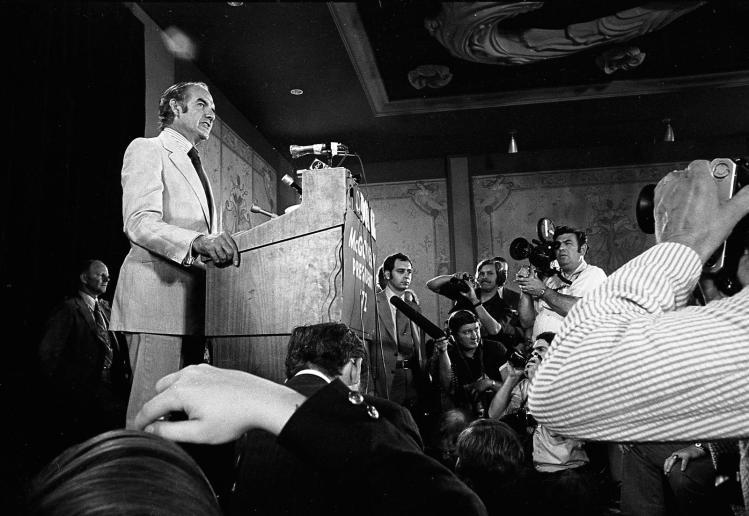
The action inside the convention hall was less dramatic but far more consequential. In a decision that much of the media ignored, the delegates approved a new Commission on Party Structure and Delegation Selection, with Sen. George McGovern as chairman. The aim was to get rid of the old nominating system, in which big-city bosses and state party chairmen—many of them, like Daley, working-class Irish Catholics—determined who would run for the party’s presidential nomination, and replace it with a more democratic process based on state primaries and caucuses. The goal behind these procedural changes was the moral and cultural transformation of the Democratic Party.
In his minutely researched book Why the Democrats Are Blue (2007), journalist Mark Stricherz retraces the steps by which Robert F. Kennedy’s and Eugene McCarthy’s 1968 campaign leaders used the new nomination process to create a “social change” coalition based on upper-middle-class suburbanites, women, African Americans and—especially—college-educated baby-boom activists from the civil-rights and antiwar movements. For the 1972 convention, an informal quota system was adopted to ensure strong participation by women, racial minorities, and the young. Such a coalition, it was thought, would produce the kind of antiwar platform on which McGovern, the party’s presidential nominee, could stand.
Leaders of the party’s old constituencies—blue-collar workers, Roman Catholics, and union leaders—were shut out of the reorganization and delegate-selection process and put on reserve political status behind the party’s fresh new faces. A conspicuous example: the credentials committee rejected an elected Illinois delegation headed by Mayor Daley and replaced it with one led by civil-rights leader Jesse Jackson. Culturally and politically, the delegates at the 1972 convention resembled the protestors outside the 1968 convention, while many of those who had sat inside four years earlier now watched the convention on television.
Despite all the planning by McGovern’s operatives, what everyone witnessed on television was almost as contentious as what took place outside the previous convention. Delegates fought over numerous planks in a twenty-five-thousand-word platform that bore little resemblance to any of the party’s earlier platforms. A plank commending the busing of students to achieve racial balance in public schools passed, but a minority plank favoring gay rights did not. On the second night of the convention, feminists fought until four in the morning for a plank proclaiming “reproductive freedom” a “human right.” The McGovern campaign worked the hall to block the move, fearing it would cost them the election, and even permitted a speech by a pro-life congressman. In the end, the plank was defeated, but it was the last time the party would allow any pro-life Democrat to address its national convention. On the third and final night, delegates insisted on nominating their own candidates for vice president to compete with McGovern’s choice. Feminists pushed for Frances “Sissy” Farenthold, the only woman in the Texas state legislature, with a non-delegate—Gloria Steinem—making the nominating speech. Farenthold did well against a field of seventy-seven men that included prankish votes for CBS television reporter Roger Mudd, China’s leader Mao Zedong, and All in the Family’s Archie Bunker. The prolonged exercise pushed McGovern’s acceptance speech back until 2:28 in the morning, well beyond the bedtime of even the most politically avid Americans.
During his campaign, McGovern hailed the revamped Democratic Party as a “coalition of conscience” that would not only end the war but also “reorder” the basic institutions of American society. As a campaign slogan, “coalition of conscience” was wholly in character: McGovern, the son of a Methodist minister, was raised in a Methodist manse, graduated from a Methodist college, and had briefly studied for the ministry himself. More to the point, the phrase flattered youthful voters like me who would not have supported President Nixon under any circumstances. But to others, “coalition of conscience” reeked of moral, cultural, and class contempt. McGovern lost every state except for Massachusetts and the District of Columbia. Eventually he learned to laugh about it: “I opened the doors of the Democratic Party,” he liked to say, “and twenty million people walked out.”
To be sure, enough of the walkouts returned in 1976 to elect another Democrat, Jimmy Carter. But that was after Watergate and with the help of white born-again Christians from the South who saw in Carter—with his born-again bona fides—one of their own. By then, lines of separation by class, education, and income had been drawn, lines that hardened over time and resurfaced in spectacular fashion during the 2016 presidential election.
Far more consequential was the Democratic Party’s alliance with the early feminist movement. In 1968, most of the Democrats who would later vie for the party’s presidential nomination—Ted Kennedy, Jesse Jackson, Al Gore, Eugene McCarthy, Jimmy Carter, Walter Mondale, and McGovern himself—were pro-life. By 1992, no Democrat who ran for president or other high public office could identify as pro-life and count on the party’s support. Quite the contrary. At that year’s Democratic National Convention in New York City, placards from Planned Parenthood and the National Association for the Repeal of Abortion Laws were everywhere; the old AFL-CIO placards, meanwhile, were nowhere to be seen. I attended that convention and watched as the platform committee barred Pennsylvania’s liberal, labor-friendly governor, Bob Casey Sr., from presenting a dissent to the platform’s pro-choice plank; worse, in an unprecedented public rebuke, the committee welcomed Casey’s pro-choice Republican opponent to speak in his stead.
One of the earliest effects of the Democrats’ new coalition was to dislodge the Catholic vote from its traditional moorings in the Democratic Party. This led to the emergence of the Reagan Democrats in the 1980s and to Catholics becoming the largest swing vote by the turn of the century. In 2004, John Kerry, the first Catholic presidential nominee since John F. Kennedy, actually lost the Catholic vote. In 2016 and again in 2024, a majority of Catholic voters supported Donald Trump.
The McGovern Commission’s preferential option for college graduates signaled the end of the trade unions as a major pillar of the Democratic Party. But it was also prescient. As the United States shifted from an industrial to an information-based economy and companies outsourced manufacturing to lower-cost labor markets in Asia, private-sector unions lost most of their membership and, with it, their political clout. A major exception affirms the rule: the teachers’ union, which is woven into the party’s leadership apparatus, represents four-year college graduates and often endorses liberal educational reforms—such as gender-identity lessons for grade school—that clash with the values of most working-class parents.
McGovern’s slogan, “coalition of conscience,” fell out of use after his failed run for president, but the social, moral, and class assumptions behind it remained. Simply put—and it was often put very simply—American society was, to judge by the rhetoric of the new Democratic Party, divided between two groups, the oppressed and their oppressors. The former included—by definition—“women and minorities.” Initially, “minorities” connoted Native Americans, African Americans, and other nonwhite citizens. But the category quickly expanded to include sexual and gender minorities—gay, bisexual, transgender, and nonbinary Americans. Each of these minorities was entitled, in the party’s progressive view, to government protection and redress.
Who, then, were the oppressors? They were, by process of elimination, straight, mostly working-class white males, together with their wives and children. To the wealthier, better-educated progressives ascendent in the Democratic Party, such people were assumed to be racist, boorish, backward because of their religion, homophobic, ignorant or at least poorly informed, and atavistic in their views of women. In the words of Hilary Clinton, they were “a basket of deplorables” who stood athwart every form of social “liberation.”
In his lacerating last book, The Revolt of the Elites (1992), social critic Cristopher Lasch turned this view on its head. “The culture wars that have convulsed America since the Sixties,” he argued, “are best understood as a form of class warfare in which an enlightened elite (as it thinks of itself) seeks not so much to impose its values on the majority…much less to persuade the majority by means of rational public debate, as to create parallel or ‘alternative’ institutions in which it will no longer be necessary to confront the unenlightened at all.”
Lasch, it should be noted, defined himself as an old-fashioned Midwestern populist who had graduated from Harvard and earned his PhD in history from Columbia. He was also old enough to remember the 1950s, when the gap between the poorest and richest Americans was at its narrowest and the culture wars had yet to become a major force in U.S. politics. By the turn of the century, however, that gap was widening rapidly, and party affiliation was based less on support for what one’s own party represented than on opposition to what the other party stood for. The academic term for this is “negative polarization.”
In the fall of 2018, the political scientist Lilliana Mason published Uncivil Agreement, which described how, in the previous few decades, party affiliation had absorbed and solidified a whole range of identities along class and culture divides:
The competition is no longer between only Democrats and Republicans. A single vote can now indicate a person’s partisan preference as well as his or her religion, race, ethnicity, gender, neighborhood and favorite grocery store. This is no longer a single social identity. Partisanship can now be thought of as a mega-identity, with all the psychological and behavior magnifications that implies.
In Donald Trump, “mega-identity” found its perfect embodiment. Those who supported him in 2016, defended the January 6 attack on the Capitol, stood with him during the Biden interregnum, and then voted for him a second time are loyal to an individual, not a political party. What attracts Trump’s hardcore supporters is his ability to identify with them—and to do so without sharing any of the traditional norms that working-class Americans strive to uphold. He’s a thrice-married womanizer, a convicted felon, a braggart and huckster. His social profile is etched in tabloid ink. He says he believes in God, but when a reporter once inquired whether Trump had ever asked God for forgiveness, he replied that he had never had a reason to do so. Still, as an article in The New Statesman points out, one thing Trump has never done is talk down to working-class Americans. And why should he? The bond he has with them is based on an abiding resentment of educated elites and their institutions.
That said, President Trump’s actions since taking office in January have benefited oligarchs, not his working-class supporters. The firing of a hundred thousand government workers; the gutting of regulatory agencies that protect public health, welfare, and parks; the heartless and misguided elimination of USAID; the “Big Beautiful Bill” that cuts Medicaid funding to offset tax cuts for the wealthy—none of this was mandated by working-class Americans. Some of them may enjoy all the fireworks, but they will surely suffer from the long-term effects.
To be sure, popular reaction against the roughshod tactics of the president and Elon Musk’s Department of Government Efficiency have given Republican officeholders reason for concern. But it would be foolish to assume that Trump will simply self-destruct. His base believes in him the way the pious believe in prayer.
If Democrats hope to return to power, they will have to abandon the conceit that theirs is the party of moral high-mindedness. The simplistic narrative of oppressors versus oppressed minorities has allowed the party to ignore the plight of the undereducated working class (two-thirds of the population) that Trump has made his own. The party of the educated best and brightest has become a sclerotic coalition of progressive hobby horses and special interests—gender fluidity, unrestricted abortion rights, and monopoly public education to name a few—that has failed to deliver basic public goods like safe streets, reliable public transit, and quality schools. It’s a party that preaches diversity, equity, and inclusion, but can’t tolerate dissent and is no longer the automatic choice of racial minorities. After half a century, the “coalition of conscience” that replaced Roosevelt’s New Deal has become a victim of its own magnificent obsessions. It needs to be replaced.


No comments:
Post a Comment