
In Plain Sight
President Donald Trump owes a great deal of his political fortune to his enthusiasm for conspiracy theories. Before running for president, Trump embraced the nascent “birther” movement, repeatedly taking to Twitter and cable news to allege that Barack Obama was born in Kenya and therefore ineligible to be president of the United States. During the Republican primaries, Trump suggested that Rafael Cruz, the Cuban-born father of Sen. Ted Cruz, had ties to Lee Harvey Oswald and was likely involved with the assassination of John F. Kennedy. And, of course, Trump spearheaded the campaign to overturn the results of the 2020 presidential election, spouting widely discredited claims of systemic vote-stealing by the Democratic Party. This particular conspiracy theory led to a real conspiracy: the seditious violence of January 6, 2021, when MAGA diehards stormed the Capitol to disrupt Congress’s formal certification of the election results.
Since returning to the White House, Trump has not tempered his penchant for crackpot theories. He appointed Robert F. Kennedy Jr., who has promoted the baseless theory that childhood vaccines cause autism, to run the Department of Health and Human Services. Stephen Miller, Trump’s deputy chief of staff for policy, built the administration’s draconian immigration policy on the white supremacist great-replacement theory, which alleges that Democrats are using immigration to change the demographic makeup of the country for their political advantage. In 2020, Trump’s director of national intelligence, Tulsi Gabbard, accused Obama of ordering a “false” intelligence analysis to make it appear as if Russia interfered in the 2016 election. (As a 2020 report from the Senate Intelligence Committee confirmed, Russia did in fact interfere in that election.)
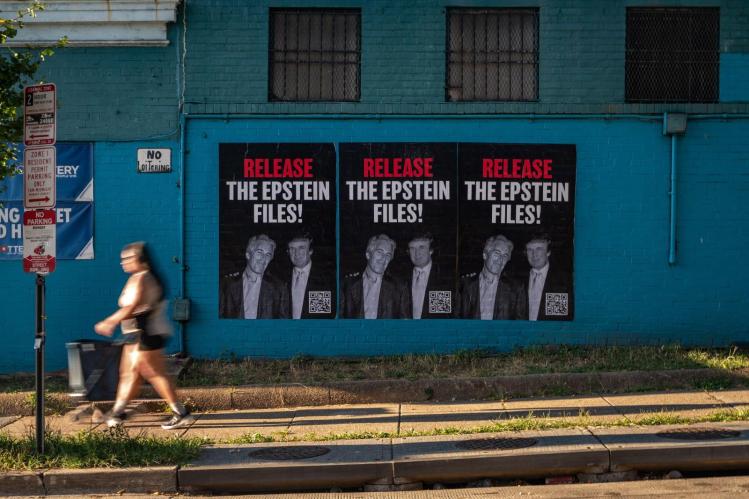
For all of Trump’s success manipulating conspiracy theories in his favor, the one he hasn’t been able to get a handle on is the Jeffrey Epstein case, the most sprawling and scrutinized plot since the Kennedy assasination—particularly among QAnon fanatics, who believe that Epstein, a convicted sexual predator, was at the center of a global ring of pedophiles enabled by the so-called “deep state.” On the campaign trail, Trump promised to release all the files related to the Justice Department’s prosecution of Epstein, who died in a federal prison in 2019 following his arrest for sex trafficking minors. Trump’s long and very public friendship with Epstein and rumored inclusion on his list of clients did little to shake QAnon’s belief that, if Trump returned to the White House, he would expose the conspiracy once and for all.
Instead of releasing the Epstein files, Attorney General Pam Bondi handed out binders full of previously published information about the case to conservative influencers, which rankled many prominent Trump supporters, including far-right activist and 9/11-truther Laura Loomer, who called on Bondi to resign. In July, the Justice Department announced it had found no evidence of a client list, seemingly contradicting Bondi’s previous claim that the list was “sitting on [her] desk right now to review.” To contain the backlash, the deputy attorney general met with Ghislaine Maxwell, Epstein’s coconspirator, supposedly to gather new information. Shortly after that interview, Maxwell, who is currently serving a twenty-year prison sentence, was transferred from a notorious federal prison in Florida to a more comfortable minimum-security facility in Texas. The move outraged victims and further exposed a growing rift among the MAGA faithful. The subsequent release of documents subpoenaed by the Republican-controlled House Oversight Committee—which included a lewd illustration allegedly drawn by Trump for Epstein’s fiftieth birthday and another well-wisher’s joke about Epstein selling a “fully depreciated” woman to Trump for $22,500—made two things clear: the Epstein story isn’t going away and the president is deeply involved in it.
Though it’s unlikely we’ll ever learn the full details, we know that Epstein leveraged his relationships with powerful men to facilitate his crimes and avoid prosecution. His team of lawyers—Alan Dershowitz; Jay Lefkowitz, a former George W. Bush–administration official; and Kenneth Starr, the former Whitewater special prosecutor—negotiated a plea deal with U.S. Attorney Alex Acosta in 2007, which included a sealed nonprosecution agreement granting immunity to Epstein and “any potential co-conspirators.” And as The New York Times recently reported, JPMorgan processed more than $1 billion in transactions for Epstein and set up accounts for women federal investigators later determined to have been victims of Epstein’s sex-trafficking operations.
All of this damning information is already on the public record. So it is no longer really a conspiracy theory to claim that the crimes of Epstein and Maxwell were abetted and covered up by people who have yet to be held accountable. It often looks as if the more byzantine fantasies of QAnon and other Epstein obsessives were concocted precisely to keep Trump’s supporters from having to acknowledge the sordid story staring them in the face all along: that Jeffrey Epstein and their hero, an adjudicated sexual abuser, built a close friendship on their shared sexual interests. As Trump’s birthday message to Epstein put it: “We have certain things in common, Jeffrey.”
The journalist Michael Wolff, who interviewed Epstein not long before he died, has suggested the most recent revelations about Trump and Epstein, coupled with Trump’s own bungling of the Epstein files, could be the start of a long lame-duck period, with the people around him jockeying to inherit the MAGA mantle from their disgraced leader. That’s certainly possible, but no one who remembers the Access Hollywood tape or Trump’s two impeachments or his thirty-four felonies would bet on it.
No comments:
Post a Comment