
Corpus Christi
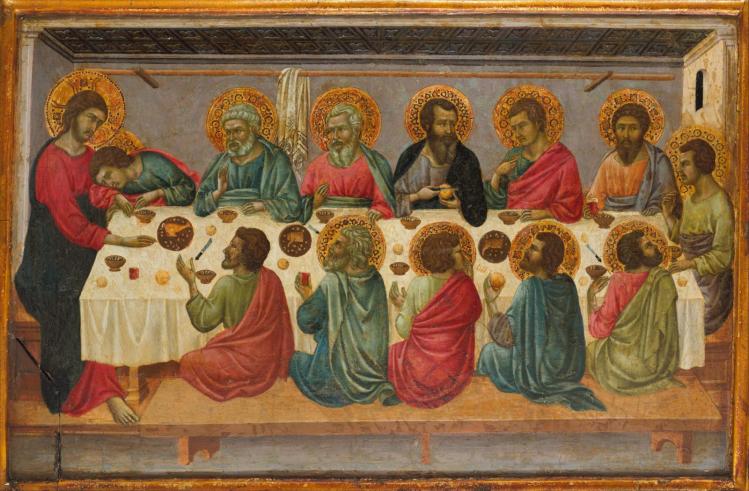
I took my first Catholic Communion in 1973, when I was seven years old. I didn’t wear the white lace wedding-cake confections and veil and patent-leather shoes often associated with the rite. Instead, my mother bought me a sky-blue sleeveless Izod shirt-dress that she had picked up somewhere half-price and which, in her view at least, was sufficient unto the solemnity of the occasion (or in any case, less vulgar than the whole tiny-bride-of-Christ routine). I looked more like an aspiring tennis champ than a Communicant.
Still, I watched as Fr. Tom reenacted the Last Supper, preparing the body and blood of Christ for our consumption. “Take this, all of you, and eat it. This is my body, which will be given up for you.” My mother’s parting instructions as I left the pew to go up to the altar: “Don’t fidget in the Communion line, and don’t chew the host.”
This latter request was easier said than done. Lodged between my tongue and palate, the wafer would often stick to the roof of my mouth. Once back in my seat I’d have to surreptitiously scrape it off, sucking the dissolved remnants of God’s body off my index finger.
The indelicacy of sinking one’s teeth into Christ’s flesh had always posed a theological quandary for the Church. Augustine took a politely symbolic view of the Eucharist, referring to the bread and wine as visible “signs” only, and thus distinct from the divine substance they signified. Others who resisted the idea of cannibalizing Christ’s body leaned on the elegant image of consuming the metaphorical Word made flesh, after the fashion of Ezekiel and John of Patmos swallowing divine scrolls, “sweet as honey in their mouths.”
Later scholastic theologians, however, doubled down on the literal identity between body and bread, and performed ever-more-baroque spiritual gymnastics to account for how, in fact, the sacred substance could be metabolized—chewed, swallowed, digested, and excreted—without losing its sacred character. What does it mean to digest God?
In an actual back-and-forth dialogue among tenth-century monks regarding the hypothetical case of a church mouse eating leftover Eucharist crumbs on the altar, the more indulgent theologians gave the creature a pass. Since animals were not rational beings, they could not receive the host as sign, and therefore consumed the bread and wine as mere stuff, not meaning. Others, however, took no chances; Peter Paludanus insisted that in such a case, the mouse would have to be burned and its ashes returned directly to the earth in order to avoid desecration. Following a similar logic, twelfth-century theologian Alain of Lille recommended that any criminal condemned to death be denied Communion in the three days prior to his execution, lest “Christ, who was still believed to be in the stomach, should be handed over to hanging,” killed twice in a species of theological double jeopardy. (That it was less sacrilegious for Christ’s body to be excreted than to be hanged didn’t, apparently, come up for question.)
Luckily, in the twelfth century, Thomas Aquinas came to the rescue with a neat philosophical solution: transubstantiation. Aristotle had taught that any physical thing was composed of substance—an essence that subsisted across time—and accidents, the myriad incidental shapes and changes that a substance might undergo. For instance, a man might be tall or short, bent or straight, but beneath the accidents of appearance, his essence as “man” persisted unchanged. So argued Thomas of Aquinas: “Whatever is eaten as under its natural form, is broken and chewed under its natural form,” he wrote in the Summa Theologica. “But the body of Christ is not eaten as under its natural form, but under the sacramental species.” Thus was God’s body saved from the indignity of mere matter.
I remember my parents trying to explain transubstantiation to me. “You know the Episcopalian Church, the one with the red door, on Diamond Park?” my father asked me. I did. “They take Communion too. But when they do it, they think it is just a symbol. Catholics believe it is actually Christ’s body and blood.” This cleared matters up a little bit, but in the end just led me to conclude that Catholics believed in magic and Protestants didn’t (which, I suppose, is a short answer to why the Reformation happened). For a while, this knowledge made me feel special, like I had access to a secret superpower denied my Protestant friends.
Still, the fact was unavoidable: a rather crude act of eating lay at the heart of Christian belief. In his 1890 work of speculative anthropology, The Golden Bough: A Study in Comparative Religion, Sir James George Frazer traced the Christian sacrificial meal back to Bronze Age vegetation cults. The “savage mind” of early humanity, Frazer hypothesizes, pictured the change of seasons as a drama of life and death, keenly aware that “the same processes which freeze the stream and strip the earth of vegetation menace [man] with extinction.” Through ritual reenactment of the death and resurrection of a nature god, early agricultural societies hoped to secure the annual return of life-giving crops.
In Frazer’s genealogy, the earliest avatar of this sacrificed nature divinity is the Assyrian god of grain, Adonis, young lover of the earth-mother and fertility goddess Ishtar. When Adonis is killed by demons and dragged to the underworld, Ishtar descends to his rescue, and the earth is left barren by her departure. Only when the couple reascend to earth does life return to vine and womb. In the yearly Babylonian festival memorializing the god’s death and resurrection, women mourners worshipped an effigy of Adonis made of patched-together honey, wheat, and flowers, while bewailing the world’s barrenness in his absence: “Her lament is for the woods, where tamarisks grow not,” runs one funereal hymn. “Her lament is for a wilderness where no cypresses grow. / Her lament is for the depth of a garden of trees, where honey and wine grow not.… Her lament is for a palace, where length of life grows not.”
Other versions of the myth were bloodier. The Phrygian earth-goddess Cybele, lovesick for the fair young shepherd Attis, struck him with a fit of madness to prevent his marriage. The frenzied youth unmanned himself and bled to death beneath a pine tree, and the grief-stricken goddess made a deal with Zeus to resurrect her fallen lover. Attis and Cybele’s cult, which was widely popular under the Roman Empire, celebrated an extended festival during the vernal equinox. A pine tree, wreathed in the violets said to have sprung from Attis’s blood, was carried into the sanctuary of Cybele. Whipped into an ecstatic frenzy, the cult’s clergy “gashed their bodies with potsherds or slashed them with knives in order to bespatter the altar and the sacred tree with their streaming blood” (the more zealous among them castrated themselves, in imitation of their god). The god-in-effigy was buried and, when the tomb was opened on the morning of the third day, Attis was found to have risen from the dead. Initiates into the mystery cult of Attis, Frazer suggests, partook of a sacramental meal by “eating out of a drum and drinking out of a cymbal,” prefiguring the Christian supper.
Christianity was, then, not without precedents when it came onto the scene. Frazer discusses the importation of these “Asiatic” mother-goddess cults, including Christianity, in second- and third-century Rome with barely disguised disgust, noting that by “saturating the European peoples with alien ideals of life,” they “gradually undermined the whole fabric of…Greek and Roman society.” “The ecstatic frenzies…the mangling of the body, the theory of a new birth and the remission of sins through the shedding of blood, have all their origin in savagery,” he claims. It was only with the revival of Roman law and Aristotelian philosophy at the close of the Middle Ages that “the tide of Oriental invasion turned at last.” Frazer is at pains to explain how the more sophisticated Roman citizens could have fallen for such a crass “Asiatic” bait-and-switch, but concludes that the “true character” of these rites “was often disguised under a decent veil of allegorical or philosophical interpretation…reconciling even the more cultivated of them to things which otherwise must have filled them with horror and disgust.”
And indeed, Anglo-American religious histories never tire of pointing out the childish, savage, and overall distasteful nature of Catholic literalism as embodied in the Eucharist. As the Reformation historian Preserved Smith noted in a 1916 essay on “Christian Theophagy,” Catholics fail to heed Cicero’s civilized skepticism of the gods and their associated sacrifices: “When we call corn Ceres and wine Bacchus,” Cicero mused in his essay on religion, “we use a common figure of speech: but do you imagine there is anybody so insane as to believe that the thing he feeds on is god?” As Cicero to the “savage” and overly literal worshippers of Bacchus and Attis, so prim nineteenth-century Anglicans to those wearisome Catholics too dumb to recognize a metaphor when they saw one.
Growing up in Syracuse in the 1940s and ’50s, my mother butted up against these prejudices again and again: she and her Irish immigrant parents were credulous peasants, trapped in a backwater eddy of superstition, throwing sand in the gears of civilization. “Mackerel snapper,” snickered Protestant school mates (and indeed, my grandmother did cook fish for supper on Fridays).
Yet the Catholic insistence that one eats God’s body (“broken and chewed,” to cite Aquinas) not symbolically but as literal enzymatic and chemical fact—as metabolic feat—helps make sense of the synoptic gospels’ otherwise baffling obsession with broken and suffering bodies. There is no more visceral way to experience the fact of our shared flesh—to understand that our participation in the other is literal, not figurative—than to come face-to-face with the physical vulnerability of the other’s body. The historical Jesus of Nazareth scandalized his community by provoking precisely this gut-level reaction of outrage and disgust at our broken one-ness, our unity-in-disintegration, again and again and again. He walked around Galilee and Judea touching every person he encountered who might be considered low or unclean: rotten flesh, empty bellies, blasted eyes, dirty feet, bleeding prostitutes. Instead of cursing the broken bodies, he consecrated them. More confounding still: he insisted there was no difference between those bodies and his own. “Verily I say unto you, inasmuch as ye have done it unto one of the least of these my brethren, ye have done it unto me” (Matthew 25:40). And he gave an unprecedented name to this outrageous fact of participation in and responsibility for a larger order of being: he called it love.
As part of the process of confirmation in eighth grade, I went on a service trip to a poor rural pocket of West Virginia. We split up into groups and I went to visit a homebound elderly man, bringing him food and, perhaps more importantly, an hour of company. My memories of the place are blurry: I see a single dark room, sparsely furnished, with a bare floor reflecting tepid sunlight from the front window. Of the old man himself, sitting on a sofa, I retain only this: that the flesh of his face was pale, pasty, crumpled-looking. There was something larval about his presence, indistinct and folded in on itself, like a paint smudge of a face in a Francis Bacon painting. At the sight of his collapsing flesh, I felt pity and disgust.
During the course of this visit, the man took down from a shelf a gray object the size of his palm to show us: a tiny box, complete with a lid, carved out of the tooth of a sperm whale. It was not a fine or polished bone sculpture; it appeared rough and rusty and dirty, as if still trailing bits of the whale maw from which it had been plucked. Still, we politely pretended to wonder at it.
The visit has stayed with me, perhaps because it was the first time I understood how hard it is, counterintuitive even, to love one’s neighbor as my religious training was asking me to love this man. It went against the will, against all desire and inclination: indeed, it incited creaturely revolt. The service worker who brought us on the visit was serene, patient, and efficient. For her, this rite of bearing witness to our shared imperfect flesh had become reflexive, like muscle memory, like prayer. This was the meaning behind the rite of swallowing God’s body. This—in this dim room, admiring an indecent hunk of whale’s tooth in the old man’s shaky palm—this was what love looked like, and it terrified me.
I was a very poor science student in high school, barely scraping by in physics and chemistry, but I loved biology—perhaps because it is such an incarnational science. I dissected a worm: slid a scalpel along its rubbery length, then pulled back the flaps and pinned them to the bed of black wax lining a dissection tray. Inside, its organs matched point-for-point the diagram in my textbook: ganglia, gonads, intestine: a tiny hidden universe laid to light. A frog was next. I remember the feathery green-brown lobes of liver; the duodenum a shiny, smooth kink of an organ leading away from the pillow of stomach. The duodenum looked like it would yield to my scalpel but instead resisted, like cutting into a rubber bouncy ball or biting down on a licorice rope. The lips of the opening were thick and yellow once I finally managed to slice my way in. Rubber, bounce, recoil: I can still feel in my right hand—the ghost of a muscle memory—the surprising resistance those inert bodies opposed to my instrument, as though instinctively protecting their inwardness.
I remember, too, a poster I made illustrating the process of phagocytosis: an amoeba eating a paramecium, shooting out its jelly-like appendages—a primitive, makeshift mouth—to encircle its prey before digesting it, stripping it for parts and ejecting the waste. This is what heterotrophs—other-eaters, from amoebas to humans—do: whether their mouths are formed by cytoplasmic claws or fully evolved teeth and tongue, they eat other living or once-living things and incorporate them into their own flesh and blood, metabolizing foreign substances into the substance of the self. My 1980s biology book featured a diagram of the food chain as a predatory merry-go-round, a struggle of all against each to suck down enough stored solar energy—grass, grain, flesh—to keep the machine running another day, before dissolving back into the earth and starting the whole cycle over.
“Food becomes blood; blood becomes heart and brain, food for thoughts and feelings,” wrote German philosopher Ludwig Feuerbach in an 1850 review of contemporary physiology. And he concluded, in a catchphrase that has since become a trite health-and-wellness mantra, “Man is what man eats.” What nineteenth-century German physiologists called Stoffwechsel—stuff-changing or matter-changing, in English, metabolism—posed as much a philosophical as a chemical conundrum for early biochemists, making them the unlikely scientific heirs of Aquinas. “The ultimate aim of biochemists,” wrote J.B.S. Haldane in 1938, was to give a complete account of “the transformations undergone by matter in passing through organisms.” Early models for metabolism looked at food as fuel, and the body as a stable fuel-burning machine, on the model of the engine: matter goes in; energy and waste come out. Scientists rigged up baroque experiments to measure and weigh their subject-animals both before and after eating, tracing the pathways by which food was transformed into energy. Bodies on this model were like giant juicers, extracting the fruit’s life-giving elixir and spitting out the husk and pulp.
But the introduction of isotopes into these experiments, whereby the food’s molecules could be traced throughout the most byzantine of metabolic twists and turns, revealed that the mode of interaction between eater and eaten, organism and foodstuff, was much more intimate than this mechanical model had allowed for. Foreign matter in the guise of food wasn’t just grist for the mill of the organism’s structure, but actually got swapped out with the mill works themselves: foreign Stoff was metabolized into self, and self was then metabolized into foreign Stoff to be sloughed off in turn. “Living beings are not in being,” writes Ludwig von Bertalanffy of the ceaseless shift and shake of molecules by which our bodies do their work of holding out against entropy. Rather, “they are happening.”
But what, then, is metabolism, this endless cycle of eating and being eaten, if not the chemical expression of the most ancient myth of all: the cyclical death of the earth; its dispersal, ingestion, and rebirth; the original splitting that consecrates our oneness; the cosmic metabolic arc that binds all life?
Once, my Catechism teacher told the class that even when she took Communion on an empty stomach, afterwards she “felt full.” Then she smiled beatifically. When I reported this possibly miraculous circumstance to my mother, she rolled her eyes and dismissed it as “unlikely.” And besides, she continued, “What does God care whether she feels full or not?”
Our participation in a larger body—a church, a community, a species, a planet—is true regardless of what we “feel.” “Faith,” Flannery O’Connor once observed, “is what someone knows to be true, whether they believe it or not.” This is what my overly literal Catholic upbringing taught me: that our shared flesh and fate is not a feeling or a choice or even a belief but a fact, the founding fact, measured against which all other facts are as nothing.
There was a side table in the living room of the house I grew up in where my parents kept a cluster of Catholic artifacts picked up in their travels through Mexico, small statues and portraits that had once adorned household shrines. A faded painting of St. Jerome on tin, showing him seated in front of his cave in a red cloak, head pensively cradled in an open palm and a docile, curly-haired lion at his feet. A blackened wooden crucifix with hanging Christ, his tiny face pinched in pain, including real nails piercing his hands and feet and a miniature crown of thorns. A painted plaster Christ-in-robes whose hands had long ago broken off, such that the empty sleeves of his raised arms appeared to hold forth the gift of nothing. All these miniature icons in various stages of decay did little to counter my intuitive sense that to be a believer in this Church was inescapably tied up with the fragility of my body.
It wasn’t until much later in life—after I had had more experience with my literal body being cracked up and cracked open—that I’d realize it wasn’t brokenness per se that I’d been taught to hold sacred. Later, I knew these ragged-edged household gods were meant to serve as a reminder that we are all shards of a larger whole that transcends our ken. That the edge of our skin is not an end but a beginning, not a closing off but an opening up, not an answer but a mystery.
Such is, in any case, how I now choose to think of my mackerel-snapping Irish ancestors, and of the wine and wafers of my Catholic girlhood: an acknowledgement that our bodies are bound to the earth as both grain and grave, life and death, eaten and eater by turn. Back further still: recapitulation of ancestral cell memory, ritual reenactment of the mystery of metabolism, both split and stitch, the original un-cleaving into which furrow a world was first sown.


No comments:
Post a Comment