
A Rule for the Rest of Us
In 2023, the Biden administration’s surgeon general, Dr. Vivek Murthy, issued an urgent advisory titled “Our Epidemic of Loneliness and Isolation,” which warned Americans about the significant cost of loneliness: “Loneliness is far more than just a bad feeling—it harms both individual and societal health.” Since then, various media outlets have amplified this warning and proposed various cures for loneliness, but many of these are little more than life hacks designed to promote greater “connection,” variously—and often vaguely—defined.
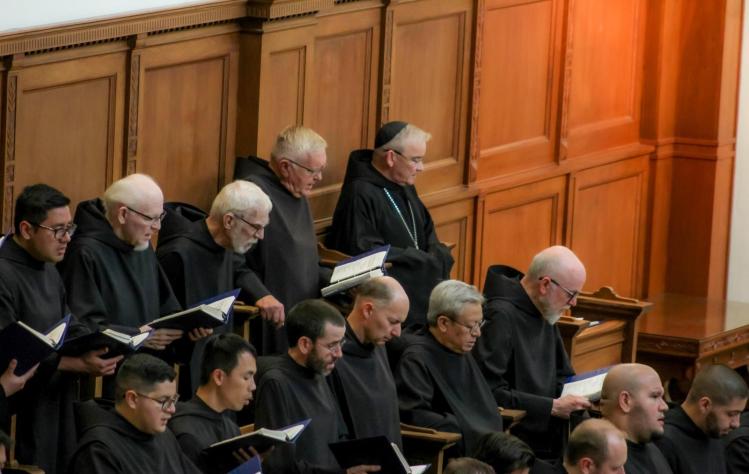
But connection is not quite the same thing as community, which is the real cure for loneliness and isolation. And if we want to encourage community, we’ll need to revisit the habits, social structures, and traditions that have long made a sense of belonging possible. Among the traditions that have taken the shape of shared life seriously, monasticism is one of the most enduring. The Rule of St. Benedict, in particular, offers a way of living that can sustain commitment, humility, and presence in community. It wisely assumes that people will sometimes get on each other’s nerves, that attention to details will eventually fray, and that love and community therefore need some kind of scaffolding. They will not survive on sentiment alone.
The vision of community as a shared discipline is not unique to Benedict. Long before monasteries, the early Christian community in Jerusalem built its common life around practices that made belonging visible and durable. Acts 2:42–47 gives us a glimpse of what that looked like. People prayed and broke bread together, pooled their resources, and lived cooperatively, forming a substantial community that went well beyond merely “connecting” with one another. Benedict’s Rule built on this tradition. Chapter 48, which outlines the daily work of the monk, opens with a clear claim: “Idleness is the enemy of the soul. Therefore, the brothers should be occupied at certain times in manual labor, and at other times in lectio divina.” The goal was to shape time in a way that formed people in community and prayer. The Rule divides the day into clear parts, assigning time for work, reading, and communal prayer. The details may vary somewhat from one community to another, but the basic structure is the same for Benedictines everywhere.
This structure is the key to Benedict’s conception of friendship and community. Many relationships now take place in the gaps between everything else—whenever both people happen to be available and are in the mood for company. By contrast, Benedict’s Rule assumes that if we are to share our lives together then we must begin by sharing our time; relationships take root when people live according to the same schedule. You become close to others by showing up, again and again, in the same place and at the same hour. The Rule treats these routines as the foundation for community life. It aims to hold people in place so that they can be shaped together over time. The word Benedict uses is “stabilitas,” which is a commitment to remain rooted in a particular community with a particular location. Those who stick around long enough will be gradually transformed by a shared pattern of life.
Alongside stability, the Rule assigns work. Everyone is expected to contribute, and the work is shared: physical labor, common prayer, service to guests, care for the poor, and tending to the sick. No task is beneath anyone, and no one is exempt. Work is envisioned as a form of love made visible through attention and effort. This is also where Benedict introduces hospitality: “All guests who present themselves are to be welcomed as Christ” (Rule of Benedict 53.1). That welcome is not symbolic, because it requires action, food, shelter, presence, and time. Otherwise, it is no welcome at all.
Benedict also insists on something we tend to avoid in discussions of connection and community: the need for correction. The Rule assumes that community life will involve failure. People will forget their tasks, lose patience, and drift into self-importance or petty resentments. The Rule instructs us to correct with firmness and mercy, rather than with shame and isolation. The goal is always reconciliation and restoration, which requires a kind of love that demands and accepts accountability rather than merely indulgence.
The Rule is full of such instructions. Benedict understood that love, to last, must take on a shape, a particular set of habits that are repeated and reinforced every day until they become second nature.
So much of modern self-help focuses on building a structure for personal habits. What often gets overlooked is the role of structure in forming relationships. That’s where the idea of “micro-monasticism” comes in. Micro-monasticism, as used here, refers to shared practices shaped by the Rule of St. Benedict and adapted for laypeople who live outside formal religious orders. It means borrowing the logic of Benedict’s Rule to form durable friendships and foster community in ordinary life.
In practice, this might mean setting a fixed time each week to eat with others. There’s no RSVP, no agenda, just a table where presence is expected. It might mean committing to regular shared prayer or a routine of checking in on one another. It might even mean adopting your own “rule,” tailored to your household or circle of friends, with a rhythm you collectively agree upon and commit yourselves to. The point is to foreground attention, repetition, and accountability. Friendship in this form is something we give ourselves to, trusting that love needs a frame to hold it together. Benedict teaches that love grows through practice, not preference. Micro-monasticism begins with the premise that friendship is shaped through rhythm, especially when it’s hard.
Another example might be a group of friends who gather regularly to read something short, then discuss it together. The goal is a harmony of attention—everyone focused on the same text. A routine like this is simple and repeatable. The text will eventually become secondary to the habit. What matters is the commitment to show up, to listen well, and to express one’s thoughts clearly. The order of operations will not vary much from one meeting to the next, nor will the frequency of the meetings—and that is by design. The repetition is the point.
Benedict imagines friendship as a form of shared spiritual labor. Galatians 6:2 puts it plainly: “Bear one another’s burdens, and so you will fulfill the law of Christ.” This is not as simple as it may sound. It is a command to enter each other’s lives with care and seriousness. This is why stability is so important: when people remain rooted in place, bound by routine and commitment, they come to know each other beyond their surface traits. They recognize when someone’s struggling. They learn how to step in because the rhythm of shared life makes avoidance impossible. Correction, encouragement, forgiveness, and the making of amends become habit.
Small communities around the world are already adopting and adapting these ancient monastic practices. Urban Monastics is an ecumenical movement founded in 2019 to bring the Benedictine tradition to laypeople living in cities. It offers a clear structure for daily and monthly practice grounded in a rule and supported by the rhythm of liturgy. Participants pray Compline together online each evening and gather locally for Vespers, Eucharist, and shared conversation. These gatherings are open to the public and intentionally small. They are held regularly in cities such as Paris and Berlin. The movement publishes its own Breviary for Morning and Evening Prayer, following a two-week Psalm cycle and including Old and New Testament readings. Participants also adopt the movement’s Way of Life, a rule rooted in Benedictine tradition. This includes practices and disciplines such as lectio divina, contemplation, silence, hospitality, simplicity, and work. Urban Monastics demonstrates that a Benedictine structure of prayer and presence can be practiced without withdrawing from ordinary life. Its stability depends on shared routines, practiced together in person or online, rather than on a shared residence. These routines create durable ties among people who may have little else in common, people whose lives are otherwise fragmented in all the ordinary modern ways.
The Community of St Anselm was founded in 2015 under the leadership of Justin Welby, the former Archbishop of Canterbury. It brings together Christians between the ages of twenty and thirty-five for a one-year commitment to common prayer, study, and service. The community is divided between residential members, who live at Lambeth Palace, and nonresidential members, who live and work in London but join for shared prayer and formation. Both groups follow a Rule of Life adapted from monastic tradition. Participants attend regular theological instruction, pray together according to a fixed daily schedule, and engage in local service, including work with food banks and shelters. The Rule also includes periods of silence, shared meals, and confession. Each member is expected to participate fully in the rhythms of the community, regardless of background or ecclesial affiliation.
Like Urban Monastics, the program is intentionally ecumenical. Members come from Anglican, Catholic, Orthodox, and Protestant traditions. Their shared life is structured by a Rule that emphasizes humility, mutual care, and presence. The Community of St. Anselm is not intended as a vocational pipeline; at the end of each year, its participants are expected to return to parish life, professional work, or further study, though many continue to follow some version of the Rule after leaving the community. What makes the experience truly formative is that it binds theological reflection and daily practice into a single pattern of life. That pattern shapes how members pray, speak to one another, and listen. The Rule gives these practices a durable form that can last beyond the end of the program itself.
Accountability in this monastic frame is about trust earned over time. For monks, it comes from praying with someone at dawn, working alongside them in silence, and sharing meals when the day is done. Applying those rules to contemporary life is not easy, partly because of understandable discomfort with the idea of holding friends accountable and fear of alienating them. Many of us have experienced friendships that collapsed under the weight of unspoken tension or felt the sting of a comment that crossed a line and could not easily be taken back. In looser, uncommitted forms of community, the safer move is to sidestep the risk of rupture by avoiding the hard conversation altogether.
But that safety is thin. Over time, it can lead to distance, even to the gradual dissolution of community. True accountability becomes possible only when there is enough stability for relationships to persist through periods of discomfort. And that happens only when relationships have a structure that holds people together long enough for them to be changed. In the structure provided by a stable community, dealing with awkwardness and conflict becomes part of the formation.
That’s what’s so often missing in today’s attempts to address loneliness. We hear calls to “connect” more, to “build community,” to be more open, more social, more vulnerable. We hear much less often about how durable relationships and communities are actually structured. The result is a wave of ambient friendships, in which people check in or drop by only if it’s convenient. Such connections do not make people feel less alone. What makes us feel less alone is commitment, knowing that we can depend on others, even as they can depend on us. Benedict understood that people need more than good intentions to live together. They need a rule, a shared form, that holds them together when their shifting moods and inclinations don’t. The Rule provides the scaffolding for a shared life rooted in daily practice. That scaffolding becomes more important in a culture where most relationships are fluid, optional, and easily dissolved.
The U.S. Surgeon General’s 2023 advisory presented loneliness as a public health crisis, and rightly so. But it also pointed toward solutions like social engagement, volunteering, and increased digital access, all of which leave people to structure their own social lives entirely from scratch. Benedict’s Rule points in another direction. It offers a model in which things like shared work, prayer, meals, and mutual care aren’t add-ons or optional “group activities” but the very foundation of a community.
Benedict’s model begins with humility, the willingness to be shaped by others, to submit to a pattern not of our own making, and to serve without being seen. Humility is acquired through ordinary acts done consistently: deferring to another, asking for help, admitting fault, and remaining silent. Chapter 7 of the Rule presents twelve rungs on the ladder of humility, from reverence for God to self-restraint in speech. These are habits meant to be lived each day. In Benedict’s world, humility is what allows correction, fosters patience, and gives the community its cohesion.
For most of us, traditional monastic life isn’t possible or even desirable. But Benedict’s logic still applies. Communities like Urban Monastics and St. Anselm, which follow a rule through shared prayer, study, and service, take on some of the attributes of monastic life—above all, consistency. That’s what many people are missing today. They don’t just need more connections; they need a framework that helps their connections endure.
Pope Francis made a similar point in Fratelli tutti, where he called for “a community of belonging and solidarity worthy of our time, our energy and our resources” (§36). That call aligns with the Rule’s conviction that habits and commitments, not just ideals, make love sustainable. This is both a theological and social claim. Theologically, it affirms that the ordinary routines of daily life, when shaped by shared commitments, can become a site of sanctification. Socially, it recognizes that belonging cannot rest on sentiment or impulse alone. It requires a framework for mutual responsibility. This vision also aligns with Pope Francis’s broader call for a “culture of encounter,” which insists that human dignity is best honored through face-to-face relationships.
What Benedict offers—and Francis affirms—is the reminder that love becomes sustainable when it is shaped by habit. We can apply this old principle to new communities in new ways, but we cannot escape it. The building of any real community takes time, and it requires stability and constancy. And what is true for community is also true for any friendship: both are a form of life we enter with others and both require a shared commitment. When we treat community and friendship that way, they can become something rare and lasting, rather than just another fleeting connection.


No comments:
Post a Comment