
In a political commercial last fall, actress Julia Roberts reminded women that “what happens in the booth, stays in the booth,” assuming that conservative women needed to hide their votes for Kamala Harris from their Trump-loving husbands.
Turns out that wasn’t really a thing.
Although men were more likely to vote for Donald Trump in the 2024 presidential election—and women were more likely to vote for Harris—the much-touted gender gap actually narrowed, especially among two religious demographic groups: Evangelicals and Catholics.
Lauretta Froelich, a Catholic retired prosecutor who lives in the Chicago suburbs, didn’t conceal her vote for Trump. But she says attitudes like those in the commercial are evidence that conservative women are misunderstood and unheard. “I sometimes feel like people want to put me in a box: You’re female, therefore you must be a feminist and vote for Kamala,” she told me.
A staunch pro-lifer who cohosts a Catholic podcast, Foelich believes Trump is a competent businessman who is addressing the problems facing the country and, yes, making it great again for people who have worked hard all their lives.
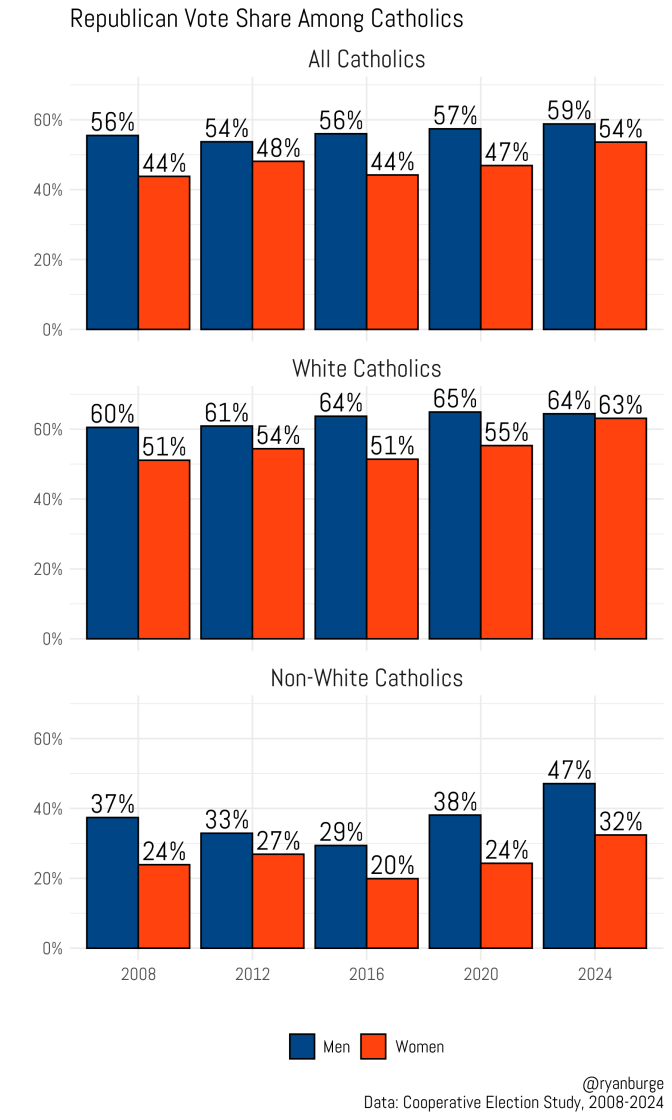
Stories like Froelich’s provide an alternative narrative to the dominant story of Trump’s “bro” victory and the rightward shift of male voters, especially young men. It’s true that Trump made gains among men of all ages, races, and most religious persuasions. But he also made significant inroads among some women. The shrinking gender gap indicates that women, especially conservative Christian women, have warmed to Trump, according to political scientist Ryan Burge of the John C. Danforth Center on Religion and Politics at Washington University in St. Louis.
Burge’s analysis shows that the female Catholic vote became noticeably more Republican in 2024, increasing seven percentage points since 2020 and 10 points since 2016. Support for Donald Trump grew more among Catholic women than among Catholic men, although more men than women still voted Republican.
“Among white Catholics, there is essentially no gender gap, only one percentage point,” Burge said. “However, there is a significant racial component to the gender divide. For Catholics of color, it’s 15 points. That’s something to watch in the future.”
Although conservative women often cite their religious faith to justify their votes and may have heard pro-Trump, or at least pro-Republican, messages in their churches, many analysts think the move toward MAGA among Christian women has little to do with religion.
“A lot of what you’re seeing among Catholic women is an amplification of overall voting trends among white women,” said Michelle Nickerson, professor of history at Loyola University Chicago and author of Mothers of Conservatism: Women and the Postwar Right.
“There never has been a ’women’s vote” in this country. Women tend to vote the way their families vote,” she said. “If white and Hispanic men of certain class categories, without a college education, are voting for Trump, then women in those categories, for the same reasons, are turning toward Trump.”
Some women were comfortable voting for Trump from the beginning. Froelich said she had no hesitations, even if she didn’t approve of his marital infidelity. “That’s his wife’s problem,” she said. “I want him to be my president, not my priest.”
But the increasing percentage of Catholic women opting for Trump between 2016 and 2024 indicates that some women were slower to accept, or at least overlook, Trump’s negatives. Mary FioRito, the Cardinal Francis George Fellow at the Ethics and Public Policy Center, observed that working-class white Catholic men were quicker to respond to Trump because he tapped into their feelings of being disrespected by elites.
“Women were slower, because his record was shameful in terms of his own personal life,” said FioRito. “But no one is looking to Donald Trump as some paragon of moral virtue. That ship sailed with [former President Bill] Clinton and Monica Lewinsky.”
Trump’s choice of Catholic convert J. D. Vance as his running mate and the assassination attempt in July 2024 may have also brought around some Catholic women voters, FioRito said.
The shift among women voters is at least partially the result of a decade-long process of Trumpism becoming “normalized,” said Steven P. Millies, professor of public theology and director of the Bernardin Center at Catholic Theological Union in Chicago. “So, in some sense, it’s not surprising that some of the gender differences begin to blur,” he said.
Froelich admitted that many women—especially for professional reasons—downplayed their support for Trump for fear of being ostracized. But by 2024, that fear had dissipated, she said.
Abortion may have been the issue that first attracted women to the GOP and to Trump, but in the aftermath of the U.S. Supreme Court decision that overturned Roe v. Wade, other issues took precedence. Pre-election polling and exit polls consistently put economic issues and immigration as top concerns for voters, including women. The Democratic Party was also perceived by some as too extreme on culture-war issues, such as support for transgender people.
Froelich cited concerns about “illegals who have committed heinous crimes” and Biden border policies that she deemed “the largest gerrymandering scheme in the world,” because they admitted migrants who would “vote Democratic for life.” She also said she had few concerns about how the Trump administration has been enacting mass deportations.
But for some Catholic women, family separation and the violent detention of migrants, including some here legally, have pricked their consciences and prompted action. Katie Holler, an Ohio social worker and mother of two, was concerned about migrant detention and rising authoritarianism under Trump, so she reached out to other Catholic moms online and formed the Dorothea Project, a group to educate others about Catholic social teaching.
The Dorothea Project is named after two women on the path to sainthood: Catholic Worker founder Dorothy Day and Sr. Thea Bowman, FSPA, who famously called out the U.S. bishops for racism in 1989. The group’s first project was to write to U.S. bishops to encourage them to speak out against Trump’s mass deportations. Some 150 letters were sent to seventy-five bishops.
While some of the group’s members are proud progressives, others are moderate or even conservative, especially on the issue of abortion. At least one member said she had previously voted for Trump, in 2016, but has not voted for him since—the opposite of the trend of Catholic women being more likely to vote for Trump in 2020 and 2024.
So how to explain this increase in the percentage of Catholic women voting for Trump? Some women likely became more comfortable as “MAGAism” was normalized. But another hint comes from the fact that there were fewer Catholics overall as part of the electorate, according to Burge. The rise of the “nones” has been well documented, and there is growing evidence that the “secular surge” is, at least in part, a reaction to the increasing partisan exercise of religion—effectively a backlash to the religious right. For many Catholic women, the perception of their Church as aligned with the Republican Party and Donald Trump may have been the last straw.
That’s what I heard from Catholic women I interviewed shortly after the election. Many were disappointed by the lack of movement on issues such as women deacons after the Synod on Synodality last October and then shocked at fellow churchgoers’ increased support for Trump in November. Some were reconsidering their relationship to the Church.
Opinion polls of self-identified Catholics—which would include these women struggling with their relationship with the Church—consistently find majority agreement among U.S. Catholics on issues such as support for legalized abortion in all or most cases (59 percent) and Church recognition of gay marriage (54 percent). So there are progressives, including progressive women, who still identify as Catholic. But it isn’t “trads” who are becoming “nones.”
If progressive Catholic women leave, the remaining Catholic women are more likely to be conservative—thus the higher percentage of GOP voters. With 56 percent of Catholic voters opting for Trump, to be Catholic becomes equated with being Republican, noted Millies. “In part because of the long, corrosive effect of abortion politics, to call oneself religious today is to claim a partisan side,” he said. “That’s a tragedy.”
Yet that feeling of no longer being welcome is exactly how conservative voters feel about the Democratic Party, said FioRito, who has supported pro-life Democrats, such as former U.S. Rep. Dan Lipinski of Illinois, in the past.
When someone yelled “Jesus is Lord” at one of Harris’s rallies, the candidate quickly shot back that they might be at the wrong rally. That sent a clear message to FioRito—and likely other Christian women. “They have made it clear they don’t want people like me,” she said.


No comments:
Post a Comment